
What AI search changes about getting found
AI assistants answer before showing links, so businesses get found by being named in the answer, through reviews, consistent details and clear pages.
 By GroundBreaker Media6 min read

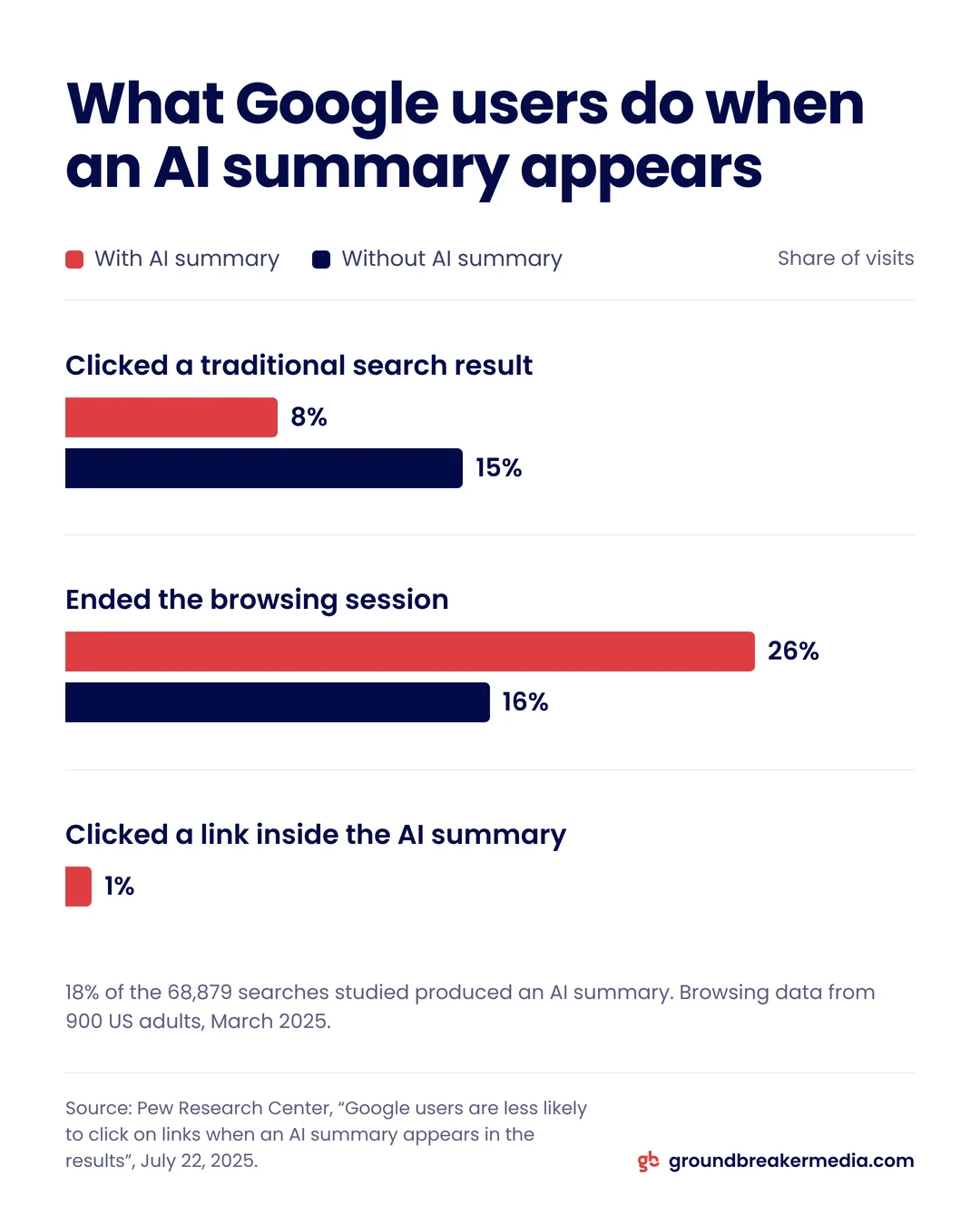
Google users clicked a traditional search result in 8% of visits when an AI summary appeared, against 15% without one, in a 2025 Pew Research Center study. As ChatGPT, Gemini, Perplexity and Google’s AI features answer first, a business gets found by being named and cited inside the answer. Reviews, consistent business details, outside mentions and plain answers decide that.
How are people using AI tools to find businesses?
They ask full questions and expect a shortlist, not a page of links. These tools are now mainstream.
OpenAI said on February 27, 2026 that ChatGPT has more than 900 million weekly active users. On Alphabet’s Q2 2025 earnings call on July 23, 2025, Sundar Pichai said AI Overviews had over 2 billion monthly users across more than 200 countries and territories. In his Q2 2026 remarks on July 22, 2026, he said AI Mode had passed 1 billion monthly active users, the Gemini app had 950 million, and Google had brought AI Overviews and AI Mode together into one Search experience.
Local decisions are shifting too. BrightLocal’s Local Consumer Review Survey 2026, published February 11, 2026, found that use of ChatGPT and other generative AI tools for local recommendations rose from 6% to 45% among the 1,002 US consumers surveyed.
Questions trigger AI answers most. Pew Research Center found Google searches phrased as questions produced an AI summary 60% of the time, against 8% for searches of one or two words.
How do AI assistants decide which businesses to recommend?
No AI company publishes its full selection method. What they publish points to familiar signals: being crawlable, reviewed, described consistently and mentioned by others.
Google’s documentation on AI features and your website, last updated December 10, 2025, says AI Overviews and AI Mode may use "query fan-out", running several related searches to build one answer. A page must be indexed and eligible to show a snippet. No special schema or AI text file is required. Google recommends structured data that matches the visible page and a current Business Profile.
For local results, Google’s help page on local ranking names relevance, distance and prominence. Prominence draws on how many websites link to a business and how many reviews it has, and Google states there is no way to pay for a better local ranking.
Other assistants also read the open web. OpenAI’s publishers and developers FAQ says any public website can appear in ChatGPT search if it does not block the OAI-SearchBot crawler. Perplexity says each answer includes numbered footnotes linking to its sources.
Pew found Wikipedia, YouTube and Reddit were the most cited sources in Google’s AI summaries, and 88% of summaries cited three or more sources. What other sites say about a business carries weight.
What happens to clicks when an AI answer appears?
Clicks fall. Pew’s study, published July 22, 2025, tracked 900 US adults and 68,879 Google searches from March 2025:
- 18% of searches produced an AI summary.
- Users clicked a traditional result in 8% of visits with an AI summary, against 15% without one.
- Links inside the summary drew a click in 1% of visits.
- Sessions ended on 26% of pages with a summary, against 16% without.
Google’s AI features documentation says clicks from results pages with AI Overviews are "higher quality", with visitors spending more time on the site. That is Google’s observation, not a published study. Either way, traffic alone becomes a weaker measure of whether marketing works.
What is generative engine optimization (GEO)?
Generative engine optimization (GEO) is the work of increasing how often, and how accurately, AI assistants name or cite a business in their answers. It builds on SEO rather than replacing it.
The term comes from the paper GEO: Generative Engine Optimization, first posted November 16, 2023 and accepted to KDD 2024. In its tests, adding cited sources, quotations and statistics improved visibility in AI answers by 30 to 40% relative to the original text, while keyword stuffing offered little to no improvement.
| Classic search | AI search | |
|---|---|---|
| How people ask | Short keyword phrases | Full questions with context |
| What they see first | A ranked list of links | A written answer citing a few sources |
| What earns a place | A ranking for a page | Being named or cited in the answer |
| Where trust comes from | Your site and its links | Your site plus reviews, profiles and mentions |
| What to measure | Rankings, clicks, sessions | Mentions, citations, resulting inquiries |
What can a business actually influence?
Most of the inputs. A business cannot control the answer, but it shapes much of what the answer draws on.
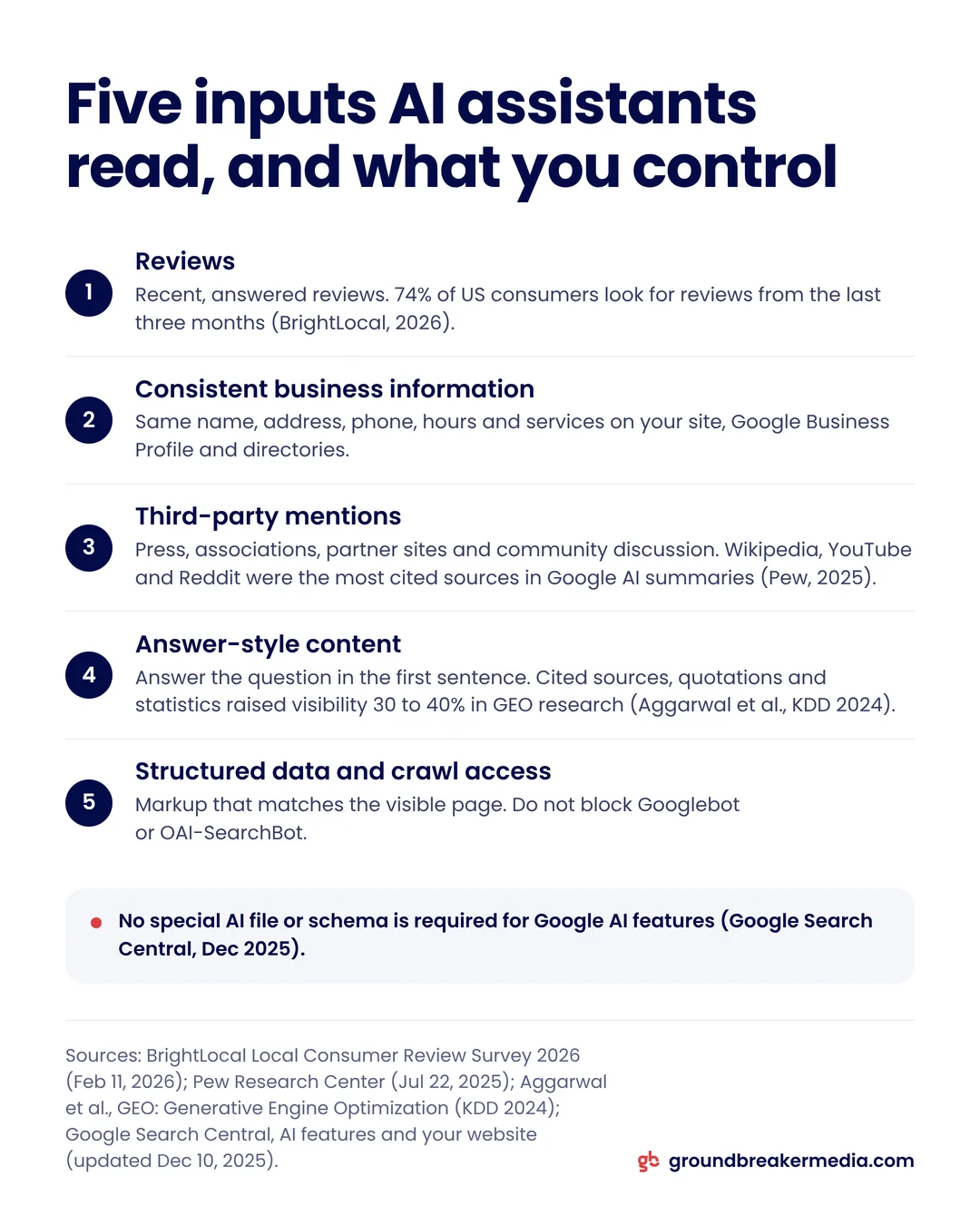
- Reviews. BrightLocal found 97% of consumers read reviews for local businesses, 74% look for reviews from the last three months, and 89% expect owners to respond.
- Consistent business information. Name, address, phone, hours and services should match across your site, Google Business Profile and directories.
- Third-party mentions. Press, associations, partner sites and genuine community discussion give an assistant something to cite beyond your own claims.
- Answer-style content. Pages that answer a real question in the first sentence are easy to quote. Definitions, named sources and real numbers help.
- Structured data. Google describes structured data as a standardized format for classifying page content. It should match what is visible.
- Crawl access. Robots.txt and hosting settings should not block Googlebot or OAI-SearchBot.
How do you measure visibility in AI search?
Measure answers and outcomes, not only rankings. Check a fixed list of real buyer questions on each assistant monthly.
AI share of answers = prompts where the business is named or cited ÷ total relevant prompts tested
GroundBreaker Media builds this measurement into its search and AI authority work.
Track referrals too. OpenAI says ChatGPT adds utm_source=chatgpt.com to referral links, and Google says AI features traffic is included in the Search Console Performance report under the Web search type. Then tie visits and calls to inquiries and revenue, as with any channel. For a worked case in a regulated field, see the playbook for Costa Rica clinics.
Frequently asked questions
Is SEO still worth doing if AI answers the question?
Yes. AI assistants still draw on indexed pages, business profiles and reviews. Google says a page must be indexed and eligible for a snippet to appear in AI Overviews or AI Mode, and ChatGPT search reads public websites its crawler can reach. Solid SEO is the foundation that GEO builds on, not something it replaces.
Do I need special code or an AI text file to appear in AI Overviews?
No. Google’s documentation says there are no additional requirements or special optimizations for AI Overviews or AI Mode, and no special schema, machine-readable file or AI text file is needed. The usual practices apply: allow crawling, keep key content in text, use structured data that matches the page, and keep Business Profile details current.
Can I pay to be recommended by ChatGPT or Google’s AI?
Not in the organic answers. Google states there is no way to request or pay for a better local ranking, and OpenAI’s publisher guidance describes appearing in ChatGPT search by allowing its crawler, with no paid placement mentioned. Being recommended depends on what assistants find: reviews, consistent details, credible mentions and clear content. Ads, where offered, are a separate product.
How fast does GEO work?
No AI company publishes a timeline. Changes to reviews, profiles and site content only count once pages are recrawled and assistants run fresh searches. A practical approach is to record a baseline with a fixed prompt list, make improvements, and compare results each month. Judge progress by mentions, citations and the inquiries that follow, not by traffic alone.
Written by
GroundBreaker Media
A performance marketing agency that connects what you spend to what it brings back. About us
Related insights
All insights


Want one version of the truth? Let's look at your numbers.
A short call, an honest read on what your marketing is producing, and clear next steps.