
Local SEO for small business: how Google ranks local results
Local SEO for a small business means improving relevance and prominence, because Google ranks local results on relevance, distance and prominence.
 By GroundBreaker Media7 min read

Google says there is no way to request or pay for a better local ranking. Its local results are ranked mainly on relevance, distance and prominence, and local SEO for a small business is the work of improving the two you can influence: how well you match the search, and how well-known you are.
What is local SEO for a small business?
Local SEO is the work of getting a business found when people search for what it sells in a specific area, both in Google’s local results and in the web results around them. Local results are the business listings Google shows with a map, on Search and in Google Maps, with ratings, contact details and directions.
The local pack is the block of map listings that Google places inside its regular results for a search with local intent. It sits above or between ordinary web pages, so one search for "emergency plumber" or "family dentist" can return both at once.
Two ranking systems are at work. Local results rank business listings. Web results rank pages on content and links, with place signals such as the city named on the page. Most businesses that serve a defined area need both, because a customer who scrolls past the map still sees the web results.
Google limits local listings to businesses that have a location customers can visit or that travel to customers where they are, according to its guidelines for representing your business. A clinic, a restaurant, a roofer and an accountant all qualify. An online store with no customer-facing location does not.
How does Google rank local businesses?
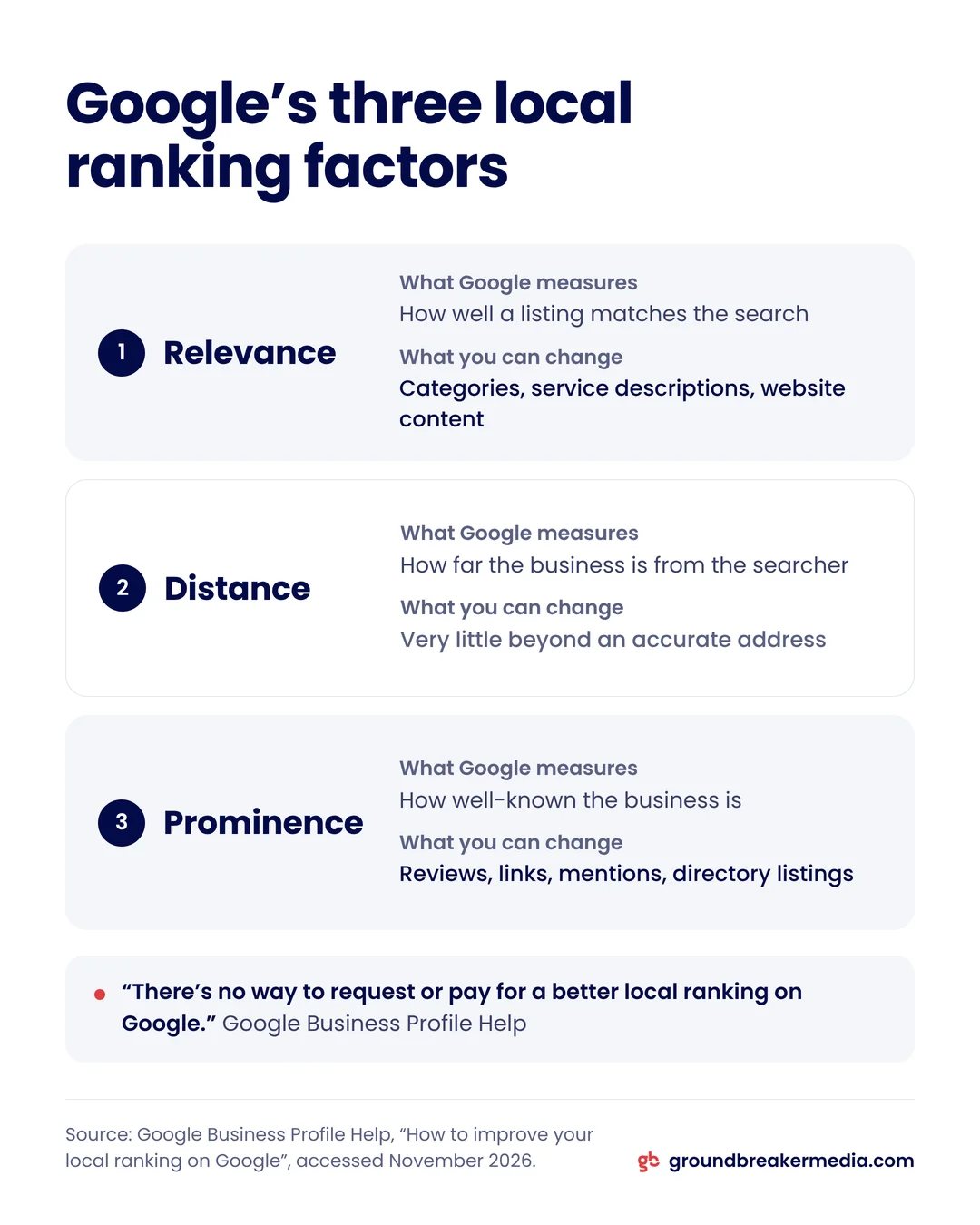
Google ranks local results mainly on relevance, distance and prominence, and its local ranking help page says that together "these factors help Google find the best match" for each search.
| Factor | Google’s definition | What you can change |
|---|---|---|
| Relevance | "How well a Business Profile matches what someone is searching for" | Categories, service descriptions, website content |
| Distance | "How far each business is from the customer who’s searching" | Very little beyond an accurate address or service area |
| Prominence | "How well-known a business is," based on links, reviews and ratings | Reviews, links, mentions and directory listings |
Relevance comes from words and categories that match the query. Google adds: "Businesses with complete and accurate info are more likely to show up in local search results." A business that names every service it offers gives Google more searches it can match.
Distance belongs to the searcher as much as to you. When a customer does not share where they are, Google "uses what it knows about their location." Two people typing the same words from different neighborhoods see different results, so a ranking checked from your own office describes one spot on the map.
Prominence, which the same page also calls popularity, is "based on info like how many websites link to your business and how many reviews you have," and the page says, "More reviews and positive ratings can help your business’s local ranking."
Which local ranking factors matter most?
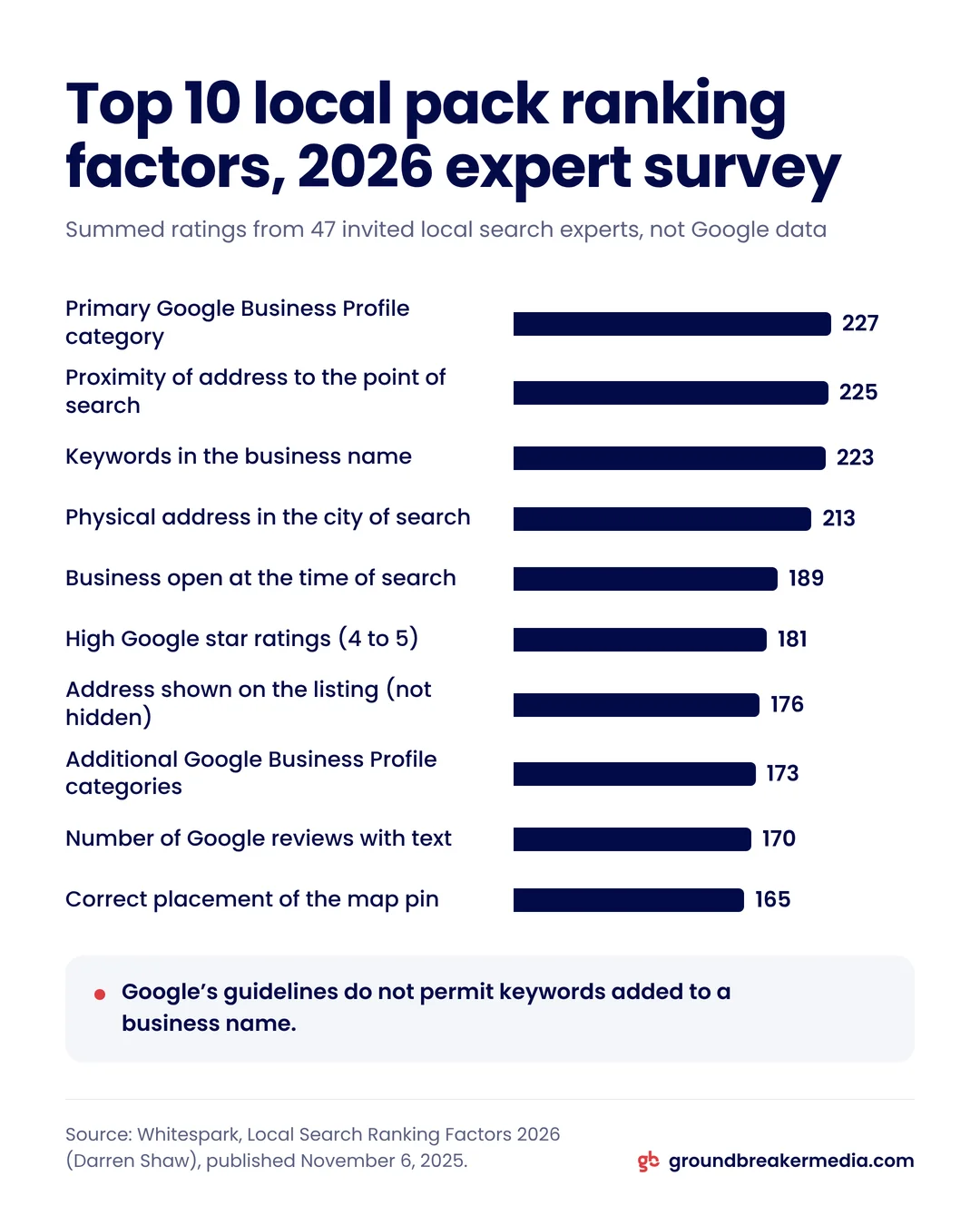
Google does not publish how it weights its factors, so the most useful guide is expert opinion. In Whitespark’s 2026 Local Search Ranking Factors survey, published November 6, 2025, 47 invited local search specialists scored 187 factors, and the primary category and proximity to the searcher came out on top for local pack rankings.
| Rank | Local pack and Maps | Local organic results |
|---|---|---|
| 1 | Primary Google Business Profile category | A dedicated page for each service |
| 2 | Proximity of the address to the point of search | City or neighborhood relevance of the content |
| 3 | Keywords in the business name | Quality and authority of links to the domain |
| 4 | Physical address in the city of search | Keywords in the title tag of the page the listing links to |
| 5 | Business open at the time of search | Links from industry-relevant domains |
Source: Whitespark, Local Search Ranking Factors 2026, by Darren Shaw. Each factor was scored from 0 to 5, then the scores were "summed and ranked by total score."
Read the list with three cautions. The scores are pooled expert judgment, not measurements from Google. Proximity and a physical address in the searched city sit near the top and are mostly fixed, which is why relevance and prominence are where the work goes. Keywords in the business name placed third, yet Google’s guidelines state, "Including unnecessary information in your business name isn’t permitted," and warn that breaking the guidelines "could result in the suspension of your Business Profile." Use the name on your sign and your invoices.
What should your website do for local SEO?
Your website should give every main service its own page, state plainly where you work, and repeat the same business details as your listings, because the site supplies much of the relevance Google reads. A dedicated page for each service topped Whitespark’s local organic list, ahead of content tied to a city or neighborhood.
A good service page names the service the way customers search for it, explains who it suits, where it is offered and how pricing works, and ends with one clear next step. Service pages often double as landing pages for ads, so the same principles in the landing page conversion rate guide apply to them.
NAP stands for name, address and phone number, the three details that identify a local business across the web. Write the NAP the same way in the site footer, on the contact page and on every listing, down to the suite number and the abbreviation for "street." Consistent details make it easy to tell that two mentions refer to the same business.
Structured data helps Google read those details. Google Search Central’s LocalBusiness structured data documentation, last updated September 8, 2026, requires two properties, name and address, and recommends others such as telephone, url, geo and openingHoursSpecification. Google says that with it, "Search results may display a prominent Google knowledge panel with details about a business." We mark up only what visitors can also see on the page.
How do links, citations and reviews build prominence?
Prominence grows when other websites, directories and customers refer to a business, because Google treats links and reviews as evidence of how well-known it is.
A citation is any mention of a business’s NAP on another website, such as a directory, a chamber of commerce listing or a news article. Citations confirm that the business exists where it says it does. Links do more: they pass authority, and Whitespark’s experts ranked link quality third and links from industry-relevant domains fifth for local organic results.
The links worth earning usually come from relationships a business already has:
- Suppliers and manufacturers that list local dealers or installers.
- Trade associations and licensing bodies with member directories.
- Community groups whose events, teams or causes the business sponsors.
- Local news sites that cover projects, openings or expert comment.
Customers also look beyond Google. BrightLocal’s Local Consumer Review Survey 2026, published February 11, 2026 and based on 1,002 US consumers, found the average consumer uses six different review sites when choosing a business, and Google’s share as a review source fell from 83% in 2025 to 71%.
Reviews count twice: Google weighs them for prominence, and customers read them before they call. How to earn reviews within Google’s rules, along with the rest of the profile setup, is covered in the Google Business Profile guide. AI assistants draw on the same reviews and mentions when they recommend local businesses, as the guide to AI search explains.
How do you measure local SEO results?
Measure local SEO by the calls, forms and bookings it produces, backed by ranking checks from many points across your area, because a single position from one address hides how distance changes results.
Local visibility rate = grid points where the business appears in the local pack ÷ grid points checked
- Map a grid. Choose points across the area you serve and check your main searches from each one every month, using a rank tracker that simulates the searcher’s location.
- Read Search Console. Google Search Console’s Performance report shows clicks, impressions, click-through rate and average position for your website by query and page. It covers web search types, not Google Maps.
- Tag every lead. Record the source of each call and form in your CRM, so local leads can be counted beside other channels. The CRM guide covers the stages and fields to set up.
- Log your changes. Note each fix with its date, then compare month against month, so movement in the grid can be tied to a cause.
A rising local visibility rate with flat leads points to the wrong searches or weak pages. Rising leads with a flat rate usually means the business already ranks where it matters and is converting more of those searchers. GroundBreaker Media tracks local SEO this way, from map grids to CRM leads, as part of its search and AI authority work.
Frequently asked questions
How long does local SEO take to work?
There is no fixed timeline, and Google does not publish one. Corrections to business details take effect once Google processes them, while prominence builds slowly through reviews, links and mentions. Record a baseline of map positions and local leads before changing anything, then compare results month by month instead of week by week.
How do I rank higher on Google Maps?
Work on relevance and prominence, since distance depends on where you and the searcher are. Describe each service on its own page, keep your name, address and phone identical everywhere, earn local links and collect reviews steadily. Whitespark’s 2026 survey ranks the primary category and proximity as the two strongest Maps factors.
Do I need a separate page for every city I serve?
Only when each page has something real to say about that city. Google’s spam policies list "multiple domain names or pages targeted at specific regions or cities that funnel users to one page" as doorway abuse. A city page with local projects, staff, directions or pricing earns its place. A copy with the city name swapped does not.
Should a small business list itself on Apple Maps and Bing?
Yes, both are free. Apple Business Connect, announced January 11, 2023, manages place cards across Apple Maps, Siri, Wallet and Messages, and Bing Places can import an existing Google listing. BrightLocal’s 2026 survey found 27% of US consumers use Apple Maps to read reviews, up from 14% in 2025.
Written by
GroundBreaker Media
A performance marketing agency that connects what you spend to what it brings back. About us
Related insights
All insights


Want one version of the truth? Let's look at your numbers.
A short call, an honest read on what your marketing is producing, and clear next steps.