
What is a good landing page conversion rate?
A good landing page conversion rate beats your own baseline for the same traffic and offer; Unbounce's 2024 median across industries was 6.6%.
 By GroundBreaker Media7 min read

A landing page conversion rate of 4% can be worth more than one of 12%, if more of those leads become customers. For reference, the median landing page in Unbounce’s 2024 Conversion Benchmark Report converted 6.6% of visitors. A good rate beats your own baseline for the same traffic source and offer, counted in qualified leads.
How do you calculate landing page conversion rate?
Divide the conversions a page produced by the visitors it received, then multiply by 100, counting only the action the page was built for.
Landing page conversion rate = conversions ÷ visitors × 100
A landing page is the destination of a campaign link: the page an ad or email sends people to, built to get one specific action, such as a quote request, a call or a booking. A conversion is one completion of that action.
The result depends on what each tool counts. Google Ads defines conversion rate as the average number of conversions per ad interaction, so 50 conversions from 1,000 interactions is 5%, and it notes that tracking several conversion actions, or counting every conversion, can push the rate above 100%. Unbounce’s benchmark is built on unique visitors to each page. A page’s rate in Google Ads and in your analytics will rarely match, so choose one source for each page and keep it.
What is a good landing page conversion rate by industry?
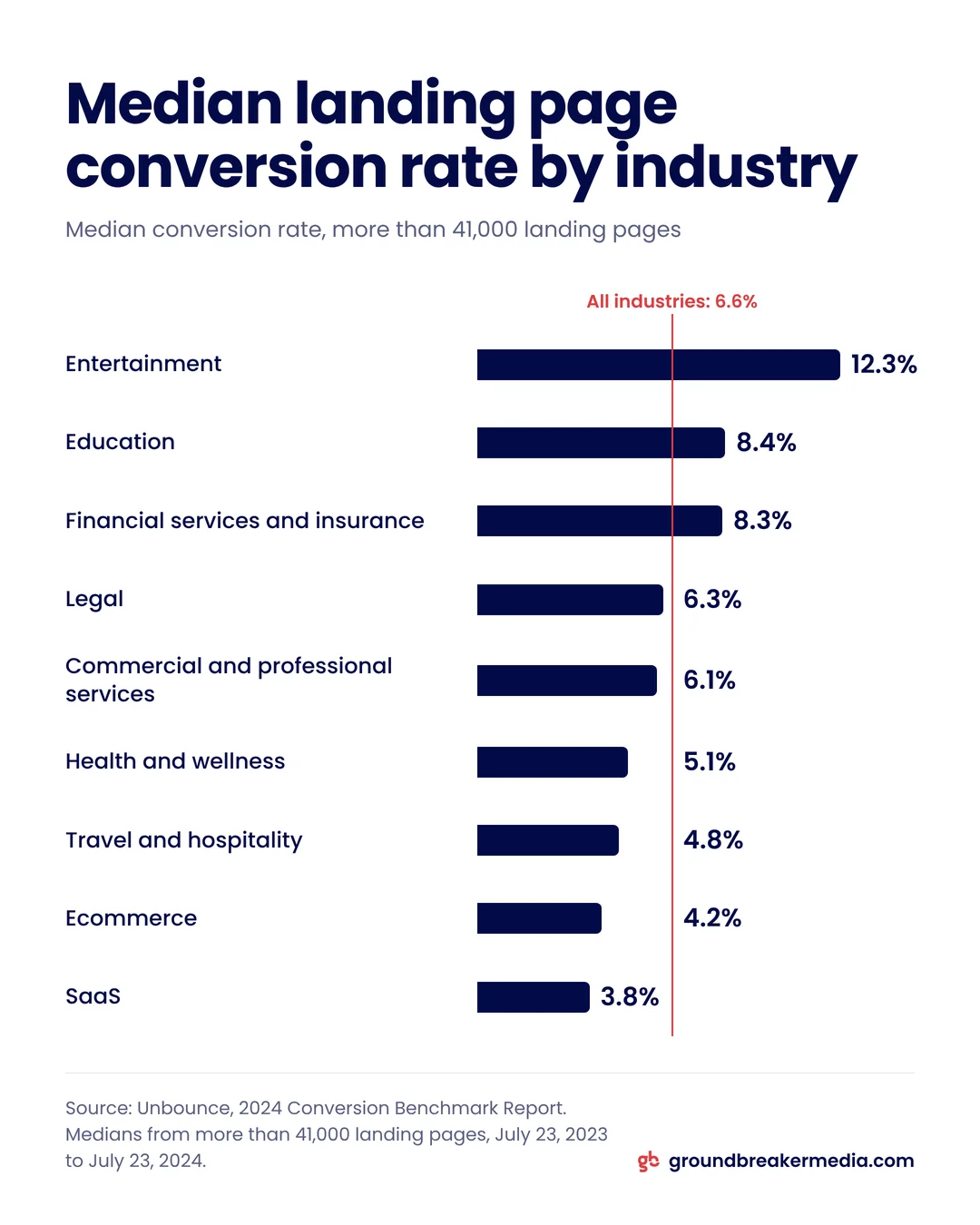
Unbounce’s 2024 Conversion Benchmark Report puts the median landing page conversion rate at 6.6% across industries, with industry medians from 3.8% for SaaS to 12.3% for entertainment. Use the median for your industry as a sanity check, then set targets from your own results.
The report covers more than 41,000 landing pages, 464 million unique visitors and 57 million conversions. Its methodology dates the data from July 23, 2023 to July 23, 2024, and leaves out pages with fewer than 50 visitors or no conversions, and industries with fewer than 400 pages.
| Industry | Median landing page conversion rate |
|---|---|
| Entertainment | 12.3% |
| Education | 8.4% |
| Financial services and insurance | 8.3% |
| Legal | 6.3% |
| Commercial and professional services | 6.1% |
| Health and wellness | 5.1% |
| Travel and hospitality | 4.8% |
| Ecommerce | 4.2% |
| SaaS | 3.8% |
| All industries | 6.6% |
Source: Unbounce, 2024 Conversion Benchmark Report, overview and industry pages. Unbounce’s ecommerce page also cites 5.2% in one section; the table uses its headline figure of 4.2%.
The medians hide wide ranges inside each industry. Within financial services, insurance pages had a median of 18.2% and investing pages 3.9%. In education, online course pages reached 18.3%, against 4.9% for primary education and tutoring. Dental pages, at 4.3%, sat below the 5.1% median for health and wellness.
Google Ads benchmarks measure something different. WordStream by LocaliQ’s 2026 report puts the median Google Ads conversion rate at 8.18%, but that counts tracked conversions per ad click inside ad accounts, the figure the Google Ads budget guide uses to plan spend.
Why do traffic source and device change conversion rate?
Visitors arrive with different intent, so the same page converts differently by channel and by device. Compare a page with itself, for the same source, before comparing it with anyone else’s.
Across Unbounce’s data, email was "the highest converting channel at 19.3% on average," and paid social, at 12%, converted 10% better than paid search, at 10.9%. The report gives some benchmarks as averages and others as medians, depending on the data available, so compare these channel figures with each other rather than with the 6.6% median.
The order changes by industry. Legal pages converted at 8.3% from paid search and 2.7% from email. Ecommerce pages ran the other way, with email at 28.6% and paid search at 5.1%.
Devices split in the same uneven way. Mobile accounted for 83% of the visits Unbounce analyzed, and "desktop converts 8% better than mobile" at the industry average. Legal pages reversed that pattern, converting at 21% on mobile against 15.9% on desktop.
What landing page best practices raise conversion rate?
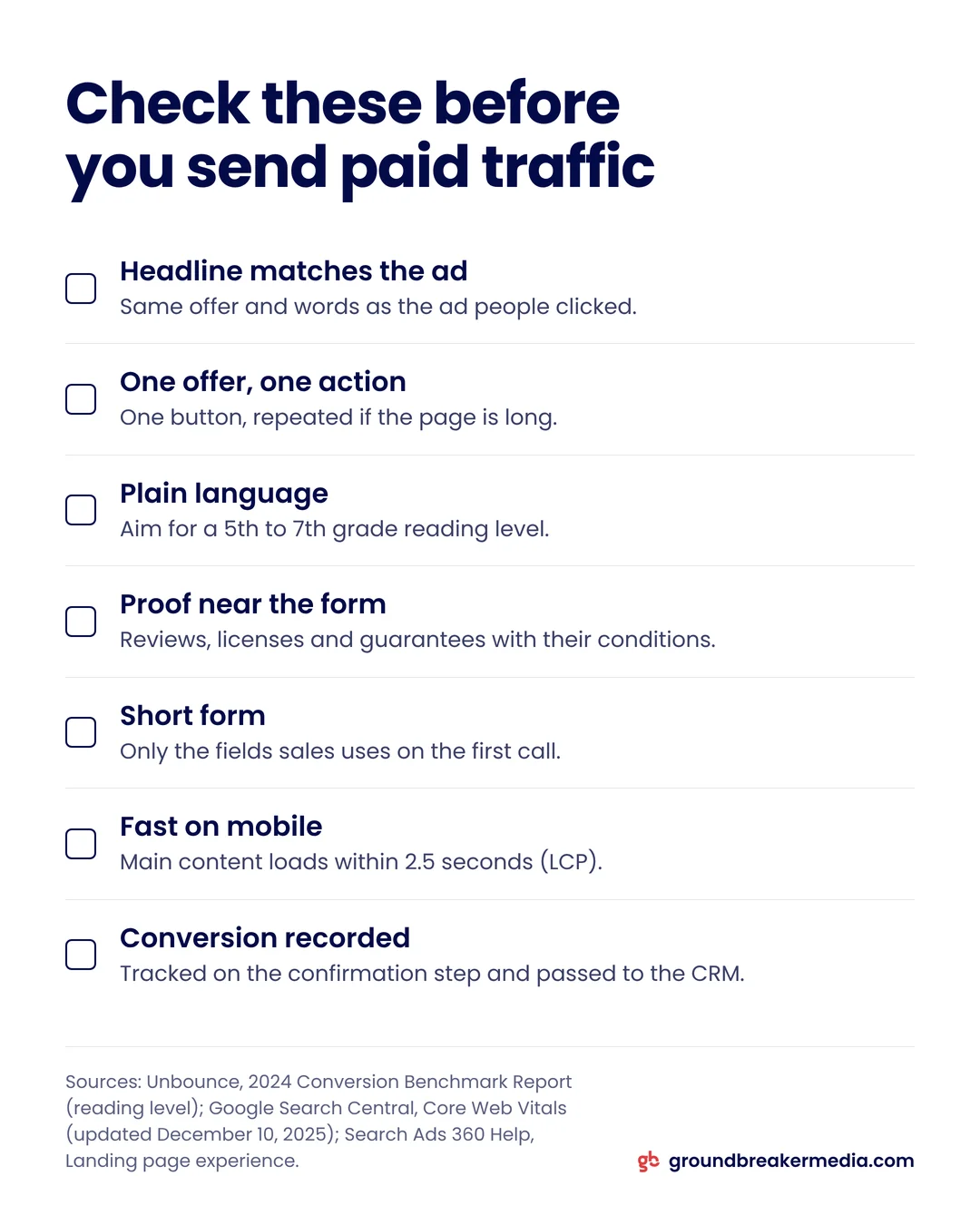
The landing page best practices that raise conversion rate are matching the ad, making one offer with one action, using plain words, showing proof and keeping the form short. Each removes a reason to leave.
- Match the click. Google’s Search Ads 360 help says landing page experience reflects, among other things, "the expectations users have based on the clicked ad creative." Repeat the ad’s offer and wording in the headline.
- Write plainly. Pages written at a 5th to 7th grade reading level converted at 11.1% in Unbounce’s data, against 5.3% for professional-level writing. Difficult words, those of three or more syllables, showed a negative correlation of 24.3% with conversion rate. Financial services was the exception, where more complex language can help.
- Ask for one thing. Give the page one offer and one button, repeated further down if the page is long. A second offer splits attention between two decisions.
- Show proof near the action. Put reviews, licenses, named clients who agreed to be named, and guarantees with their conditions close to the form. The Google Business Profile guide covers how to earn the reviews.
- Shorten the form. We cut any field the sales team does not use on its first call.
- Design for the thumb. Use buttons large enough to tap, a click-to-call number and form fields that open the right keyboard.
How much does page speed affect landing page conversions?
Enough to measure. In research commissioned by Google and carried out by 55 and Deloitte, a 0.1-second improvement in mobile site speed raised retail conversion rates by 8.4% and travel conversion rates by 10.1%.
The study, Milliseconds Make Millions, followed 37 European and American brand sites and more than 30 million user sessions for 30 days at the end of 2019. On lead generation sites, the same improvement lifted progression from the first form step to submission by 21.6%. Some of the speed metrics it used have since been retired, and Google now sets its speed targets through Core Web Vitals.
| Core Web Vital | What it measures | Good result |
|---|---|---|
| Largest Contentful Paint (LCP) | When the main content finishes loading | Within 2.5 seconds |
| Interaction to Next Paint (INP) | How fast the page responds to taps and clicks | Under 200 milliseconds |
| Cumulative Layout Shift (CLS) | How much the layout moves while loading | Under 0.1 |
Source: Google Search Central, Understanding Core Web Vitals and Google search results, last updated December 10, 2025.
On landing pages, a slow LCP usually traces back to an oversized hero image, a video at the top of the page or third-party scripts that load before the content. Test on a mid-range phone over a mobile connection, not on an office desktop.
What should a landing page for Google Ads include?
A landing page for Google Ads should repeat the search term and the ad’s offer, give one action, load fast on mobile and record each conversion, because Google rates landing page experience for every keyword.
Landing page experience is one of three Quality Score components, alongside expected clickthrough rate and ad relevance, and Google rates each one below average, average or above average. Google defines it as "How relevant and useful your landing page is to people who click your ad." For a below average status, Google’s definition page says "you might want to consider some changes to improve your website’s landing page."
In practice that means one page per service or ad group, so a search for "water heater repair" lands on water heater repair, not on a page listing every plumbing service. Record the conversion on the confirmation step, and pass each lead’s click ID into the CRM so qualified leads can be sent back to Google Ads, the loop that the article on ad platform and CRM revenue explains.
GroundBreaker Media builds and tests landing pages for paid traffic within its demand and creative strategy work.
How do you run website conversion rate optimization tests?
Change one element at a time, split traffic evenly between the versions, run the test over whole weeks, and pick the winner on qualified leads, not raw form fills.
Website conversion rate optimization is the practice of raising the share of visitors who complete a page’s main action by testing changes against the current version. Whole weeks matter because weekday and weekend visitors behave differently, and a test that stops on a good Tuesday flatters the new version.
Qualified conversion rate = qualified leads ÷ visitors × 100
Example (hypothetical numbers): a test adds two qualifying questions to a quote form. Version A, the original, gets 1,000 visitors and 120 leads, a 12% conversion rate, but only 24 of those leads qualify, a 2.4% qualified conversion rate. Version B, with the questions, gets 1,000 visitors and 40 leads, a 4% conversion rate, and 32 qualify, a 3.2% qualified conversion rate. Version B produces a third more qualified leads from the same traffic.
Which leads count as qualified, and where that rate sits in a monthly review, is set out in the five-minute report guide. When a page produces only a handful of conversions a month, we test bigger changes, such as the offer or the form, because small tweaks need far more traffic to show a real difference.
Frequently asked questions
Is a 2% landing page conversion rate bad?
Not necessarily. It sits below Unbounce’s 6.6% all-industry median, but SaaS pages had a median of 3.8% and investing pages 3.9% in the same 2024 report. Judge it against your own baseline for the same traffic source and against cost per customer, then check what those leads are worth before rebuilding the page.
Should a landing page include the site menu?
Usually not. Every extra link is a way to leave without converting, and Google’s Search Ads 360 help lists the number of links on the page among the things that shape landing page experience. Keep the logo, a phone number and required links such as the privacy policy, and drop the main menu.
How long should a landing page be?
Long enough to answer the questions that stop someone acting, and no longer. In Unbounce’s 2024 data, word count and reading time both correlated negatively with conversion rate, at minus 18.6% and minus 19.4%. For SaaS pages, Unbounce puts the ideal length at 250 to 725 words. Expensive or complex offers usually need more explanation.
Should you send Google Ads traffic to your homepage?
Rarely. A homepage serves every visitor, so it carries menus, several offers and general copy. A dedicated page that repeats the ad’s offer meets what Google calls the expectations users have based on the clicked ad, and it gives you one conversion to measure. Brand searches are the usual exception, since those searchers want the homepage.
Written by
GroundBreaker Media
A performance marketing agency that connects what you spend to what it brings back. About us
Related insights
All insights


Want one version of the truth? Let's look at your numbers.
A short call, an honest read on what your marketing is producing, and clear next steps.