
Brand authority in Google’s AI Search: what Google rewards, and how to track it
Google says helpful, specific and consistent brands win in AI-powered Search. What that means for a small business, and how Search Console now tracks it.
 By GroundBreaker Media7 min read

Google’s advice for its AI-powered Search comes down to three habits: answer buyers’ real questions in depth, show expertise nobody else has, and keep your facts the same everywhere people look. Google’s research found that AI Search users visit about 12 touchpoints before deciding. Search Console now shows when your pages appear in AI Overviews and AI Mode.
What does Google mean by brand authority in AI Search?
Brand authority is the trust a buyer, and an AI system, can place in what your business says. It comes from specific expertise and from facts that match across every place people check. Google set out its view in October 2026, in a Think with Google article by Brendon Kraham, its VP of Search and Commerce Global Ads Solutions (Google, October 2026).
His argument is that AI features widen the buying journey instead of shortening it. Buyers check more sources before they decide, so a brand that is genuinely helpful at each of those moments has more chances to be chosen. Generic copy that repeats what every competitor says gives a buyer, or an AI answer, no reason to pick you.
This article covers what Google recommends and how to measure it. For how AI search picks its sources in general, our guide to AI search is the place to start.
How does AI Search change the way people buy?
AI Search adds steps to the buying journey. In a survey Google commissioned from Ipsos in December 2025, shoppers who used AI Search visited about 12 touchpoints in their buying process, nearly three times as many as shoppers who did not. The sample covered 14,305 AI Search users and 21,881 non-users in selected countries (Google and Ipsos, December 2025).
The same study found that three in four people who used AI Overviews or AI Mode said these features helped them make faster, more confident decisions (13,189 respondents).
Both figures come from research Google paid for, about Google’s own product, so read them as Google’s view of the journey rather than an independent measure. The practical point still holds: a buyer now meets your business in more places before contacting you, including your website, your reviews, your videos and the AI answer itself.

What does Google recommend brands do?
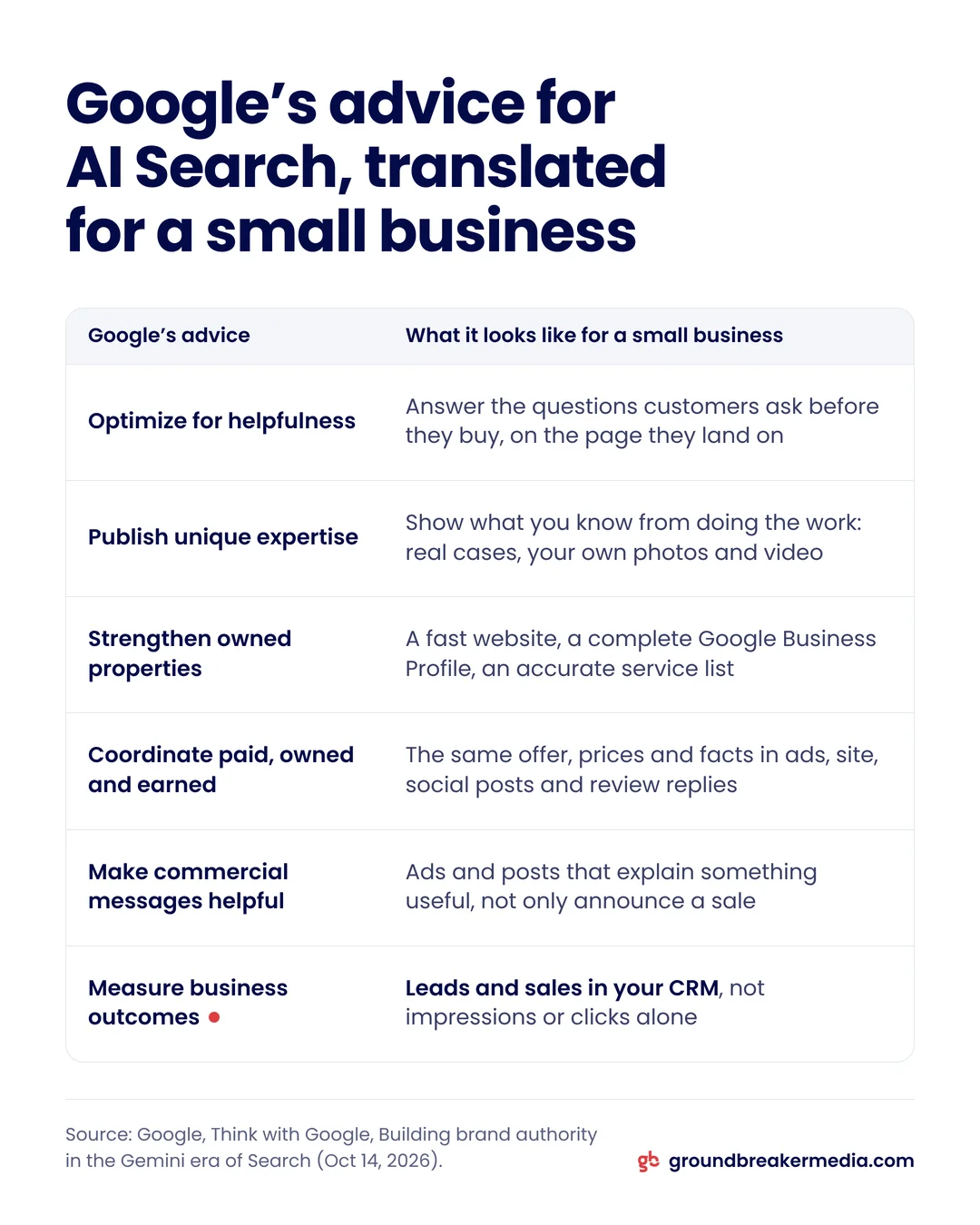
Google recommends six things: be helpful, publish unique expertise, strengthen your own properties, coordinate paid, owned and earned media, make commercial messages useful, and measure business outcomes (Google, October 2026). For a small business, each one turns into concrete work.
| Google’s advice | What it looks like for a small business |
|---|---|
| Optimize for helpfulness | Answer the questions customers ask before they buy, on the page they would land on |
| Publish unique expertise | Show what you know from doing the work: real cases, real numbers, your own photos and video |
| Strengthen owned properties | A fast website, a complete Google Business Profile and an accurate product or service list |
| Coordinate paid, owned and earned | The same offer, prices and facts in your ads, site, social posts and review replies |
| Make commercial messages helpful | Ads and posts that explain something useful, not only announce a sale |
| Measure business outcomes | Leads and sales in your CRM, not impressions or clicks alone |
The last row matters most. Google itself says to judge this work by leads and sales. An appearance in an AI answer is a step toward a customer, not the result.
What counts as unique expertise for a small business?
Unique expertise is knowledge that comes from doing the work and that a competitor could not copy from the same web pages you read. Google’s example is a running store that films a deep-dive video solving one customer’s specific shoe problem, instead of publishing another general buying guide (Google, October 2026).
For a small business, that usually means three kinds of content:
- One real question, answered fully. Pick a question a customer asked this month and answer it the way you did in person, with the trade-offs.
- Proof from your own work. Your photos, your process, results you can document. Leave out any number you cannot back up.
- The same answer in more than one format. A page for search, a short video for YouTube and social, a post for your Google Business Profile.
The goal is not volume. A dozen pages that answer real questions in depth do more than a hundred that restate what every competitor already says.

How do you see your AI Search visibility in Search Console?
Search Console now has generative AI performance reports that show how often your pages appear in AI Overviews and AI Mode. Google introduced them on June 3, 2026 and rolled them out to all websites by August 31, 2026 (Google Search Central, June 2026). A separate report covers generative AI features in Discover.
The main metric is impressions, and you can break it down by page, country, device and date. Google says it will add more metrics over time. The same data is still counted in the overall Performance report; the new reports give it its own view.
AI visibility share = generative AI impressions divided by total Search impressions, for the same pages and dates.
Search Console also tracks your social and video posts. Since July 29, 2026, anyone can add a platform property for an Instagram, TikTok, X or YouTube account and see how its posts perform in Google Search, Discover and Google News, including the search queries that bring people to them (Google Search Central, July 2026). No website verification is needed; you authorize the account itself.
How do you track brand authority month to month?
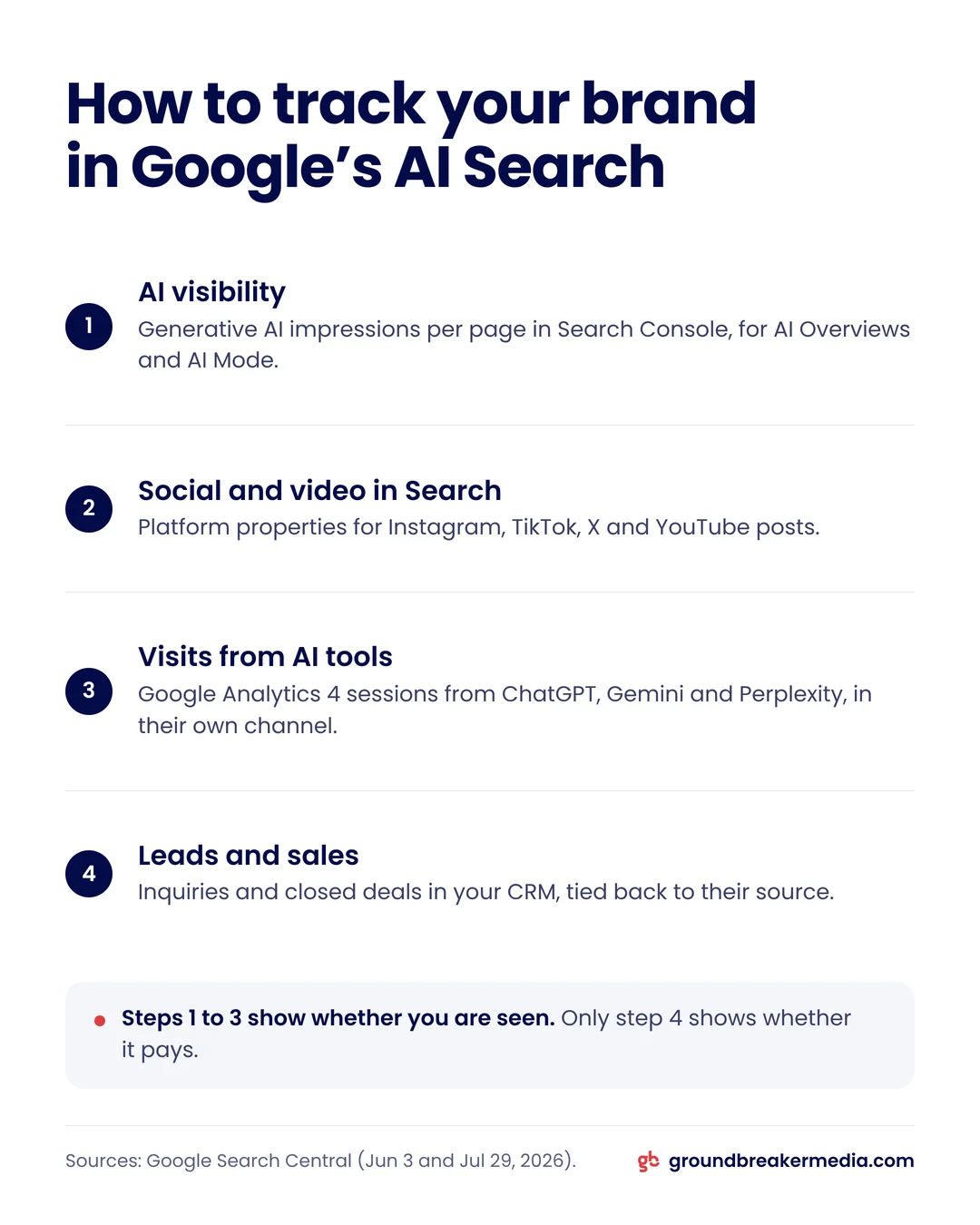
Track it in four layers, from visibility to revenue, and read them in that order once a month.
- AI visibility: generative AI impressions per page in Search Console, and the AI visibility share for your key pages.
- Social and video in Search: platform property data for your Instagram, TikTok and YouTube accounts.
- Visits from AI tools: sessions in Google Analytics 4 that come from AI assistants such as ChatGPT, Gemini and Perplexity, grouped in a custom channel so they are easy to compare.
- Leads and sales: inquiries and closed deals in your CRM, tied back to their source.
Layers 1 to 3 tell you whether you are being seen. Only layer 4 tells you whether it pays, and our guide to reading a marketing report covers which numbers to put in front of an owner.
What should a small business do first?
Start by making your facts consistent, then add one piece of real expertise a week. Check whether your website, Google Business Profile, social profiles and directories show the same hours, services and service area. An AI system that finds three versions of the same fact has to pick one, and a buyer comparing them may simply leave.
A practical first month looks like this: align the name, category, services, hours and service area everywhere you appear, including your Google Business Profile and your profile in ChatGPT. Add your social and YouTube accounts to Search Console as platform properties. Then publish one in-depth answer to a real customer question each week, and turn it into a short video.
This mix of consistent profiles, expert content and measurement is what GroundBreaker Media builds in its Search and AI Authority service.
Frequently asked questions
Is Google’s figure of 12 touchpoints independent research?
No. It comes from a survey Google commissioned from Ipsos, published as Global Consumer Journeys in December 2025, with 14,305 AI Search users and 21,881 non-users in selected countries. It is useful as Google’s description of the journey, but it is not an independent audit of how AI Search changes buying.
Do Search Console’s AI reports show clicks?
Not as their main metric. The generative AI performance reports launched with impressions as the headline number, broken down by page, country, device and date. Google says it plans to add more metrics. Clicks and impressions from AI features are still included in the overall Performance report alongside regular results.
Can I see how my Instagram or TikTok posts do in Google Search?
Yes. Since July 29, 2026, Search Console lets anyone add a platform property for an Instagram, TikTok, X or YouTube account. It shows how those posts perform in Google Search, Discover and Google News, including top and trending queries, without verifying a website.
Do Google Ads improve how often AI Search mentions my business?
Google does not say that ads raise organic or AI visibility. Its advice is to coordinate paid, owned and earned media so the same message and facts appear everywhere a buyer looks. Ads can put you in front of more of those touchpoints, but they are not a shortcut into AI answers.
Written by
GroundBreaker Media
A performance marketing agency that connects what you spend to what it brings back. About us
Related insights
All insights


Want one version of the truth? Let's look at your numbers.
A short call, an honest read on what your marketing is producing, and clear next steps.