
SEO and AI search for small businesses: how to get found on Google and in AI answers
A small business gets found on Google, Maps and AI answers by keeping its profiles, reviews, business details and pages in order, then measuring the leads.
 By GroundBreaker Media19 min read

A small business now gets found in two places: Google’s results and maps, and the answers AI assistants write. Both draw on mostly the same inputs: a complete Google Business Profile, recent reviews, matching business details, mentions on other sites and pages that answer real questions. Judge the work by the leads it brings, not by traffic.
How do people find a local business now?
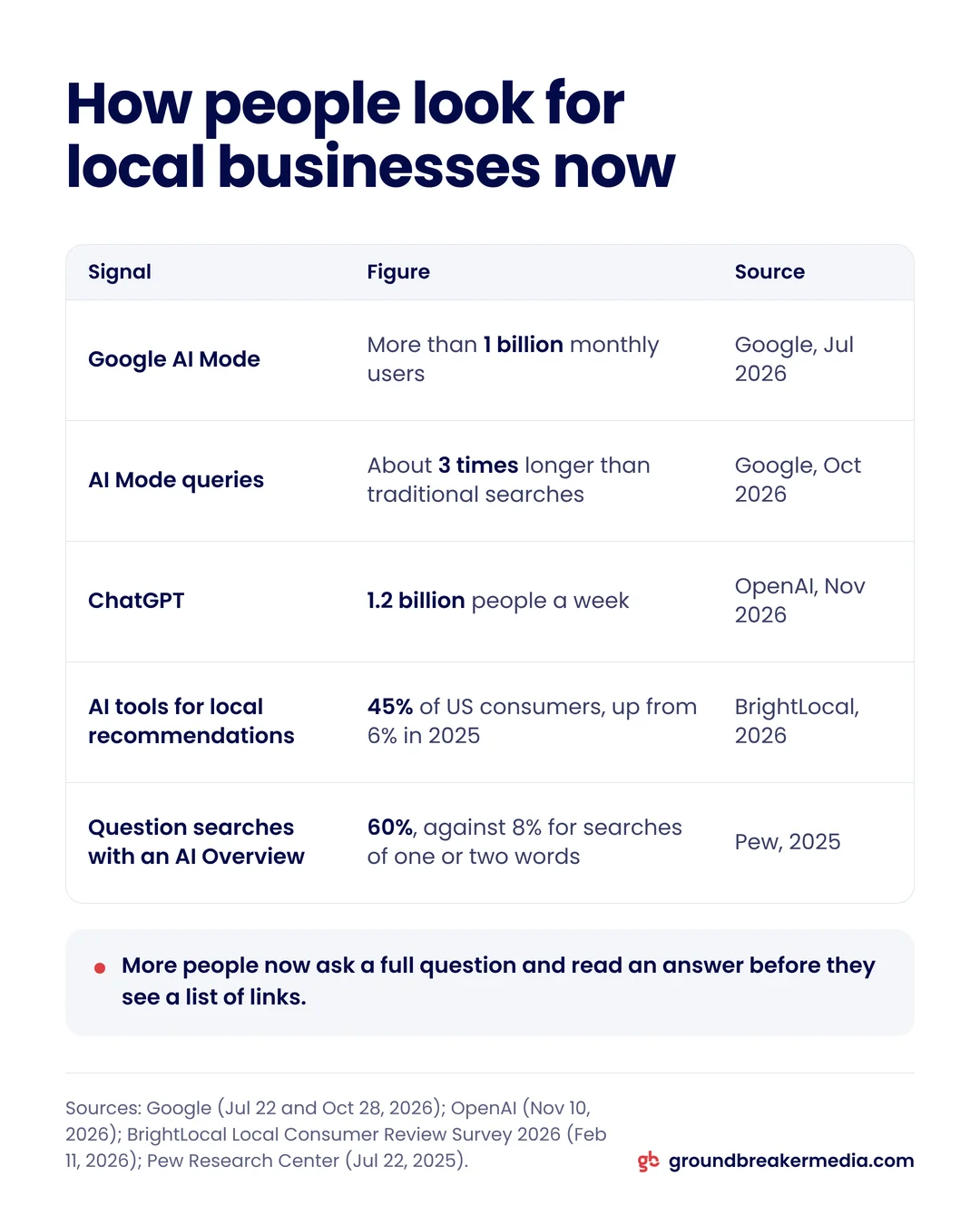
Google is still where many people start looking for a local business, but more of them now type a full question and read an AI answer before any list of links.
Google’s own figures show the shift. On July 22, 2026, Sundar Pichai said AI Mode had passed 1 billion monthly users and that Google had merged AI Overviews and AI Mode into one Search experience (Google, July 2026). On October 28, 2026, he added that AI Mode queries run about three times longer than traditional searches, and that Google’s year-over-year query growth was the highest in five years (Google, October 2026). In the US, searches for "google ai mode" averaged 450,000 a month from November 2025 to October 2026, and October 2026 brought 644% more of them than October 2025 (Google Keyword Planner, November 2026).
ChatGPT is the second place people ask. OpenAI put its audience at 1.2 billion people a week when it opened Businesses in ChatGPT on November 10, 2026 (OpenAI). For local choices specifically, BrightLocal’s Local Consumer Review Survey 2026 of 1,002 US adults found that 45% had used ChatGPT or another AI tool for local recommendations, against 6% in its 2025 survey.
The wording of a search changes what appears first. Pew Research Center found that 60% of Google searches beginning with a question word produced an AI Overview, which Pew calls an AI summary, against 8% of searches of one or two words. A person who types "dentist near me" still gets the map. A person who asks which nearby dentist fits a crown in one visit is more likely to read an answer first.
What is the difference between SEO, local SEO and generative engine optimization?
Search engine optimization (SEO) earns a place in Google’s web results, local SEO earns a place in the map results for searches near the business, and generative engine optimization (GEO) earns a mention or citation inside AI answers.
SEO is the work of making a website easy for search engines to crawl, understand and trust, so its pages rank for the searches buyers make. Local SEO adds the business listing, which Google ranks in its own map results. GEO is the work of making AI assistants name or cite a business more often, and describe it correctly. Answer engine optimization, AI SEO and AI search optimization are other names for GEO.
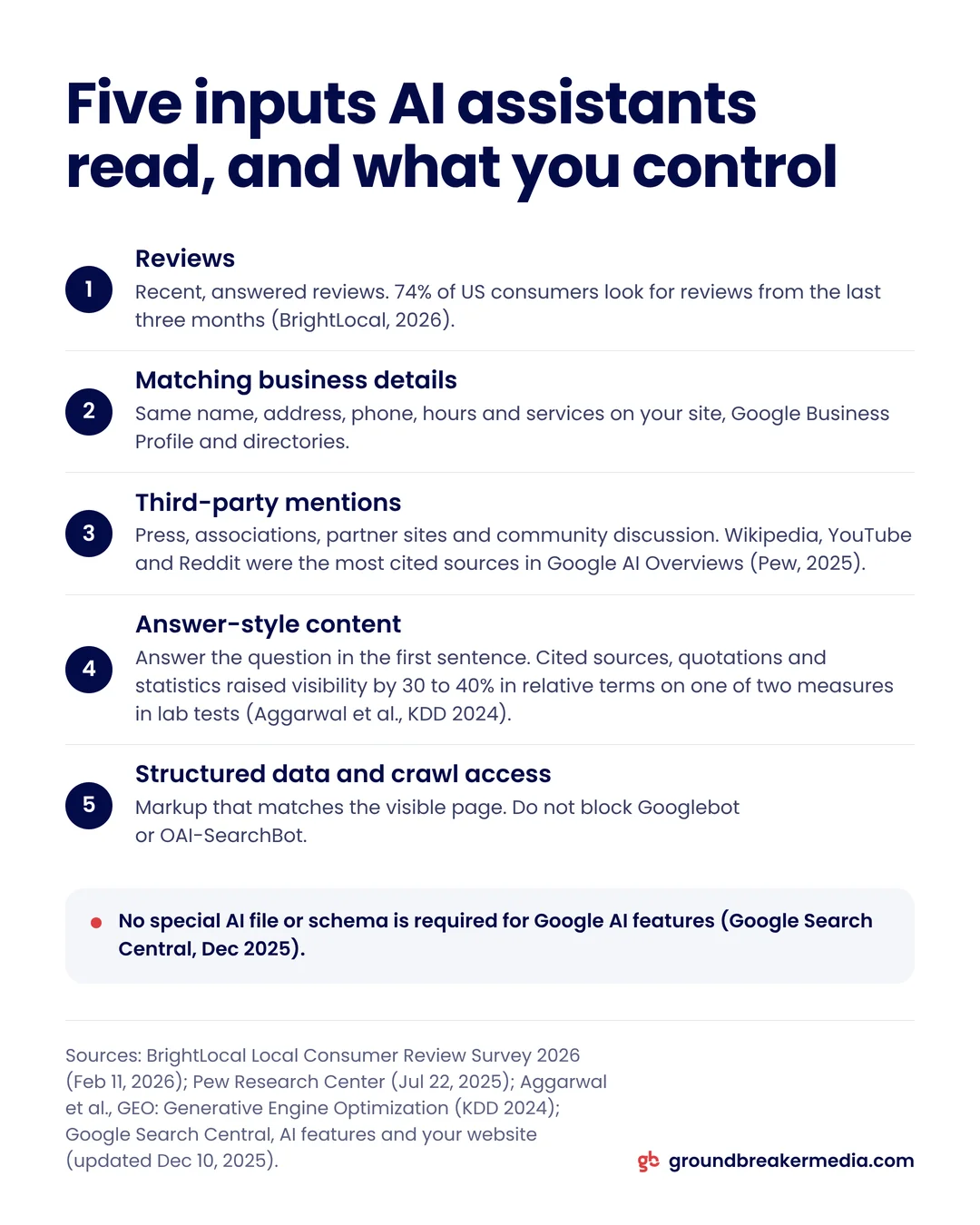
The term comes from the paper GEO: Generative Engine Optimization, first posted November 16, 2023, and accepted to KDD 2024. On the authors’ own benchmark of queries, adding cited sources, quotations and statistics to a page raised its visibility in AI answers by 30 to 40% in relative terms on one of the paper’s two measures, while keyword stuffing did little or nothing.
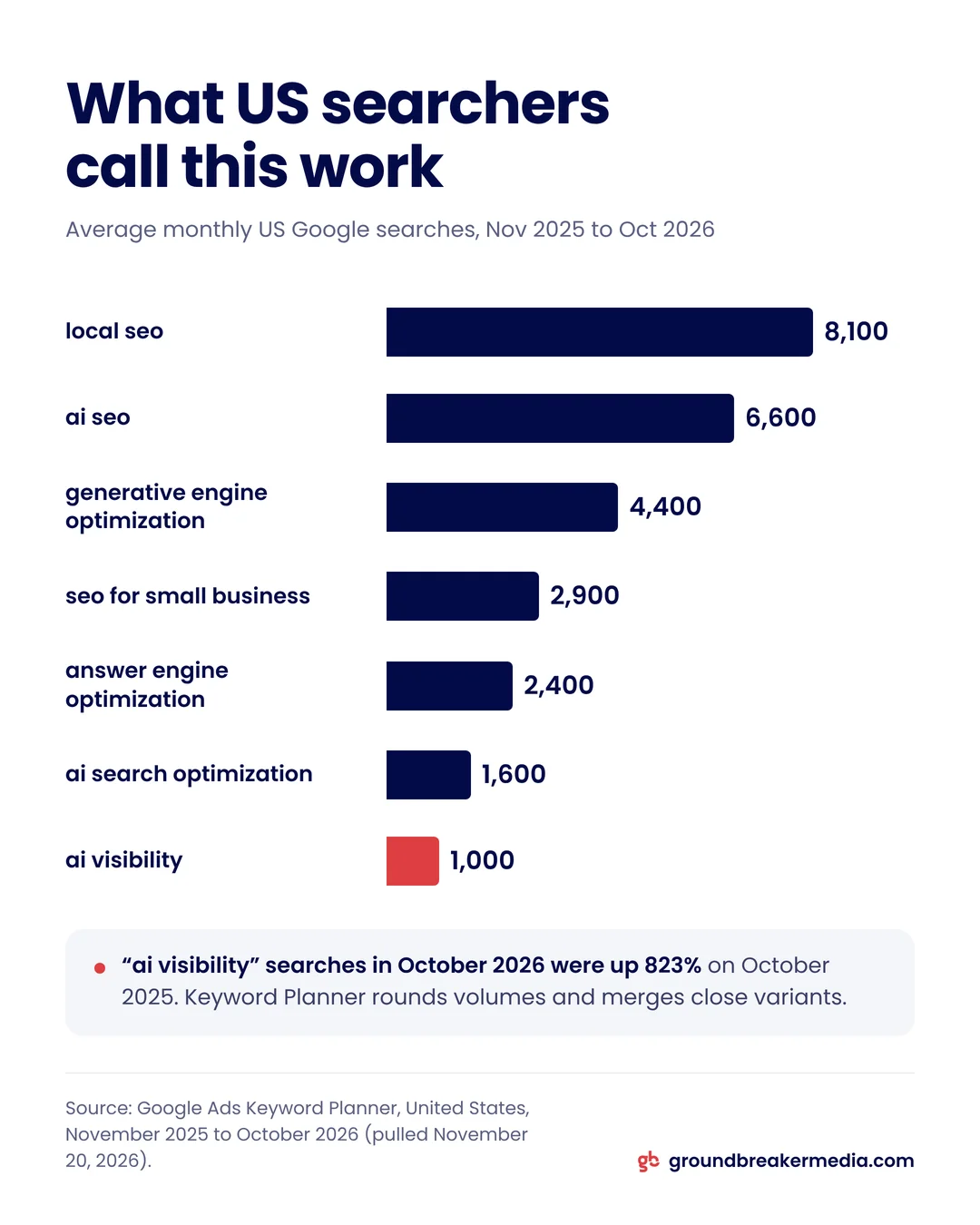
US search volumes show which names people use. From November 2025 to October 2026, Google Keyword Planner recorded an average of 8,100 searches a month for "local seo", 6,600 for "ai seo" and 4,400 for "generative engine optimization". The smallest term, "ai visibility", averaged 1,000 a month, but October 2026 brought 823% more searches for it than October 2025. Keyword Planner rounds volumes and merges close variants, so treat each figure as a rough size.
| Classic search | AI search | |
|---|---|---|
| How people ask | Short keyword phrases | Full questions with context |
| What they see first | A ranked list of links and a map | A written answer citing a few sources |
| What earns a place | A ranking for a page or a listing | Being named or cited in the answer |
| Where trust comes from | Your site, its links and your reviews | Your site plus reviews, profiles and mentions elsewhere |
| What to measure | Rankings, clicks, calls | Mentions, citations and the leads that follow |
What decides where a business shows up on Google Maps?
Three things decide a business’s place in Google’s map results: how well the listing matches the search, how close the business is to the searcher, and how well known it is.
Google names the three relevance, distance and prominence on its page of tips to improve your local ranking, which also states there is no way to request or pay for a better place. Relevance comes from the categories, services and website behind a listing. Distance is fixed by where the business sits. Prominence grows with reviews and with links from other websites, so a business can work on two of the three.
The weighting is not public, so practitioner surveys are the best guide. Whitespark’s Local Search Ranking Factors 2026 surveyed 47 specialists, who ranked the primary Business Profile category and proximity first for the map results and a dedicated page for each service first for local web results. Keywords added to the business name ranked third for the map, but Google’s guidelines forbid them and a profile can be suspended for it, so keep the legal or trading name.
How to check map positions across a service area, and the rest of the ranking factors, are in local SEO for small businesses.

How do you set up a Google Business Profile?
To set up a Google Business Profile, search Google Maps for an existing listing, claim or create it, finish the verification Google offers, and then complete the fields that decide which searches the profile can match.
The profile is a business’s entry on Google Search and Maps. Google only allows one for a business that serves customers at its own location or travels to them, with one profile per location (Google’s guidelines). Verification shows Google you represent the business, and Google’s ranking page says verification helps a profile show up in search results. Google chooses the method, which can be a call or text, email, a live video call, a recorded video or a postcard (verification). A recorded video must run at least 30 seconds in one take with no edits (video verification).
Fill in these fields first: the business name exactly as it trades, the most specific primary category, regular and holiday hours, a phone number the business controls, a website link with Urchin Tracking Module (UTM) parameters so profile visits show separately in analytics, and real photos of the place, team and work. Because the public can propose edits to any profile, check yours regularly. In April 2026, Google began rolling out email alerts that let verified owners review important edits before they go live (Google, April 2026).
Each field’s rules, common mistakes and the profile’s performance report are covered in Google Business Profile optimization.

How should a business ask for Google reviews?
Ask every customer for a Google review at the moment the job is finished, using the link or QR code Google provides, and never pay for reviews, filter out unhappy customers or give staff review targets.
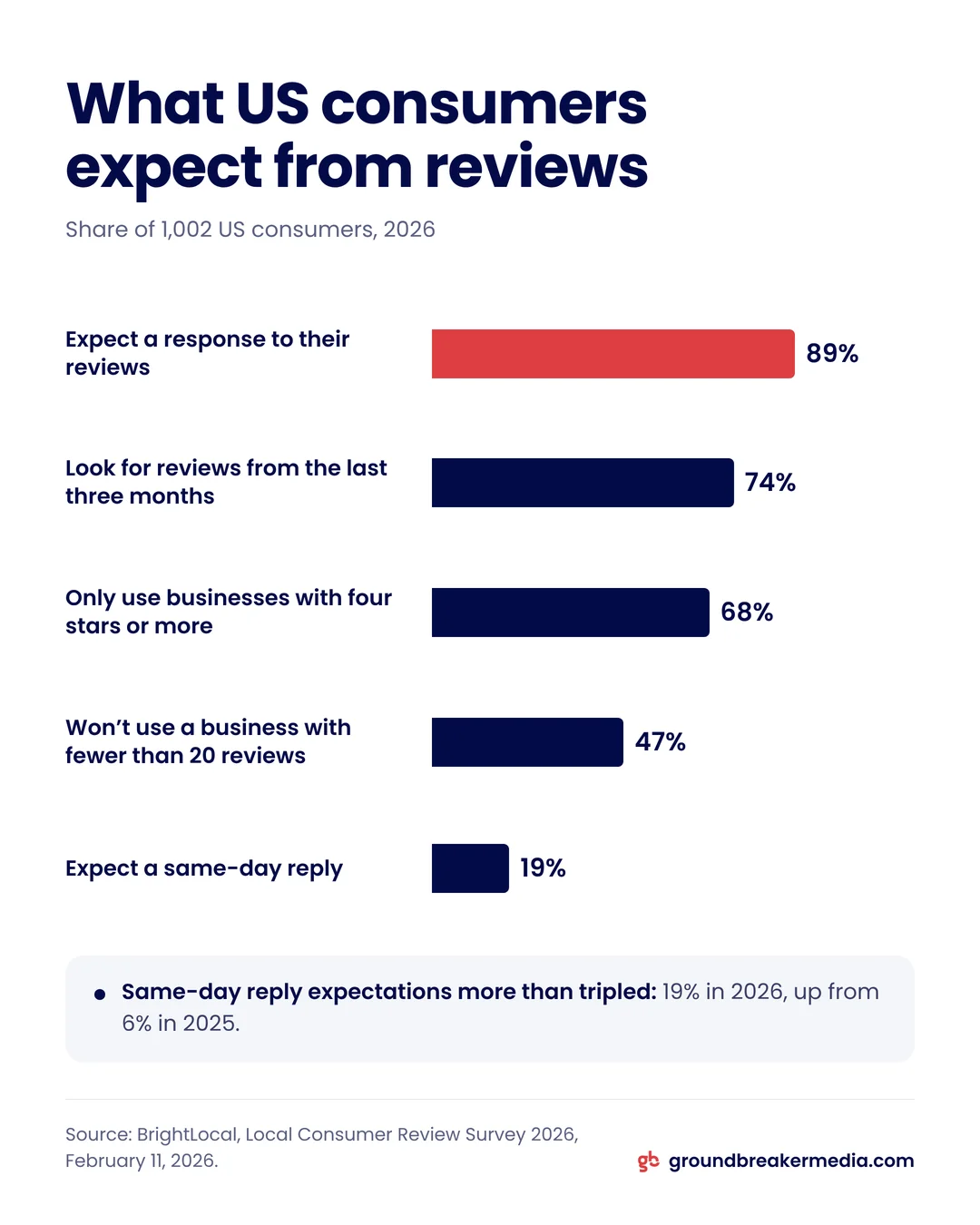
Many buyers set minimums before they choose a business. In BrightLocal’s 2026 survey, 47% of US consumers ruled out businesses with fewer than 20 reviews, 68% only use businesses rated four stars or more, and 74% look for reviews written in the last three months. The survey also found that 82% read AI-written review summaries, which are built from a business’s own reviews.
The link sits in the profile under Read reviews, then Get more reviews. A request works best as part of a step that already happens, such as the invoice, the follow-up message or the job’s completion in your customer relationship management (CRM) system.
Google’s Maps user-generated content policy bans rewards for reviews, review gating (inviting only satisfied customers), discouraging negative reviews, and asking staff to collect a set number of reviews or reviews that name them. The staff rules were added in April 2026 (Search Engine Roundtable). Google reports blocking or removing over 292 million policy-violating reviews in 2025 (Google, April 2026). In the US, the Federal Trade Commission’s rule on consumer reviews, effective October 21, 2024, also bans buying reviews that depend on what they say.
Answer the reviews as well. BrightLocal found that 89% of consumers expect a business to respond to reviews and 19% expect the reply on the same day, up from 6% a year earlier. What Google allows, what it bans and how to reply are in the Google Business Profile guide.
What should your website do to get found?
Your website needs a page for each main service, a clear statement of where you work, business details that match your listings, and settings that let search crawlers in.
Service pages carry the most weight in Whitespark’s survey for local web results. Title each page with the words customers use for the service, then cover who it is for, the area it covers and how the price is set, and answer the main question in the opening sentence. A clear opening sentence is also easy for an AI answer to quote.
The name, address and phone number (NAP) should read identically in the site footer, the contact page and every listing, so search engines and AI assistants can match each mention to one business. Google’s LocalBusiness structured data guide, last updated September 8, 2026, requires a name and address and recommends phone, URL, coordinates and opening hours. Mark up only what the page shows, as Google’s AI features guidance also asks.
Two mistakes to avoid. Google’s spam policies treat near-identical city pages that funnel visitors to one page as doorway abuse, so build a city page only when you have something specific to say about that place. And make sure robots.txt and your hosting firewall allow Googlebot and OAI-SearchBot, the crawler ChatGPT search relies on. More on service pages and city pages is in local SEO for small businesses.
How do AI assistants decide which businesses to recommend?
AI assistants recommend businesses they can find on crawlable pages, in reviews, in matching business details and in mentions on other sites, although no AI company publishes its full method.
Google’s guide to AI features and your website, last updated December 10, 2025, says a page must be indexed and eligible to show a snippet before it can appear in AI Overviews or AI Mode. Both features may run "query fan-out," several related searches combined into one answer, and current Business Profile details are among the practices Google lists.
Other assistants read the open web too. OpenAI’s publishers and developers FAQ says any public website can appear in ChatGPT search unless it blocks OAI-SearchBot, and Perplexity attaches numbered footnotes that link to its sources.
Outside voices count. Pew found that Wikipedia, YouTube and Reddit were the sources most often cited in Google’s AI Overviews, and that 88% of the Overviews it saw cited three or more sources. Press coverage, trade associations, partner sites and real community discussion give an assistant something to cite besides your own website.
What happens to clicks when an AI Overview appears?
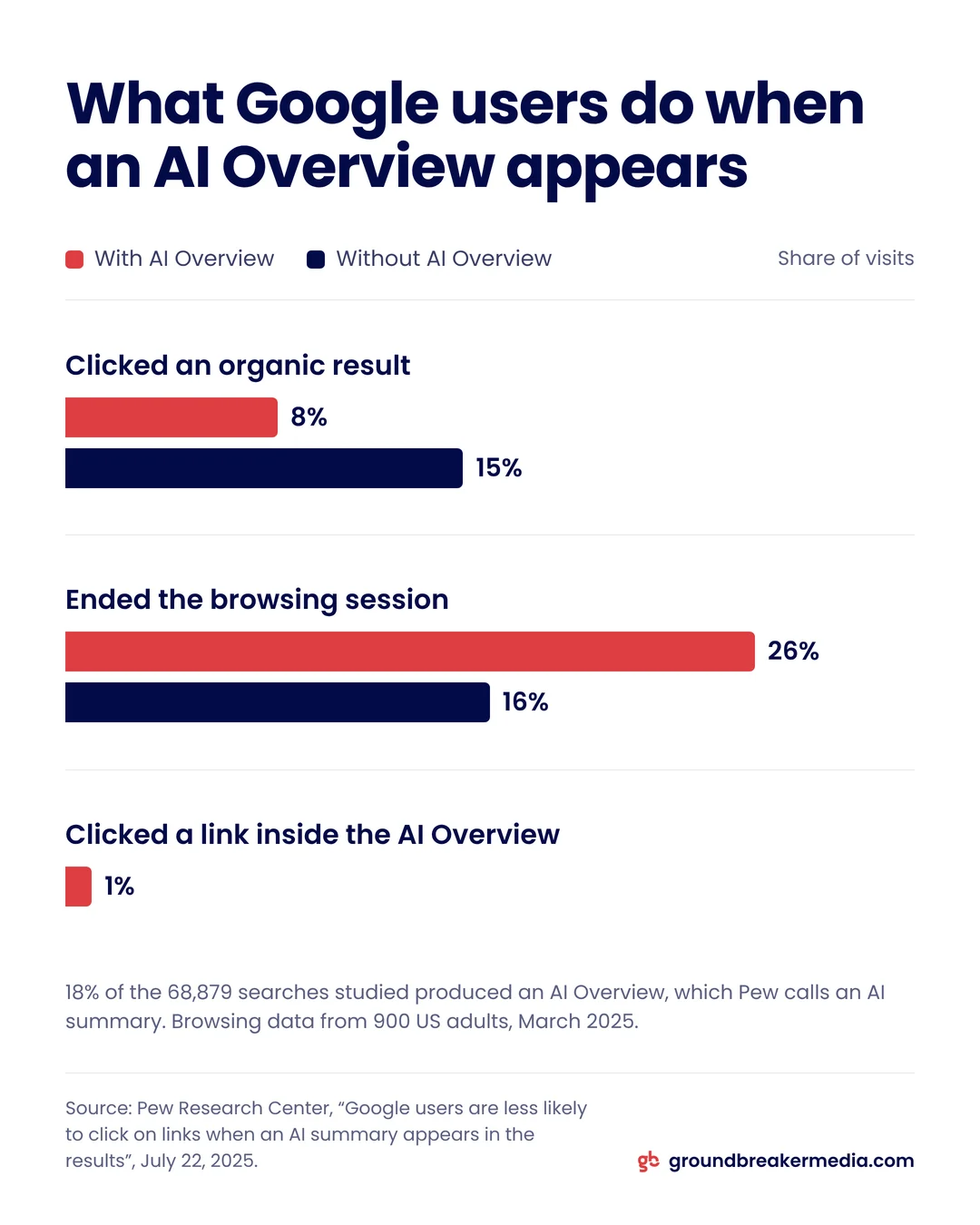
Fewer people click an organic result, one of the regular unpaid links, when an AI Overview appears above it. Pew Research Center tracked 900 US adults and 68,879 Google searches in March 2025, and published the results on July 22, 2025:
- An AI Overview appeared on 18% of the searches.
- On visits with an AI Overview, users clicked an organic result 8% of the time, against 15% without one.
- Links inside the Overview drew a click on 1% of visits.
- Sessions ended on 26% of visits with an AI Overview, against 16% without one.
Later data points the same way. In an April 2026 study of 53 brand accounts by Seer Interactive, a marketing agency, organic click-through rate on queries with an AI Overview was 2.36% in February 2026, against 3.82% on queries without one (Seer Interactive).
Google’s documentation describes clicks from pages with AI Overviews as "higher quality," with visitors staying longer on the site. That is Google’s statement, not a published study. Either way, traffic alone now says less about whether search marketing works.
Is it worth being cited in an AI Overview?
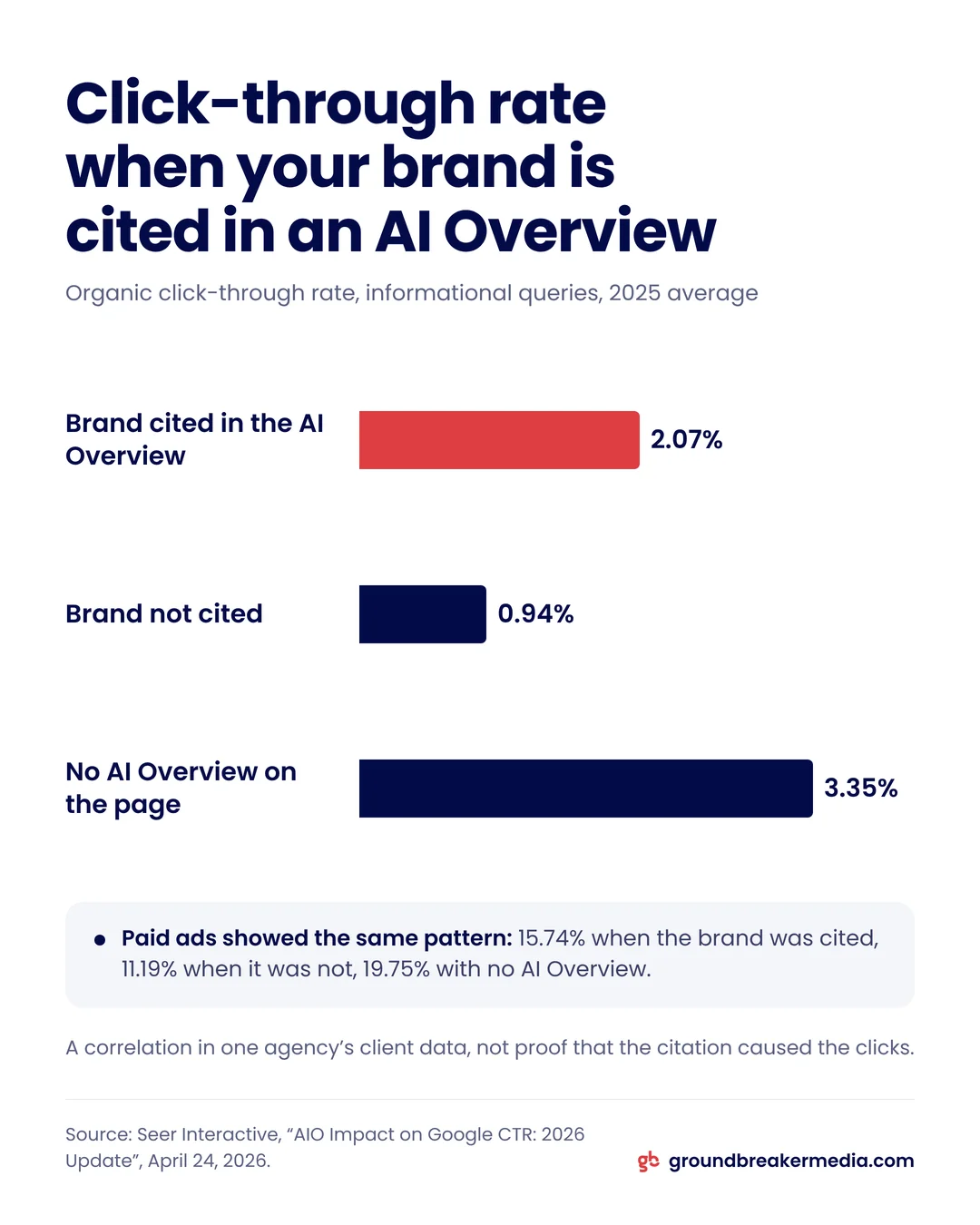
Being cited in an AI Overview is probably worth it: in Seer Interactive’s data, brands named in an Overview kept more of their clicks than brands left out, although the data shows a link, not a cause.
For informational queries across 2025, organic click-through rate averaged 2.07% when the brand was cited in the AI Overview, against 0.94% when it was not, and 3.35% on queries with no Overview at all. Paid ads followed the same pattern: 15.74% when the brand was cited, against 11.19% when it was not and 19.75% with no Overview.
Seer calls the findings directional. A single account makes up 47% of the not-cited group’s impressions, and without it that group’s rate is about 1.61%. A citation still does not bring back the click-through rate of a page with no Overview. Where an Overview appears, though, being named in it is the better place to be, and it comes from the same inputs this guide covers.
Where should a business claim its profiles beyond Google?
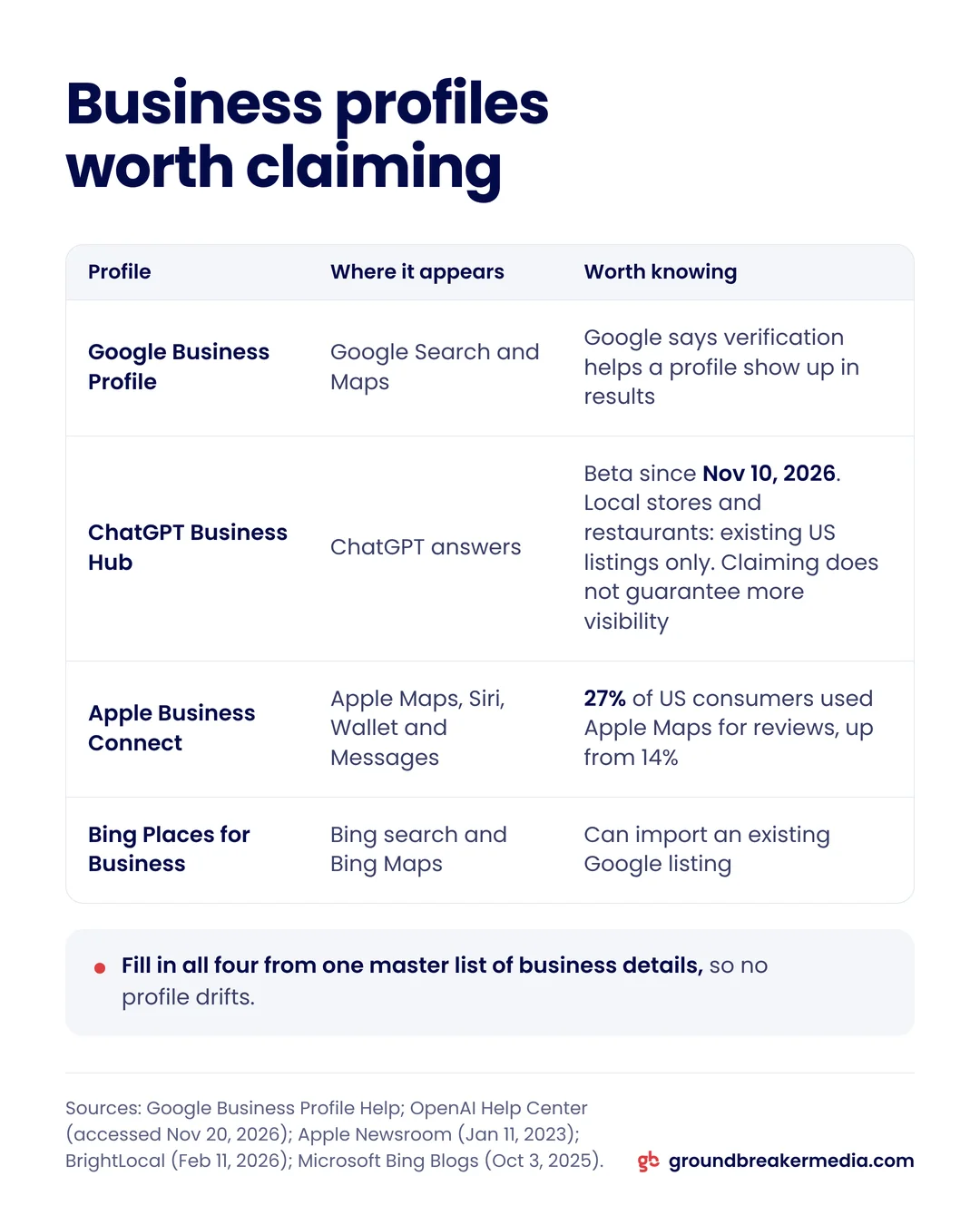
Beyond Google Business Profile, claim Apple Business Connect, Bing Places and, if your business qualifies, ChatGPT’s Business Hub, and fill in each one from the same set of business details.
OpenAI’s Businesses in ChatGPT program, in beta since November 10, 2026, lets a verified owner claim a profile in Business Hub, edit its details and see mentions, profile views, website clicks and the topics that led people to it. Owners prove control with a domain name system (DNS) record, a code sent to the business’s email address or main phone number, or a Shopify connection, followed by an identity check. For now, local stores and restaurants can only claim existing US listings, and OpenAI says claiming does not guarantee more visibility (OpenAI Help Center).
Apple Business Connect, launched January 11, 2023, controls a business’s place card in Apple Maps, Siri, Wallet and Messages. In BrightLocal’s 2026 survey, 27% of consumers used Apple Maps for reviews, up from 14% in 2025. Microsoft announced in October 2025 that Bing Places for Business was moving to bing.com/forbusiness; it can import a Google listing, and its listings appear in Bing search and Bing Maps.
Keep one master list of your name, primary category, services, opening hours and the area you serve, and copy from it every time, so no profile drifts. Eligibility, the claim steps and what Business Hub’s numbers mean are in how to claim your business in ChatGPT.
What does Google tell brands to do in AI Search?
Google’s October 2026 advice to brands sets three priorities: give people specific and helpful answers, build authority with expertise only you have, and judge the work by business results such as leads and sales.
The advice comes from a Think with Google article by Brendon Kraham, Google’s VP of Search and Commerce Global Ads Solutions (Google, October 2026). It draws on research Google commissioned from Ipsos in December 2025, in which shoppers using AI Search visited about 12 touchpoints before buying, nearly three times as many as other shoppers. That is Google’s research about Google’s product, so read it as Google’s view. The practical point still stands: buyers now meet a business in more places before they get in touch.
In a small business, that expertise sits with the people who do the work: why a repair failed, what a fair price is in your town, which option suits which customer. Write it down where buyers will meet it, on the website, in the Business Profile and in short videos, because a generic page gives an assistant nothing to quote. One habit Google does not list is worth adding: keep your business details identical everywhere, because every one of those touchpoints may show them. How Google’s advice turns into weekly work is in brand authority in Google’s AI Search.
How do you measure search and AI visibility?
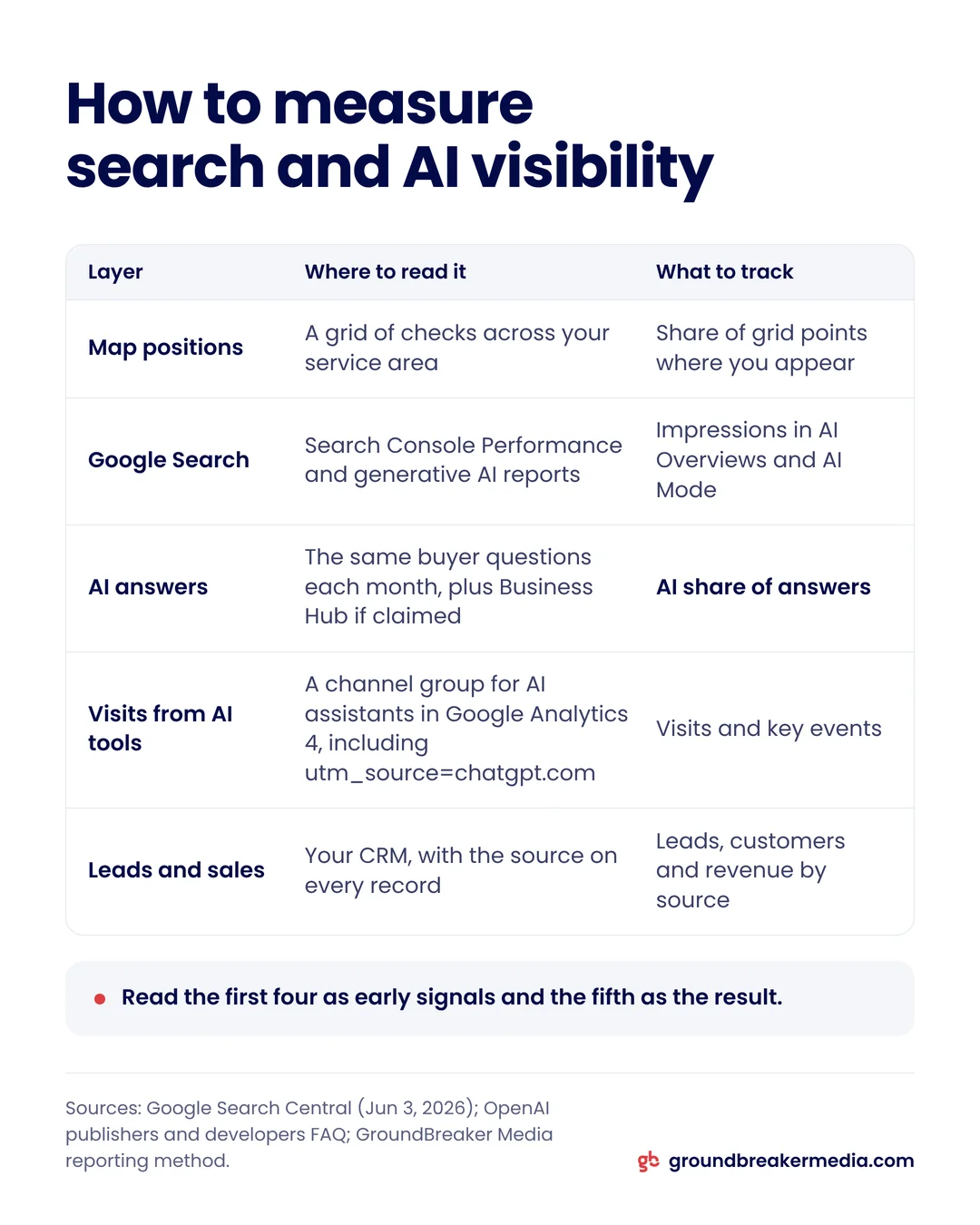
Measure search and AI visibility in five layers, from first sight to closed sale: map positions, Google Search, AI answers, visits from AI tools, and the leads and sales in your CRM.
- Map positions. Each month, check your main searches from a grid of points across your service area, not only from your office, and note the share of points where you appear in the map results.
- Google Search. Search Console’s Performance report already counts AI Overview and AI Mode traffic under the Web search type. Its generative AI performance reports, available to all sites since August 31, 2026, add how often your pages appear in AI Overviews and AI Mode (Google Search Central, June 2026).
- AI answers. Ask ChatGPT, Gemini, Perplexity and AI Mode the same list of real buyer questions each month, and record which answers name or cite you. If you have claimed Business Hub, read its mention and click counts too.
- Visits from AI tools. ChatGPT adds utm_source=chatgpt.com to the links it sends, according to OpenAI’s publishers FAQ. In Google Analytics 4, a channel group for AI assistants keeps those visits apart from ordinary referrals.
- Leads and sales. Record the source of every call, form and message in your CRM, and follow each one to a closed sale.
AI share of answers = test questions where the business is named or cited ÷ test questions asked
Read the first four as early signals and the fifth as the result. Marketing analytics for small businesses explains how to tie each source to the CRM, and the brand authority guide walks through Search Console’s AI reports.
How do businesses outside the US reach buyers in the US and Canada through search?
Businesses outside the US reach buyers in the US and Canada with the same search methods, plus more proof. A buyer who cannot visit first checks credentials, reviews, prices and legal answers online, so those answers belong on the page, in English, before the first message.
Costa Rica’s clinics are a clear case. On June 16, 2026, the CareQuest Institute reported that nearly 9.6 million US adults have traveled abroad for dental care, and the Centers for Disease Control and Prevention (CDC) names dental care as the most common form of medical tourism for US residents. A patient choosing a clinic from abroad looks for each dentist’s name and license number, accreditation, recent reviews with replies, price ranges and aftercare in English. The clinic’s Google Business Profile matters even to patients overseas, because it is the public record they check. Health ads also face tighter rules: Google’s Health in personalized advertising policy limits audience targeting for medical procedures, and Meta’s personal attributes standard bars ads that imply a viewer’s health condition, so the copy should talk about the treatment and the clinic and make no assumptions about the person viewing it. The full playbook is in how Costa Rica clinics win international patients online.
Property sales follow the same pattern with different questions. US searches for "costa rica homes for sale" averaged 18,100 a month from October 2025 to September 2026, although September 2026 searches were 33% below September 2025 (Google Keyword Planner, November 2026). A buyer abroad first wants to know whether a beach property is titled land or a municipal concession, because Costa Rica’s maritime zone law (Law 6043) limits concessions for foreigners. Housing ads shown to people in the US and Canada also fall under special targeting rules on Google and Meta. Answering those questions on each listing serves search, AI assistants and the buyer at once.
Where should a small business start?
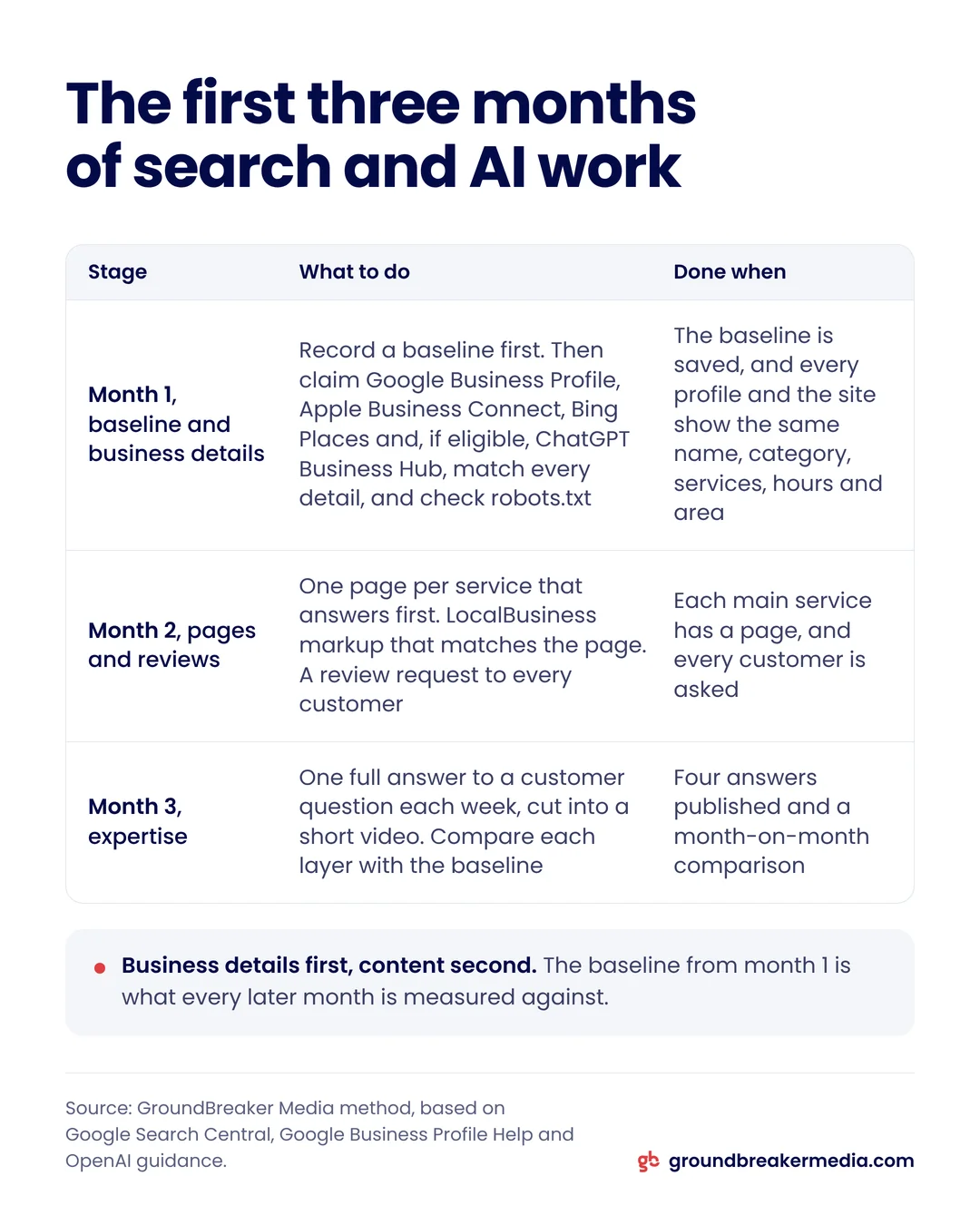
A small business should start by recording a baseline and fixing its business details, then move on to pages and reviews, then expertise, so that every later month has something to compare against.
- Month 1, baseline and business details. Before changing anything, verify your site in Search Console and record map positions, Search Console impressions, your test questions and leads by source. Then claim and verify your Google Business Profile, Apple Business Connect, Bing Places and, if eligible, ChatGPT’s Business Hub, make the name, primary category, services, opening hours and area served match on all of them and on your website, and check that robots.txt lets Googlebot and OAI-SearchBot in.
- Month 2, pages and reviews. Give each main service its own page that answers the main question in its first sentence, add LocalBusiness structured data that matches the page, and send a review request to every customer with Google’s link.
- Month 3, expertise. Publish a full answer to one real customer question each week and cut a short video from it. Compare each layer of measurement with the month 1 baseline.
If you would rather hand this work off, GroundBreaker Media offers it as Search and AI Authority.
Frequently asked questions
Is SEO still worth doing if AI answers the question?
Yes. AI answers are built from indexed pages, business profiles and reviews. Google says a page must be indexed and eligible for a snippet to appear in AI Overviews or AI Mode, and ChatGPT search reads public websites its crawler can reach. SEO is the base that GEO builds on, not something GEO replaces.
Do I need an llms.txt file or special code to appear in AI answers?
Not for Google. Google’s documentation says AI Overviews and AI Mode need no special schema, machine-readable file or AI text file. The usual practices apply: allow crawling, keep important content in text, use structured data that matches the page, and keep Business Profile details current.
Can I pay to be recommended by ChatGPT or Google’s AI?
Only through ads, where a platform sells them. Google states there is no way to request or pay for a better local ranking, and OpenAI says claiming a business in ChatGPT does not guarantee more visibility. Organic recommendations come from what assistants find: reviews, matching details, credible mentions and clear pages.
How long do SEO and GEO take to work?
No search engine or AI company publishes a timeline. Fixes to business details count once they are processed and the pages are crawled again, while reviews, links and mentions build up over months. Compare each month with a baseline recorded before any changes, and judge progress by mentions, citations and leads.
Written by
GroundBreaker Media
A performance marketing agency that connects what you spend to what it brings back. About us
Related insights
All insights


Want one version of the truth? Start with a free audit.
Answer 10 quick questions and get a written audit within 2 business days: what your marketing is producing, what's holding it back, and what to fix first.