
How Costa Rica clinics win international patients online
Costa Rica clinics win US and Canadian patients with checkable credentials, recent reviews, price ranges, fast replies and inquiries tracked to treatment.
 By GroundBreaker Media6 min read

Before writing to any clinic, US and Canadian patients compare several in Costa Rica through search, reviews, AI assistants and video. The clinics that win are easy to find, easy to verify and quick to answer, with checkable credentials, recent reviews, honest price ranges and fast replies. They also track every inquiry through to a booked treatment.
Who are Costa Rica’s international patients, and how do they research a clinic?
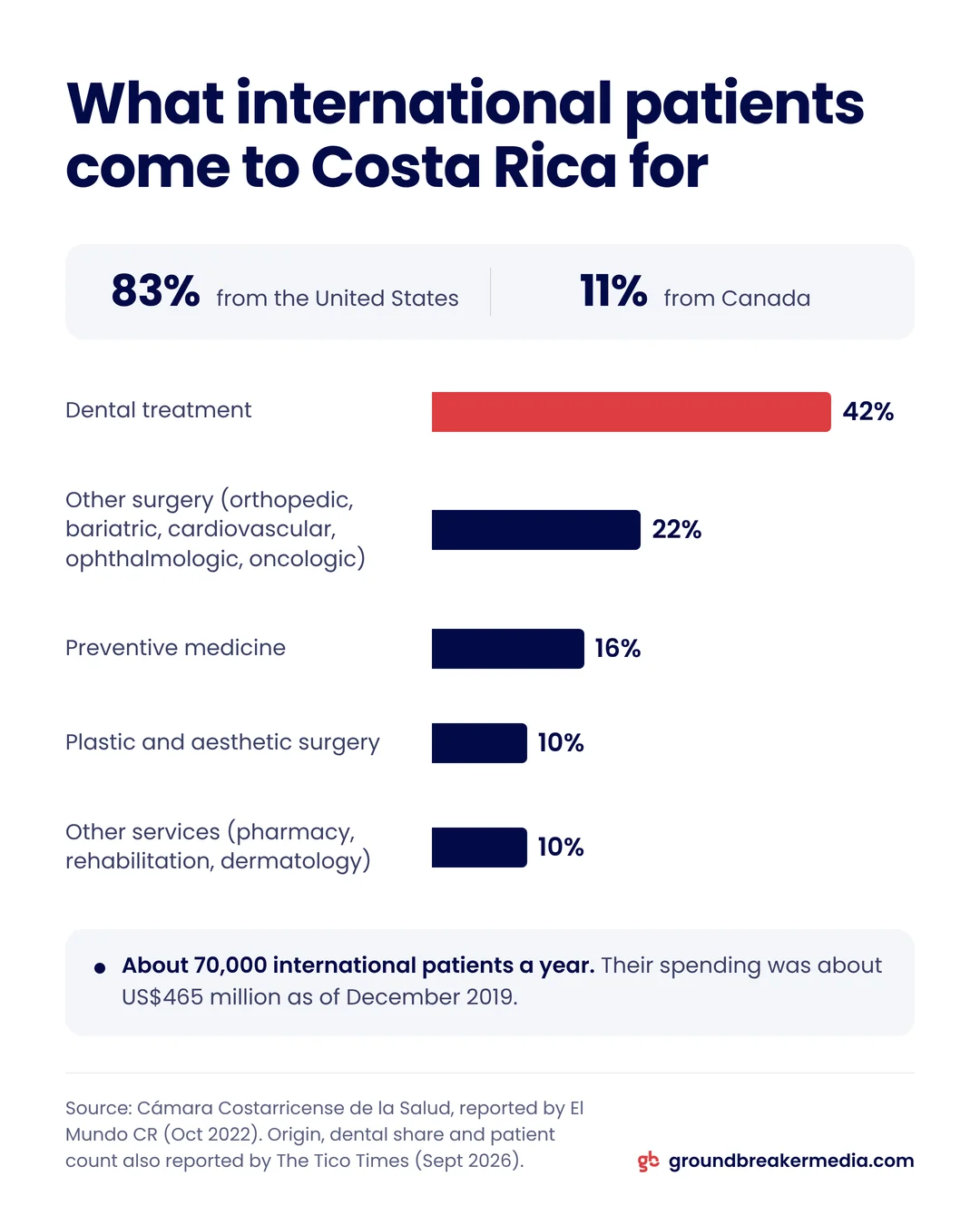
Most come from the United States and Canada, and the largest group comes for dental care. They research at length because they are choosing a provider in another country.
Figures from the Cámara Costarricense de la Salud (Costa Rican Chamber of Health), reported by El Mundo CR on October 17, 2022, put international patients at about 70,000 a year, with income of about US$465 million as of December 2019. By the chamber’s count, 83% of patients came from the US and 11% from Canada, and dental treatment made up 42% of demand. The Tico Times repeated the same figures, including the 2019 income total, on September 1, 2026, describing them as Central Bank data compiled by the chamber.
The CareQuest Institute reported on June 16, 2026 that about 9.6 million US adults have traveled abroad for dental care at some point, and 58% of them went because treatment costs less outside the US. The CDC Yellow Book calls dental care the most common form of medical tourism among US residents.
What makes a foreign patient trust a clinic they have never visited?
Proof they can check themselves. The CDC advises medical tourists to research the facility and the professional as much as possible, and notes that accreditation does not guarantee a good outcome.
| Trust signal | What the patient asks | What the clinic should show |
|---|---|---|
| Credentials | Is this doctor licensed? | Each professional’s full name and registration number |
| Accreditation | Does it meet recognized standards? | Accreditation held, such as JCI or AAAHC, with proof |
| Reviews | What do recent patients say? | Recent reviews on Google and elsewhere, with replies |
| Pricing | Can I budget before I travel? | Price ranges, what is included, what can change |
| Patient stories | Has someone like me done this? | Stories and photos shared with written consent |
| Language | Will I understand everything? | English pages, consultations and aftercare instructions |
| Aftercare | What if I need help at home? | A written follow-up plan and records in English |
Patients can verify a physician in the Colegio de Médicos y Cirujanos registry, which CRHoy explained on January 22, 2026 can be searched by name or professional code and shows specialties and active status. The CDC names Joint Commission International, which accredits hospitals, ambulatory care organizations and other facilities, and the AAAHC among accrediting bodies.
On consent, Costa Rica’s Law 8968, dated July 7, 2011, treats health data as sensitive and requires express, written consent to collect personal data.
Why does Google Business Profile matter if patients live abroad?
It is the clinic’s public record on Google Search and Maps, and Google’s AI features documentation tells site owners to keep it current.
Google’s profile guidelines say the name must reflect the real-world business without marketing taglines, and that doctors and dentists in public-facing roles can have their own profile alongside the clinic’s. Reviews and links from other websites feed the prominence part of Google’s local ranking, and the guide to getting found in AI search shows why recent, answered reviews outweigh a large, old total.
GroundBreaker Media’s Costa Rica work helps clinics build this, from search visibility through to booking data.
How should a clinic advertise to patients in the US and Canada?
Start where the decision starts, usually Google search, with video and social for awareness, and stay inside each platform’s healthcare rules. Those rules shape targeting and copy as much as budget does.
Google’s location options default to "presence or interest", which includes people interested in a place, while "presence" limits ads to people located or regularly located there. Choose deliberately between people living in the US and Canada and people showing interest in Costa Rica.
Ad policies narrow the options further. Google’s Healthcare and medicines policy restricts areas such as prescription drugs and speculative or experimental treatments, and requires certification for several categories. Its Health in personalized advertising policy treats medical procedures as a sensitive category in which advertiser-curated audiences, such as customer match and lookalike segments, are not supported.
On Meta, the personal attributes standard bars ads that assert or imply a person’s health condition, and the personal health and appearance standard bars ads that try to create negative self-perception. Copy should describe the treatment and the clinic, not the viewer.
Why do WhatsApp and fast replies matter so much?
A patient is usually comparing several clinics, so the first clear, personal answer has the advantage. WhatsApp lets that conversation move at the patient’s pace.
The WhatsApp Business app offers greeting and away messages, quick replies, labels and a catalog, and ads that click to WhatsApp send people from Facebook and Instagram straight into a chat. Tools help, but speed is a process: a named owner, a response-time target, bilingual replies that ask what a quote needs, and a clear step to a consultation. Treatment messages contain health data, so handle them like clinical records.
How do you track an inquiry all the way to a booked treatment?
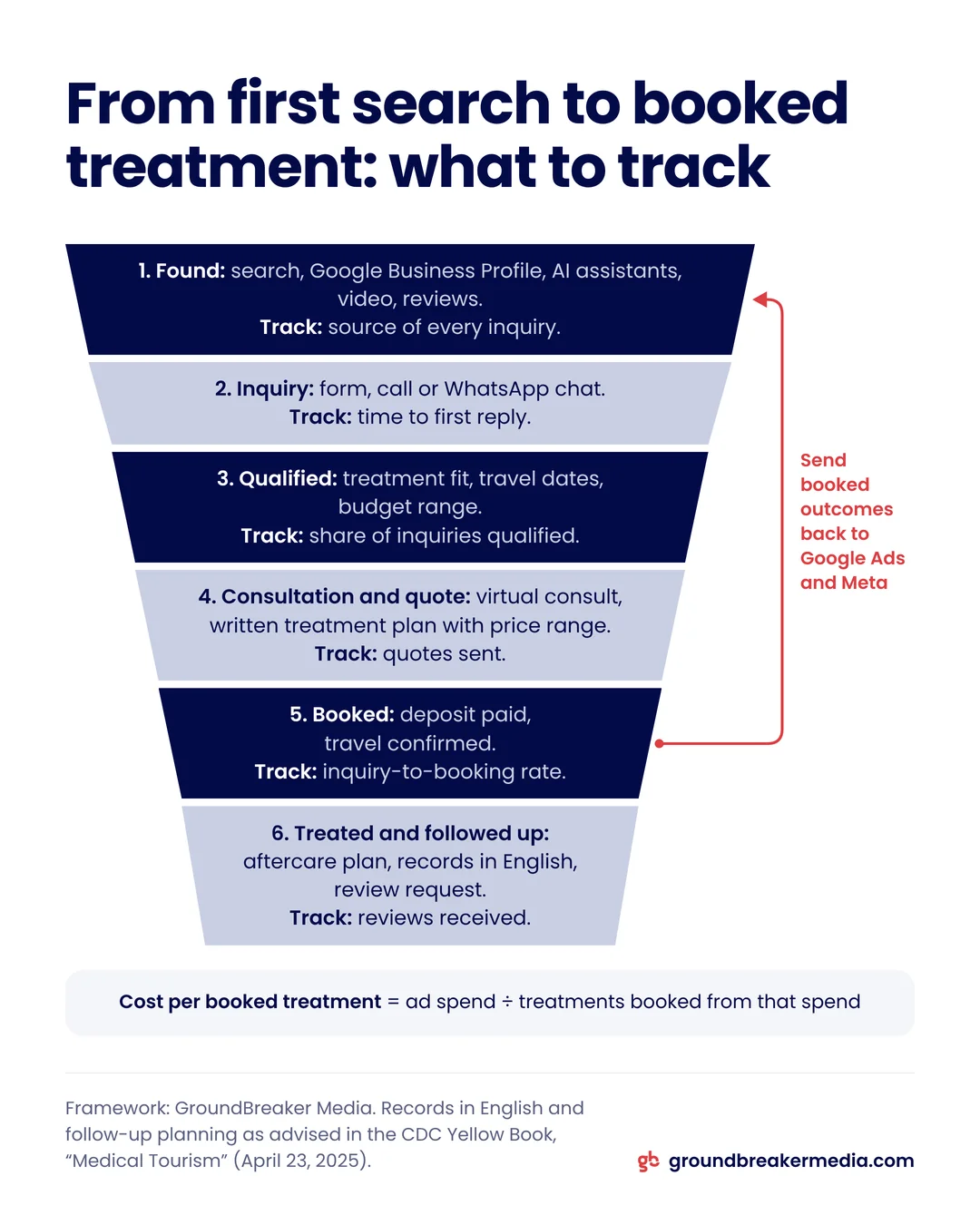
Give every inquiry a source, a stage and a value, and send booked outcomes back to the ad platforms. That shows which spend produced patients, not just messages.
Cost per booked treatment = ad spend ÷ treatments booked from that spend
Record the source of each form, call and WhatsApp chat, then move it through stages: inquiry, qualified, consultation, quote, deposit, treated. Google Ads takes booked outcomes through enhanced conversions for leads, Meta takes them through its Conversions API, and the article on matching ad platforms to CRM revenue covers the full loop. Then budget can follow booked treatments, not clicks.
Frequently asked questions
How do US patients check a Costa Rican doctor’s credentials?
They can search the Colegio de Médicos y Cirujanos de Costa Rica public registry by full name or professional code, which shows registered specialties and whether membership is active. Clinics make this easier by publishing each professional’s full name and registration number, plus any international accreditation, so patients can verify the details before they make contact.
Should a clinic publish treatment prices?
Ranges are more useful than single numbers. Patients need a realistic budget before they plan travel, so a range per treatment, what it includes and what could change after an exam builds trust. Final quotes still depend on an examination or imaging. Clear ranges also filter out inquiries that were never likely to book.
Should clinic ads target people in the US or people interested in Costa Rica?
Decide on purpose, because Google’s default covers both. "Presence or interest" includes people interested in a place, while "presence" limits ads to people located or regularly located there. Choose presence when you want only people in the US and Canada. Google’s health rules still rule out audiences built from your own customer lists for medical procedures.
Do patient testimonials need consent in Costa Rica?
They should have documented consent. Costa Rica’s Law 8968 treats health information as sensitive data and requires express, written consent to collect personal data. Before publishing a patient’s story, photos, video or name, get written permission that states where it will appear, and confirm the details with a lawyer who knows Costa Rican data protection rules.
Written by
GroundBreaker Media
A performance marketing agency that connects what you spend to what it brings back. About us
Related insights
All insights


Want one version of the truth? Let's look at your numbers.
A short call, an honest read on what your marketing is producing, and clear next steps.