
Performance Max without the black box
You keep control of Performance Max with CRM conversion values, exclusions, the new channel and search terms reports, and an experiment against Search.
 By GroundBreaker Media6 min read

Performance Max is a Google Ads campaign type that runs one budget across Search, YouTube, Display, Discover, Gmail and Maps, with Google’s automation choosing bids, placements and ad combinations. Since 2025 Google has added channel, search term and asset reporting plus campaign-level negative keywords. You keep control with CRM conversion values, audience signals, exclusions and a test against Search.
What is Performance Max and how does it work?
Performance Max works from a goal you set: you supply the conversion actions, assets and budget, and Google’s systems decide where and how the ads run.
Google describes it as a way to "access all Google Ads inventory, including YouTube, Display, Search, Discover, Gmail, and Maps, from a single campaign" (Google Ads Help). You choose the conversion actions that count, with an optional target cost per acquisition (CPA) or return on ad spend (ROAS). Smart Bidding then bids in each auction on the predicted probability of a conversion. So Performance Max is only as good as your definition of a conversion.
What does Performance Max do well?
It finds conversions across inventory you would not manage by hand and moves budget toward placements that convert. It works best when the conversion signal is accurate and plentiful.
Google says it uses real-time intent and audience signals, applies data-driven attribution, and "automatically funnels your budget toward the highest performing inventory and placements" (Google Ads Help). Google also offers a new customer acquisition goal, with a high value mode that uses your customer lists (Google Ads blog, January 2025).
Where is Performance Max visibility still limited?
Spend still moves between channels automatically, several controls cover only part of the inventory, and some query data is grouped rather than listed.
- Channel performance data covers only date ranges after June 6, 2025 (Google Ads Help).
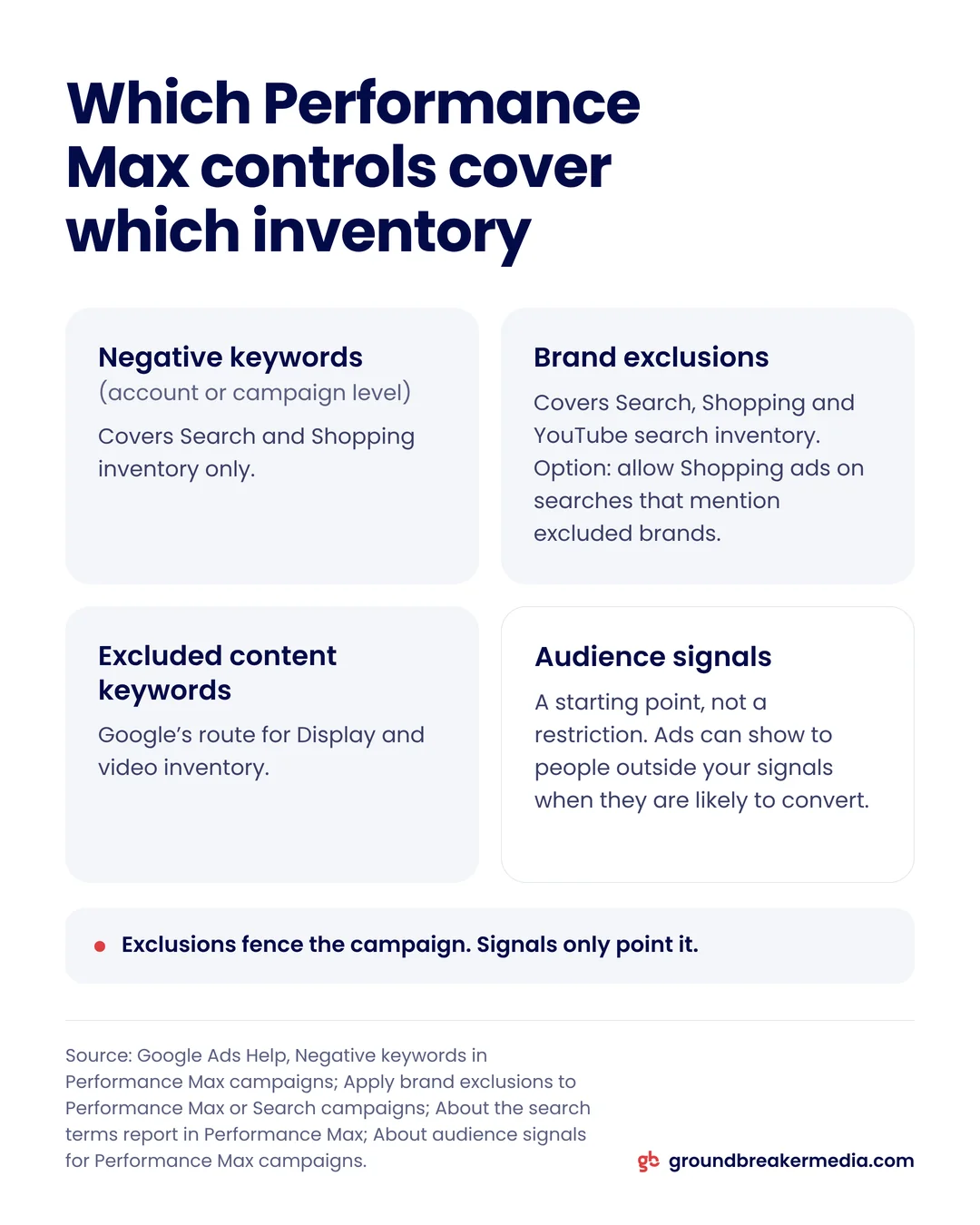
- Negative keywords "are applicable to Search and Shopping inventory only" (Google Ads Help). For Display and video, Google points to excluded content keywords (Google Ads Help).
- Brand exclusions apply to "only Search, Shopping, and YouTube search inventory" (Google Ads Help).
- Search terms insights group queries into categories that include terms the search terms report hides for privacy reasons (Google Ads Help).
What has Google added to make Performance Max more transparent?
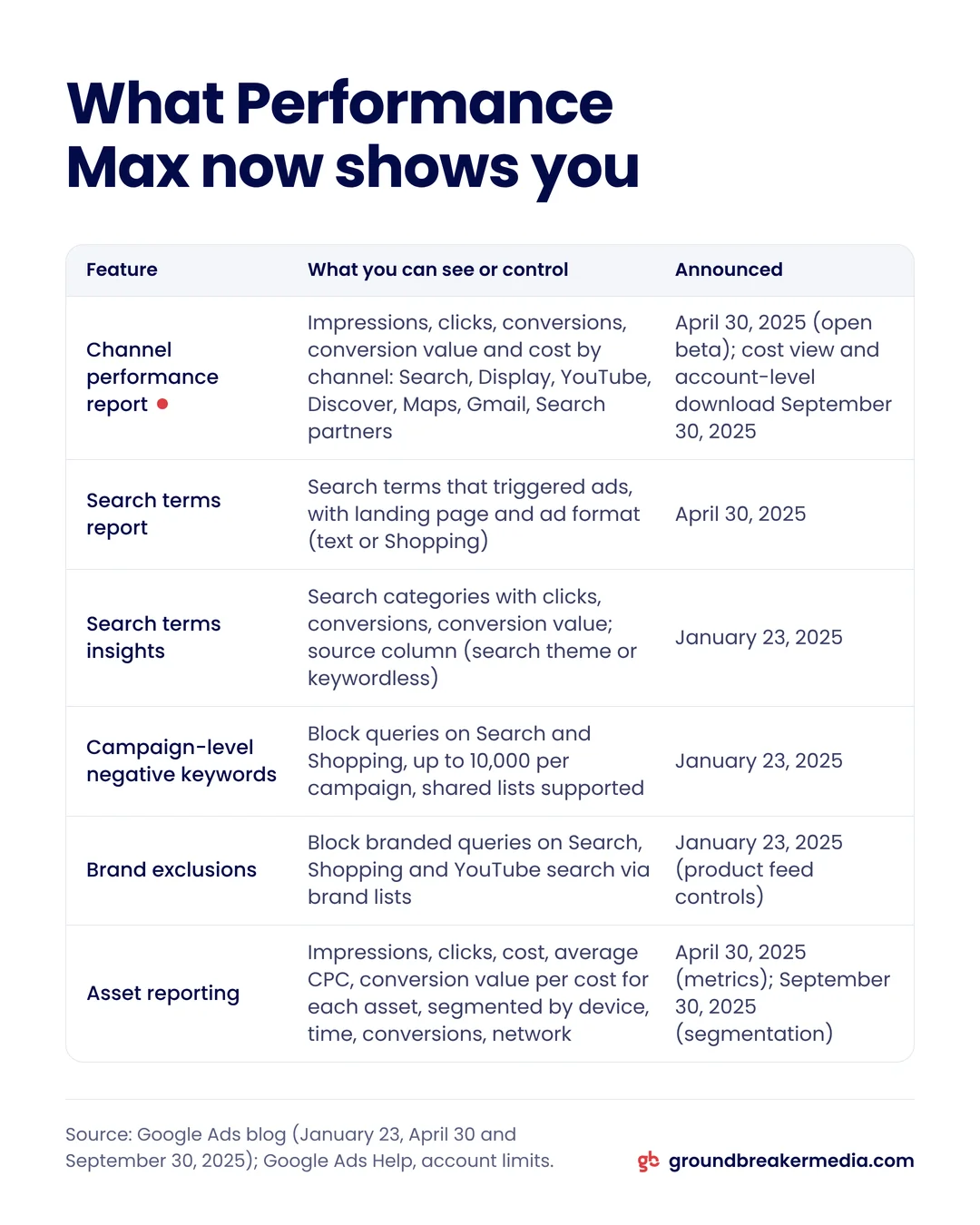
Google has added reporting by channel, by search term and by asset, plus more exclusion controls. The table summarizes each from Google’s announcements.
| Feature | What you can see or control | Announced |
|---|---|---|
| Channel performance report | Impressions, clicks, conversions, value and cost by channel, with diagnostics | April 30, 2025; cost view and account-level download September 30, 2025 |
| Search terms report | Search terms that triggered ads, with landing page and ad format | April 30, 2025 |
| Search terms insights | Query categories with conversions and value, plus a source column | January 23, 2025 (source column) |
| Campaign-level negative keywords | Block Search and Shopping queries, directly or from shared lists | January 23, 2025 |
| Brand exclusions | Block branded queries using brand lists | January 23, 2025 (product feed controls) |
| Asset reporting | Impressions, clicks, cost and conversion value per asset, segmented by device, time and network | April 30 and September 30, 2025 |
Sources: Google’s January, April and September 2025 announcements. Google’s account limits page allows "10,000 negative keywords per campaign."
How do you feed Performance Max the right conversion data?
Send it the outcomes that make you money, with values, from your CRM. If a form fill and a signed contract carry the same value, Performance Max will keep buying form fills.
Google’s guidance on value-based bidding recommends bidding toward one stage of the lead-to-sale funnel with a short conversion delay, and uploading conversions often, ideally daily. For lead generation, that means sending CRM stages such as qualified lead or closed deal back as offline conversions, a setup the closed-loop tracking explainer covers in full.
When you cannot send revenue for every lead, value each stage from your own history:
Value of a funnel stage = average gross profit per customer × rate at which that stage becomes a customer
Example (hypothetical numbers): if each customer brings $5,000 in gross profit and 20% of qualified leads become customers, a qualified lead is worth $1,000.
Building that measurement layer, from CRM conversion values to plain-language reporting, is part of GroundBreaker Media’s solutions.
How do audience signals and exclusions keep it on target?
Audience signals tell the system where to start. Exclusions tell it where not to go.
Signals can include customer lists, website visitors, custom segments and demographic or interest segments. They are not restrictions: "Performance Max may show ads to relevant audiences outside of your signals if they have a strong likelihood of converting" (Google Ads Help). Your customer list is the most direct signal you have, because it describes people who already bought.
Exclusions do the fencing. Use negative keywords for irrelevant or unprofitable queries. Use brand exclusions when a Search campaign already covers your brand terms, so Performance Max is judged on new demand.
How do you test Performance Max against Search?
Keep your most valuable queries in Search on exact match, then measure what Performance Max adds with an experiment.
Google states that "Search campaigns containing an exact match keyword are prioritized to serve over Performance Max" for matching queries, while search themes carry the same priority as phrase and broad match (Google Ads Help). Bids and copy on proven terms stay yours.
Google’s uplift experiments measure the extra conversions or value from running Performance Max alongside campaigns such as Search, and upgrade experiments compare it with Dynamic Search Ads, Display or Standard Shopping (Google Ads Help). Google’s 2023 guidance advised running experiments "for at least 4-6 weeks" (Google Ads Help). Judge the result on cost per customer in your CRM, with targets taken from the cost per lead you can afford and your Google Ads budget math.
Frequently asked questions
Can you see which channels Performance Max spends money on?
Yes. The channel performance report in Google Ads shows impressions, clicks, conversions, conversion value and cost for Search, Display, YouTube, Discover, Maps, Gmail and Search partners. Google added a cost view and account-level downloads in September 2025. The report covers date ranges after June 6, 2025, so earlier periods cannot be split by channel there.
Can you add negative keywords to Performance Max?
Yes. Google opened campaign-level negative keywords in Performance Max to all advertisers in 2025, and its account limits page allows up to 10,000 negative keywords per campaign. You can enter keywords directly or attach a shared list. They apply only to Search and Shopping inventory. For Display and video, Google points to excluded content keywords.
Should Performance Max replace your Search campaigns?
Not by default. Google gives exact match keywords in Search campaigns priority over Performance Max for matching queries, so you keep control of the terms you know convert. Run Performance Max alongside Search, measure what it adds with an uplift experiment, and decide on cost per customer from your CRM.
Do audience signals limit who sees Performance Max ads?
No. Audience signals are suggestions that give Google’s system a starting point, and Google states that Performance Max may show ads to people outside them when they are likely to convert. To keep the campaign away from specific traffic, use negative keywords, brand exclusions and content exclusions instead.
Written by
GroundBreaker Media
A performance marketing agency that connects what you spend to what it brings back. About us
Related insights
All insights


Want one version of the truth? Let's look at your numbers.
A short call, an honest read on what your marketing is producing, and clear next steps.