
Conversion tracking that survives privacy changes
Reported conversions fall when cookies expire, tags are blocked or consent is declined; first-party data and server-side tagging keep tracking durable.
 By GroundBreaker Media6 min read

Sales are steady, yet your ad platforms report fewer conversions. Browsers now limit the cookies and link parameters ad tags rely on, some visitors block tags, and consent rules stop others from being measured. Durable tracking moves measurement onto data you collect and control: first-party data, server-side tagging, enhanced conversions, Meta’s Conversions API and a wired consent banner.
What are browsers doing to conversion tracking?
Safari and Firefox restrict how long cookies last and whether trackers can connect activity across sites. Chrome still lets users choose how third-party cookies are handled.
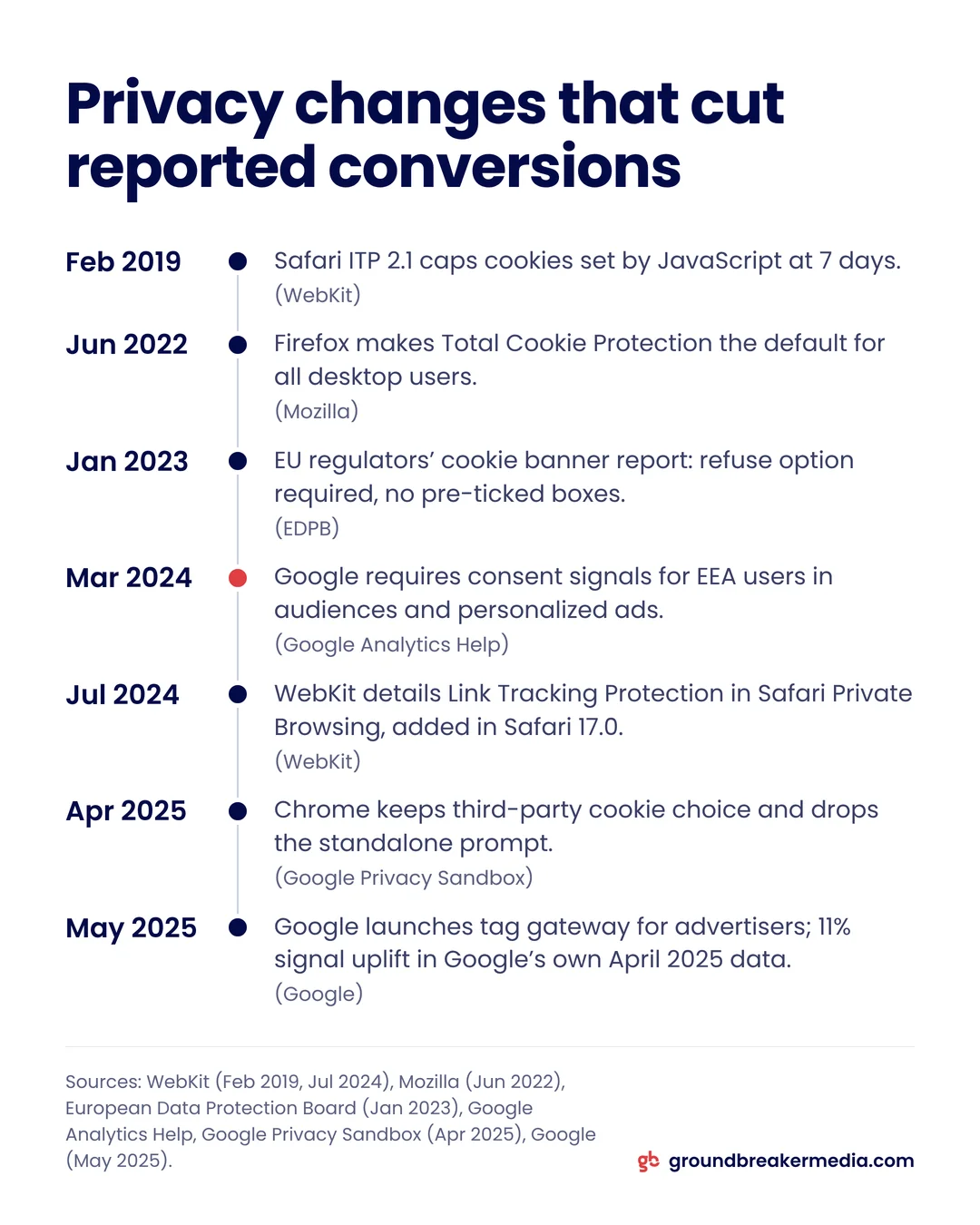
WebKit’s ITP 2.1 announcement from February 2019 says persistent cookies "created through document.cookie, are capped to a seven day expiry." A Safari visitor who clicks an ad, stays away for more than a week and then buys can look like a new visitor. WebKit’s Private Browsing 2.0 post adds that Safari 17.0 brought Link Tracking Protection to Private Browsing, removing query parameters "identified as being used for pervasive cross-site tracking granular to users or clicks."
Mozilla made Total Cookie Protection the default for all Firefox desktop users in June 2022. Chrome went the other way: on April 22, 2025, Google said it would maintain its current approach to third-party cookie choice.
How do consent rules and ad blockers reduce reported conversions?
A visitor who declines consent cannot be measured with cookies, and a blocked tag sends nothing. The sale still happens, but the ad platform never hears about it.
Google’s consent mode overview describes two setups. In basic mode, tags wait for the banner, and if the visitor declines, "no data is transferred to Google at all." In advanced mode, tags load with consent denied and send cookieless pings, which Google uses to model conversions.
For European Economic Area (EEA) traffic, consent signals decide which ad features work. Google Analytics help on consent settings says that from early March 2024, without those signals, only users outside the EEA are included in audiences for linked ad products, and "personalized advertising and remarketing will require affirmative end-user consent signals."
Ad blockers can stop tag scripts from loading. Separately, Google’s tag gateway for advertisers, announced in May 2025, serves Google tags through your own website infrastructure. Google reported an 11% uplift in signals for advertisers who configured it, based on its own April 2025 data. Google does not present it as an ad blocker workaround, and it does not override consent.
What is Google consent mode v2 and do I need it?
Consent mode passes each visitor’s banner choice to Google tags. The version marketers call v2 adds two signals, ad_user_data and ad_personalization, which govern whether EEA traffic can feed ads measurement and personalized ads.
Google’s developer documentation defines four signals:
- ad_storage: cookies and similar storage for advertising.
- analytics_storage: storage for analytics.
- ad_user_data: consent to send user data to Google for advertising.
- ad_personalization: consent for personalized advertising.
The Google Ads help page on consent mode says advanced mode "provides an advertiser-specific model as opposed to a general model," and that modeling uplift can appear after at least 7 full days. If you have EEA visitors, you need it. US and Canadian sites without EEA traffic still gain the cleanest way to pass banner choices to Google tags.
What does privacy loss do to my reports?
Reported conversions drop, more sales appear as direct or unattributed, and bidding systems learn from a smaller sample of buyers.
Platforms under-report because conversions after an expired cookie or declined banner never reach them. Channel reports drift because a returning visitor without a cookie looks like direct traffic. Automated bidding weakens because it only learns from conversions it sees. Modeled conversions fill part of the gap, but they are estimates.
Tracked lead rate = new CRM leads with a stored ad click ID or UTM source ÷ all new CRM leads
Consent rate = visitors who accept advertising cookies ÷ visitors shown the banner
A falling tracked lead rate with steady sales points to a tracking problem, not a marketing one.
Which fixes actually hold up?
The fixes that last send conversion data from systems you control, using information customers gave you directly and with their consent.
First-party data: information a customer gives your business directly, such as the email on a form or a purchase record.
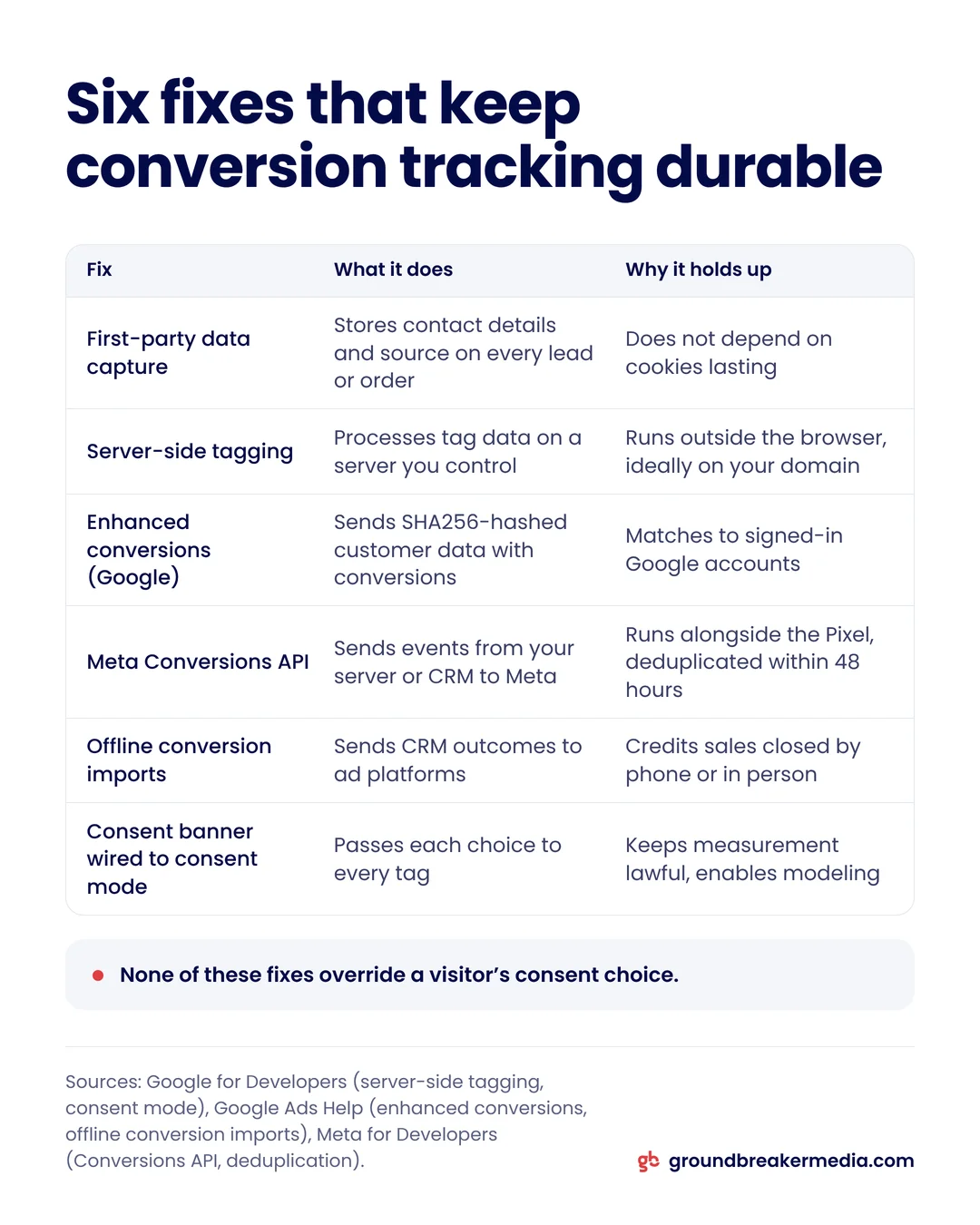
| Fix | What it does | Why it holds up |
|---|---|---|
| First-party data capture | Stores contact details and source on every lead or order | Does not depend on cookies lasting |
| Server-side tagging | Processes tag data on a server you control | Runs outside the browser, ideally on your domain |
| Enhanced conversions (Google) | Sends SHA256-hashed customer data with conversions | Matches to signed-in Google accounts |
| Meta Conversions API | Sends events from your server or CRM to Meta | Runs alongside the Pixel, deduplicated |
| Offline conversion imports | Sends CRM outcomes to ad platforms | Credits sales closed by phone or in person |
| Consent banner wired to consent mode | Passes each choice to every tag | Keeps measurement lawful, enables modeling |
Google describes server-side tagging as "processing data on a server you control, rather than in the user’s browser," and strongly recommends a first-party domain. Enhanced conversions hash data with SHA256 before it leaves your site. Meta recommends the Conversions API alongside the Pixel and deduplicates the two when event ID and name match within 48 hours. Offline conversion imports complete the set, and the CRM revenue guide covers how they close the loop between ad clicks and sales.
GroundBreaker Media wires this setup to each client’s consent banner and retests it after site changes, under Revenue Infrastructure.
How should a consent banner work?
A banner should offer a real choice, record it and pass it to every tag. A banner that makes refusing hard creates legal risk and data you cannot trust.
The European Data Protection Board’s cookie banner taskforce report, adopted January 17, 2023, records positions most EU regulators agreed on: a banner with no refuse option on any layer falls short of valid consent, pre-ticked boxes do not produce valid consent, and "withdrawal of consent must be as easy as to give consent."
Rules differ in the US, Canada and Costa Rica, so the legal design belongs with counsel. The measurement design is simpler: the banner’s choice must reach consent mode, the Meta Pixel and every other tag, and it must be retested after each site change.
Frequently asked questions
Does server-side tagging get around a visitor’s consent choice?
No, and it should not be used that way. Server-side tagging changes where tag data is processed, moving it to a server you control. Consent rules apply to the data whichever route it takes, so a correct setup reads the consent signal first and only forwards what the visitor allowed.
How long does Safari keep tracking cookies?
Since ITP 2.1 in 2019, Safari caps persistent cookies created through JavaScript’s document.cookie at seven days, according to WebKit. A Safari buyer who clicks an ad and purchases more than a week later can lose the connection to the original click, unless first-party data links the two.
Is Chrome still removing third-party cookies?
No. On April 22, 2025, Google said it would keep offering users third-party cookie choice in Chrome and would not roll out a new standalone prompt. Users can still change cookie settings themselves, and Safari and Firefox restrictions still apply, so tracking built on third-party cookies remains fragile.
Do I need both the Meta Pixel and the Conversions API?
Meta recommends both for optimal ad performance. It deduplicates the two when the event ID and event name match and the events arrive within 48 hours, generally keeping the first one received. Without matching IDs, the same purchase can be counted twice, which inflates reported results.
Written by
GroundBreaker Media
A performance marketing agency that connects what you spend to what it brings back. About us
Related insights
All insights


Want one version of the truth? Let's look at your numbers.
A short call, an honest read on what your marketing is producing, and clear next steps.