
What are UGC ads, and how do you test them?
UGC ads are paid ads made from customer-style video by customers or creators; they need written rights, FTC-compliant disclosure, testing and refreshes.
 By GroundBreaker Media8 min read

A phone video of a real person using your product, run as a paid ad, is a UGC ad. UGC means user-generated content, and brands often pay creators to film in that style. UGC ads work when you hold rights in writing, disclose paid relationships under FTC rules, test one change at a time and refresh ads before they fatigue.
What are UGC ads?
UGC ads are paid ads built from user-generated content: video or photos made by customers or creators in a customer’s own style rather than by a studio. The defining trait is the format, a person talking to a phone camera, not who paid for it.
Three kinds exist, and the difference decides the contract and the disclosure:
| Type | Who makes it | Which account runs it | What you need first |
|---|---|---|---|
| Customer content | A customer, unpaid or rewarded | Your brand account | Written permission to use it in ads |
| Paid creator content | A creator hired to film for you | Your brand account | A license that covers paid ads |
| Creator-handle ads | A creator, posted on their own account | The creator’s account, with your budget | Platform authorization from the creator |
Creator-handle ads are what TikTok calls Spark Ads and Meta calls partnership ads. They sit between UGC and influencer marketing: an influencer is paid mainly for reach to their own audience, while a UGC creator is paid mainly for the video.
Why do brands run UGC ads?
Brands run UGC ads because feed platforms reward ads that people act on, and because creative testing needs a steady supply of new videos that studio shoots rarely provide.
- The auction rewards response. On Meta, the auction weighs the estimated action rate and ad quality alongside your bid, which the Facebook ads cost guide explains, so an ad people stop for and act on can win more auctions at the same bid.
- Platforms ask for volume. Google’s Demand Gen campaigns call for vertical, square and horizontal versions of each ad, as the YouTube ads cost guide covers, and one creator session can produce several hooks in several shapes.
- Creator-handle ads look like posts. A Spark Ad runs an organic TikTok post as the ad itself, so it appears with the creator’s name and the post’s own engagement.
Treat published performance claims with care. TikTok’s Creative Center, now presented as the TikTok One Creative Suite, shows case studies with large cost reductions, but the page dates none of them and describes no control groups. Read them as examples of what is possible, not as forecasts. We do not plan on published UGC uplift figures; the test in your own account is the evidence that counts.
How do Spark Ads and partnership ads work?
Spark Ads and partnership ads let a brand pay to run a creator’s post as an ad, from the creator’s account, once the creator has authorized it.
TikTok’s About Spark Ads page (updated June 2026) describes the format as a native ad that runs organic TikTok posts, the advertiser’s own or other creators’ posts "with their authorization." The Spark Ads creation guide (updated June 2026) sets out the steps:
- The creator opens the video in the TikTok app, taps the three dots, then Ad settings, and taps "Generate" to get a post code.
- In TikTok Ads Manager, the advertiser clicks "Add post" and enters the code. Up to 20 video codes can be authorized at once.
- Each authorized post shows its authorization period. TikTok’s About Spark Ads page says you can "customize the duration of your authorization code to meet campaign needs and minimize costs."
Two details belong in the creator contract. First, "all of the Spark Ads post engagement will be attributed to the original organic post," so likes, comments, shares and follows accrue to the creator’s account. Second, "videos need to be un-authorized as a Spark Ad before it can be deleted from the organic account," which means the code length and the post’s lifespan should match the campaign dates you agree.
Meta handles the same idea through recorded permissions. Meta for Developers’ branded content ad permissions reference links a brand’s Instagram account to a creator’s Instagram account with a permission status and a count of pending requests, so the creator’s approval is a tracked step in the account, not a handshake.
What do the FTC rules require for UGC ads?
In the US, the Federal Trade Commission (FTC) expects endorsements to reflect the endorser’s real experience, expects any material connection to the brand to be disclosed where people will see it, and holds the brand responsible for what creators say on its behalf.
The rules come from the FTC’s Guides Concerning the Use of Endorsements and Testimonials in Advertising, 16 CFR Part 255, revised in a notice dated July 26, 2023. The FTC’s plain-language guides spell out what that means for creator content:
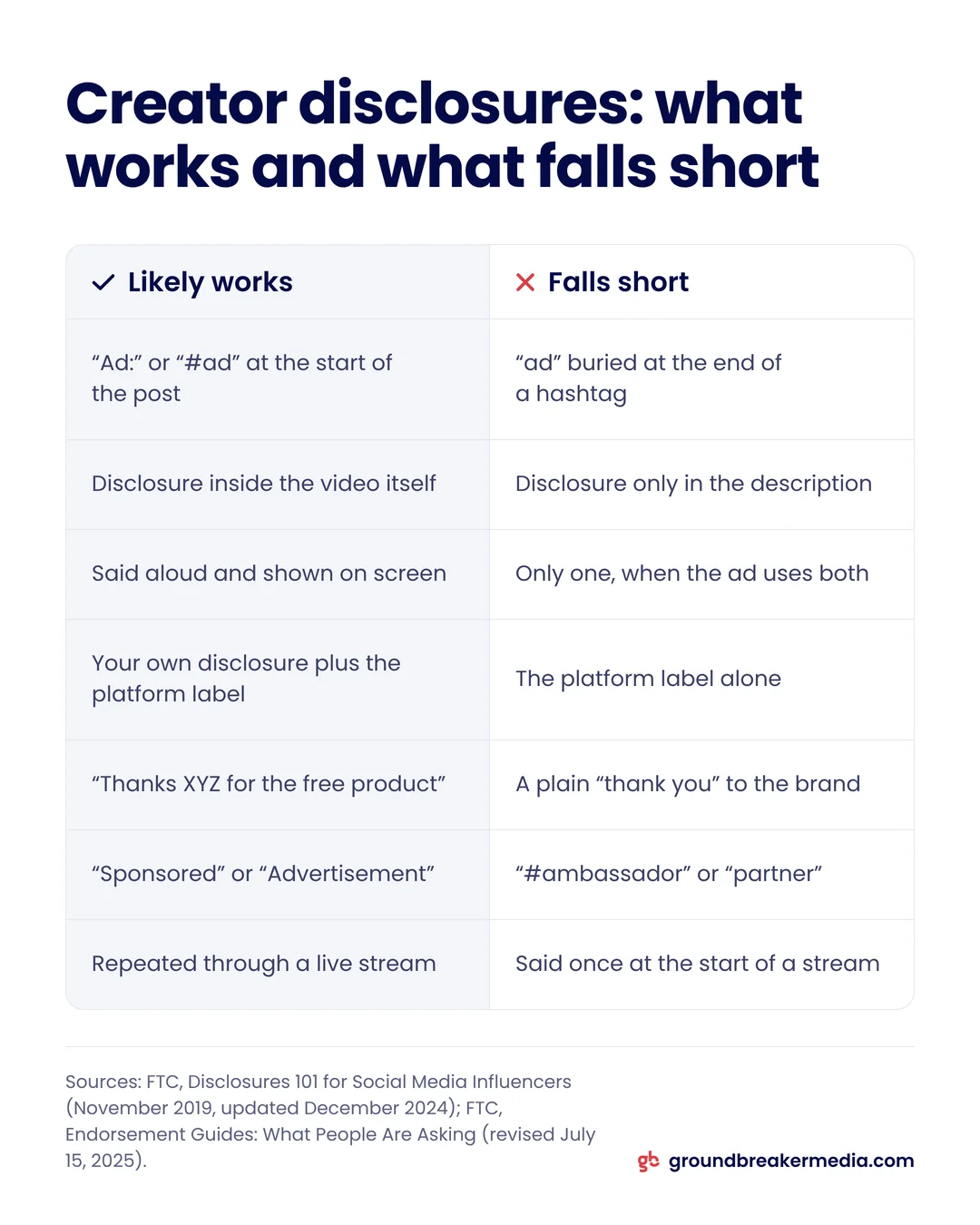
- What to disclose. The FTC’s Disclosures 101 for Social Media Influencers says to disclose "any financial, employment, personal, or family relationship with a brand," and free or discounted products count.
- Where to put it. "Place it so it’s hard to miss." In a video, the disclosure "should be in the video and not just in the description," and in a live stream it "should be repeated periodically."
- How to word it. The FTC’s Endorsement Guides FAQ (revised July 15, 2025) says starting a post with "Ad:", "#ad" or "Advertisement" would likely be effective, while "#ambassador" or "partner" is "ambiguous and confusing."
- Platform labels are not enough on their own. "Don’t assume that a platform’s disclosure tool is good enough." The FAQ adds that "it’s always best to add your own disclosure even if a platform offers its own disclosure tool."
- Honesty. "You can’t talk about your experience with a product you haven’t tried," and "if you’re paid to talk about a product and thought it was terrible, you can’t say it’s terrific."
- Results claims. The FAQ warns that "endorsements claiming specific results usually will be interpreted to mean that the endorser’s experience" reflects what others can expect, and a line such as "individual results may vary" does not fix that.
A second rule covers fakes. The FTC’s Consumer Reviews and Testimonials Rule Q&A (November 8, 2024) says the rule "went into effect on October 21, 2024," covers testimonials in internet ads and on social media, addresses misrepresenting a testimonialist’s "experience" with a product, and "authorizes courts to impose civil penalties for knowing violations."
When a paid creator appears in your own ad as if they were an ordinary customer, ask counsel whether the paid relationship needs disclosing beyond the platform’s ad label. Canadian campaigns fall under Canadian law and industry codes, so have those checked separately.
How do you test UGC creative?
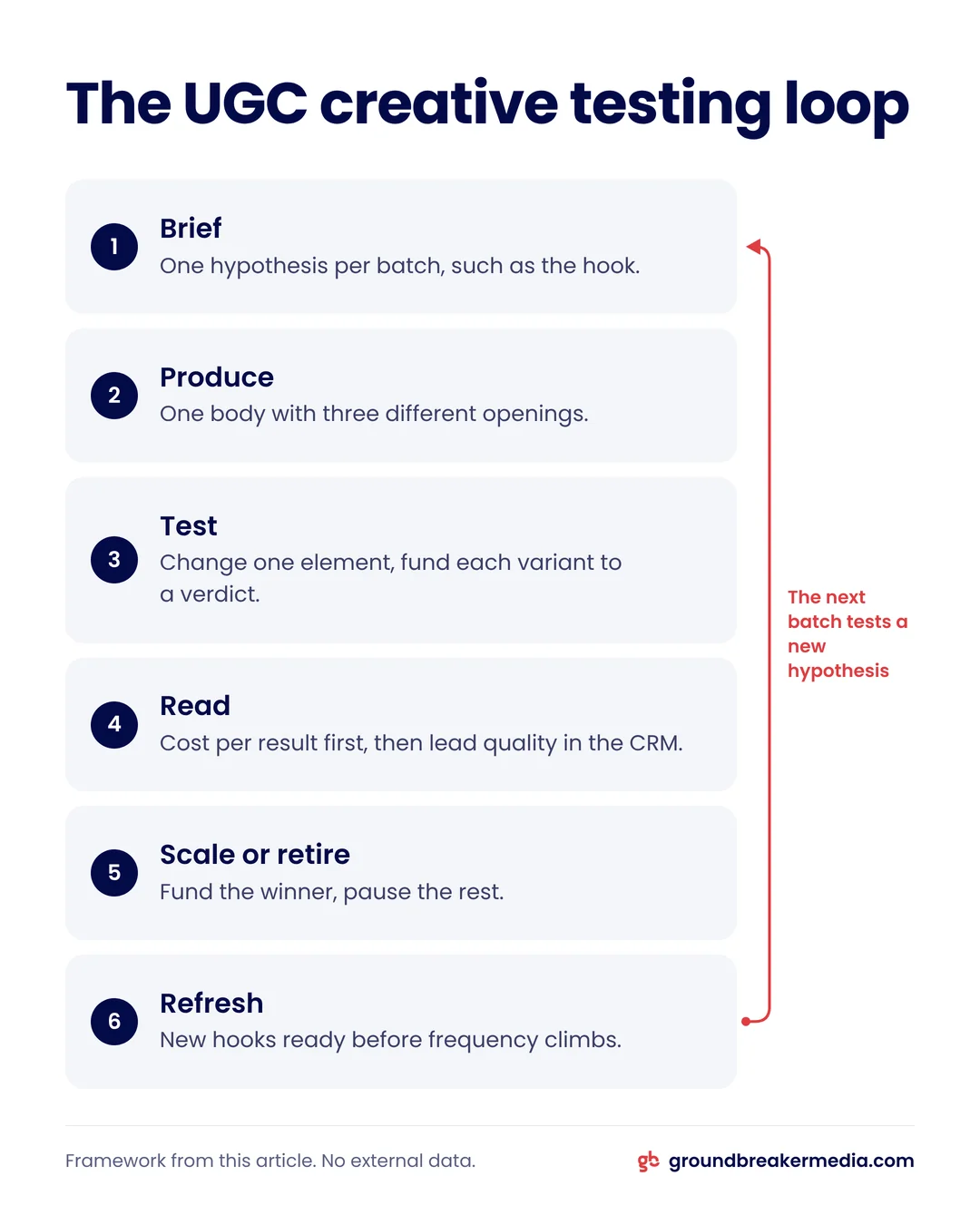
Creative testing is running ads that differ in one element against each other, with enough budget behind each to reach a verdict, so you learn which element moves results.
- Brief one hypothesis per batch. Decide what the batch tests: the hook, the offer, the proof or the format.
- Order variations, not one-offs. Ask the creator for one body with three different openings, since the first seconds decide whether people keep watching.
- Change one element per test. If the hook and the offer both change, a winner teaches you nothing you can reuse.
- Fund each variant to a verdict. Use the formula below before launch, not after.
- Judge on cost per result, then on quality. A cheap lead that never closes is not a winner, so check the CRM before you scale.
- Feed the result into the next brief. Keep a running log of winning hooks, creators and formats.
Test budget per variant = target cost per result × results needed to judge
Example (hypothetical numbers): your target cost per lead is $40, set with the cost per lead guide, and you decide 25 leads per variant is enough to call a test. Each variant needs $40 × 25 = $1,000, so three hooks need $3,000. If that is out of reach, test on an earlier, cheaper signal such as landing page views, then confirm the winner on leads.
Watch the platform’s own data needs while testing. A Meta ad set needs about 50 optimization events a week to leave learning, as the Facebook ads cost guide explains, so splitting a small budget across many variants keeps each one short of data. The click also has to land somewhere that keeps the ad’s promise, which the landing page conversion guide covers.
What is creative fatigue, and how do you spot it?
Creative fatigue is the decline in an ad’s results that sets in when the same people have seen it too many times: frequency rises, click-through rate falls and cost per result climbs.
Frequency = impressions ÷ reach
Read the three signals together and compare each ad with its own first weeks, not with a benchmark. Frequency rising on its own may simply mean a small audience. Cost per result rising while frequency stays flat points to the auction or the season, not the ad. When all three move together, the audience has seen enough of that video.
A refresh does not need a new concept. In order of effort:
- Swap the hook. Replace the first seconds and keep the proven middle and end.
- Change the creator. A different face resets attention for the same script.
- Recut the shape. Turn a vertical original into square and horizontal versions for other placements.
- Rework the offer or proof. Change the reason to act once new hooks stop working.
TikTok’s creative suite includes a Top Ads library for studying what is running and Symphony Creative Studio for generating ad variations, which help with volume but not with judgment. We plan new creative every month for active accounts, so fresh ads are ready before the current ones fatigue rather than after. GroundBreaker Media briefs, produces and tests creator-style ads as part of its Demand and Creative Strategy services, and the TikTok ads cost guide covers what those ads cost to run there.
Frequently asked questions
Who is liable if a creator makes a false claim in my ad?
The brand is. The FTC’s Endorsement Guides FAQ, revised July 15, 2025, says "your company is ultimately responsible for what others do on your behalf," and that advertisers need "reasonable programs in place to train and monitor members of their network." Give every creator a written list of approved claims and review each video before it runs.
Do I have to disclose that I paid a customer to use their review in an ad?
Yes, if the customer expected a benefit. The FTC’s Endorsement Guides FAQ says that when customers were given a reason to expect a benefit, "you should disclose that fact in your ads," and that no disclosure is needed when they had no such expectation. The FTC also says you cannot make a reward depend on the review being positive.
Can I use AI avatars in UGC-style ads?
The FTC has not banned them, but they carry risk. Its Q&A on the reviews and testimonials rule says there is "no blanket prohibition on the use of AI-generated avatars in marketing," yet an avatar can still deliver a testimonial. An avatar describing an experience no real person had misrepresents that experience, so we keep avatars out of customer-style claims.
Can I edit a creator’s video into new ads?
Only if the contract allows it and the edit keeps the meaning. Write paid usage, edits, platforms and duration into the license before filming. The FTC’s guidance says endorsements "must reflect the truthful experiences and opinions of the endorsers," so cutting a creator’s words into a claim they never made is off limits even with permission.
Written by
GroundBreaker Media
A performance marketing agency that connects what you spend to what it brings back. About us
Related insights
All insights


Want one version of the truth? Let's look at your numbers.
A short call, an honest read on what your marketing is producing, and clear next steps.