
How much do TikTok ads cost, and are they worth it?
TikTok ads cost what the auction sets, above a $50 campaign and $20 ad group daily minimum. Across 5,900+ brands, CPM was $4.08 in 2025 to 2026.
 By GroundBreaker Media7 min read

TikTok ads cost what the auction sets, above two floors: a campaign needs a daily budget over $50 and each ad group over $20 (TikTok Ads Manager help, 2026). Across more than 5,900 brands, cost per thousand impressions came to $4.08 from August 2025 to July 2026 (Triple Whale). Creative and your cost per customer decide whether that pays.
What is the minimum budget for TikTok ads?
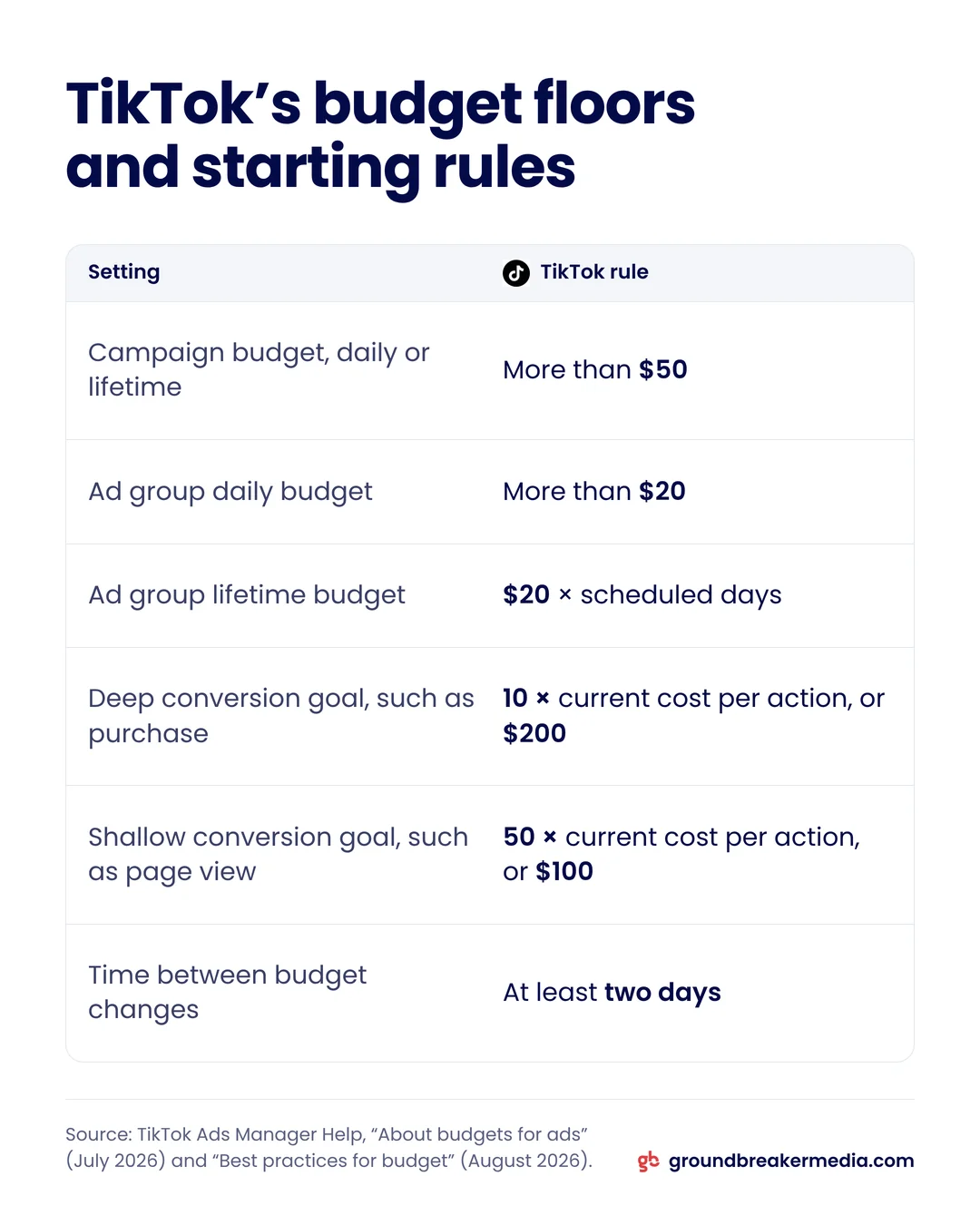
TikTok Ads Manager requires a campaign budget above $50, daily or lifetime, and an ad group daily budget above $20, according to its budget help page, last updated July 2026.
| Budget setting | TikTok minimum |
|---|---|
| Campaign daily budget | More than $50 |
| Campaign lifetime budget | More than $50 |
| Ad group daily budget | More than $20 |
| Ad group lifetime budget | $20 × scheduled days |
An ad group on a lifetime budget needs $20 for every scheduled day, so a 31-day ad group needs $620. The campaign budget should not sit below the ad group budget, because TikTok says that "can cause delivery issues." You also cannot switch between daily and lifetime budgets once a campaign or ad group is live.
The floor is not a workable budget. TikTok’s learning phase is the period when its delivery system works out which people to show a new campaign to, and its learning phase article says volatility "starts to decline after about 25 campaign results or 7 days." Pausing, edits that restart learning and what TikTok calls "unreasonable budget setting" can keep a campaign from leaving that phase.
How does TikTok decide what you pay?
TikTok sells most ads through an auction, where your bid, your budget and the billing event you choose decide what you are charged for.
Cost per thousand impressions (CPM) is the price an advertiser pays each time an ad is shown 1,000 times. TikTok’s bidding methods page lists four ways to be billed:
- CPM: you pay per 1,000 impressions.
- Cost per click (CPC): you pay per click.
- Optimized CPM (oCPM): you still pay per 1,000 impressions, but delivery aims at people likely to convert, become a lead or install an app. It is the default for the conversions and app install objectives.
- Cost per view (CPV): you pay when someone watches at least 6 seconds, or interacts with the ad within its first 6 seconds.
On top of the billing event sits a bidding strategy. TikTok’s bidding strategies page, updated September 2026, offers two. Target cost per result "keeps your average cost per result at or below the amount you specify, regardless of budget," though TikTok notes the actual cost can land slightly above or below the target. Maximum Results spends the budget to get the most results and "does not optimize towards an advertiser’s target CPA."
We start new accounts on Maximum Results, then move to a target cost once real data shows what a result costs and what the business can afford to pay.
Reserved placements work differently. TopView, the video shown first when someone opens TikTok, is bought on a CPM basis and booked through TikTok sales representatives, or directly in Ads Manager for select customers (TikTok, August 2026).
What do TikTok ads cost per impression and per click?
In Triple Whale’s TikTok benchmarks, CPM was $4.08 and click-through rate 0.61% from August 1, 2025 to July 31, 2026, down from $5.71 and 0.70% the year before.
The Triple Whale report draws on more than 5,900 brands that use its ecommerce analytics. It does not state a region, and it reports cost per acquisition (CPA) of $17.07 against $24.86 a year earlier without defining the conversion behind it. Treat the figures as a rough range for online stores: the page itself gives the CPM drop as both 24.48% and 28.48%, and its own numbers imply about 28.5%.
| Industry (Triple Whale, Aug 2025 to Jul 2026) | Median CPM | Median click-through rate | Median CPA |
|---|---|---|---|
| Electronics | $4.40 | 0.64% | $28.90 |
| Apparel and accessories | $4.16 | 0.74% | $20.64 |
| Home and garden | $4.61 | 0.59% | $19.33 |
| Sports and outdoors | $3.46 | 0.54% | $14.67 |
| Food and beverage | $4.54 | 0.45% | $12.44 |
| Health and wellness | $3.67 | 0.51% | $11.17 |
| Beauty | $3.92 | 0.51% | $10.32 |
Click-through rate is the share of impressions that end in a click. Because TikTok often bills by impression, convert CPM into a click cost before you compare it with other channels:
Implied cost per click = CPM ÷ (1,000 × click-through rate)
Using Triple Whale’s overall figures, $4.08 ÷ (1,000 × 0.61%) = $4.08 ÷ 6.1, or about $0.67 per click. That is our arithmetic on their numbers, not a figure the report publishes. Set it against the maximum cost per click your own funnel allows, worked out as in the Google Ads budget guide. Your landing page’s conversion rate decides how much each click is worth, so test the page on a phone before launch (landing page conversion rates).
How much budget does a TikTok test need?
TikTok’s budget best practices, updated August 2026, tie the minimum ad group budget to your current cost per action: 10 times it for deep conversions such as purchases, and 50 times it for shallow events such as page views.
Without a cost history, the same page suggests $200 for deep conversion campaigns and $100 for shallow ones. It also recommends a daily rather than a lifetime budget for the ad group, no targeting, bid or budget changes before a conversion campaign passes the learning phase, and at least two days between changes.
Example (hypothetical numbers): an online store expects a $30 cost per purchase. TikTok’s guidance puts each ad group’s budget at $300 or more (10 × $30), set as a daily budget. Three ad groups testing three audiences would need at least $900, many times the $50 campaign floor. With $300 to spend, the better test is one ad group with several creatives inside it.
Those rules describe what TikTok needs to learn. What you can afford comes from your own margin and close rate, through the maximum cost per lead method. When TikTok’s minimum for your goal is higher than the spend your numbers support, optimize toward an earlier, cheaper event, or wait until the budget can carry the test.
Which TikTok ad formats should you start with?
Most advertisers start with in-feed video, either a new ad or a Spark Ad, which runs an existing organic post as an ad.
- Spark Ads: built from your own posts or from a creator’s posts with their authorization. Taps on the profile open the poster’s profile, and the views, comments, likes, shares and follows the ad earns count toward the original post (TikTok, June 2026).
- Standard in-feed ads: taps on the profile photo or nickname, and swipes left, go to your landing page instead.
- Instant Form lead ads: a lead generation objective with an in-app form and real-time CRM sync (TikTok, October 2025).
- Smart+ campaigns: one AI-run campaign for sales, app promotion, leads or traffic that automates targeting, optimization and creative, shifting budget toward the best-performing creative (TikTok, June 2025).
- Promote: the in-app tool for boosting your own videos and LIVEs (TikTok, July 2026).
These formats are built around short video, so the real constraint is often producing enough of it. The UGC ads guide covers creative testing and how fast ads wear out. GroundBreaker Media plans TikTok creative and media together within its demand and creative strategy work.
Are TikTok ads worth it for a small business?
TikTok ads are worth testing when your buyers use the app, you can produce short video steadily, and you can trace sales back to the ad. Without those three, a low CPM buys attention you cannot use.
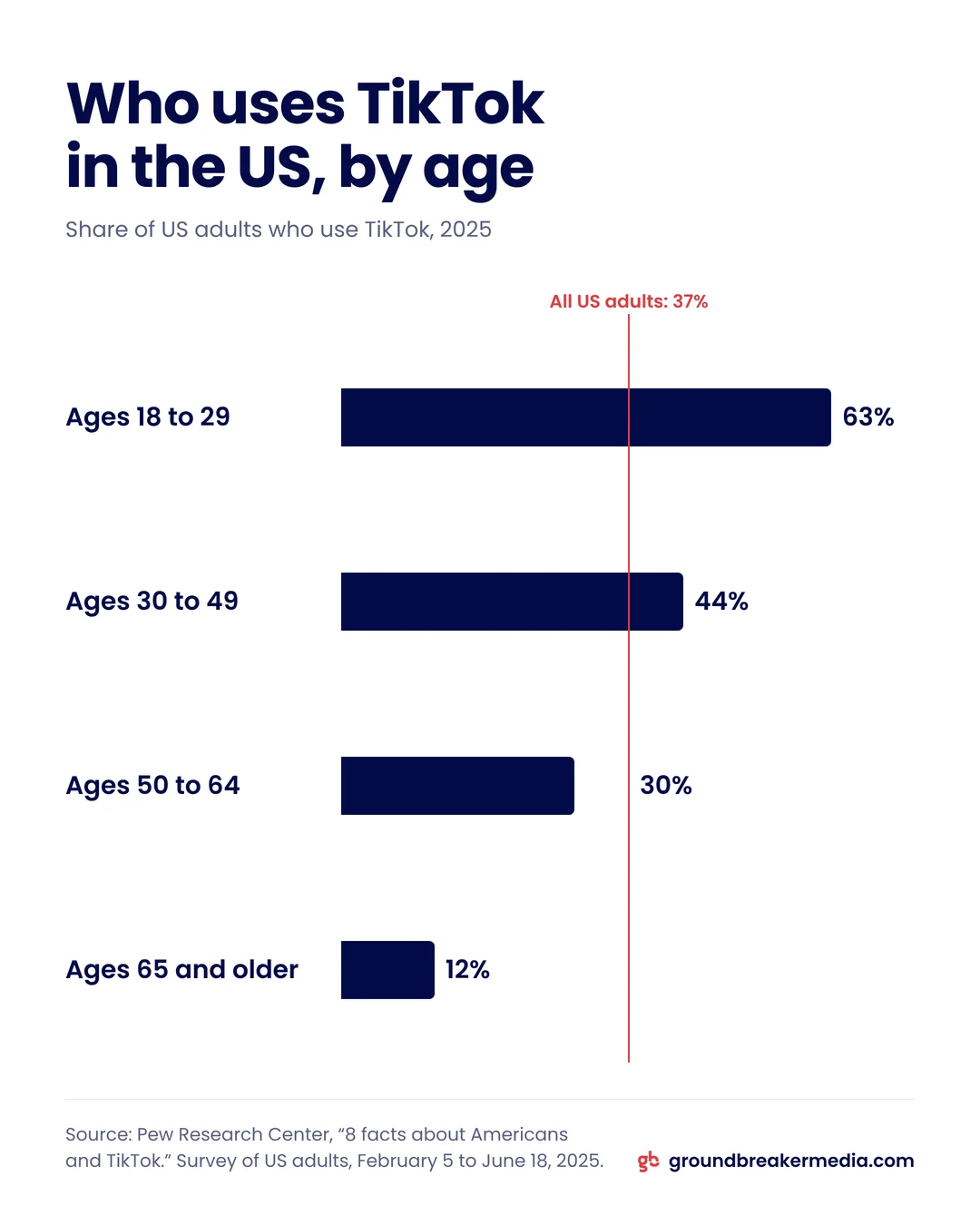
Reach skews young. In Pew Research Center’s 2026 data, 37% of US adults said they use TikTok, from a survey of 5,511 adults between January 30 and June 18, 2026. Pew’s 2025 breakdown shows 63% of adults under 30 using it, 44% of those 30 to 49, 30% of those 50 to 64 and 12% of those 65 and older.
Targeting is consumer-style. TikTok’s ad targeting page groups options into demographics, audience targeting, interest and behavior targeting, device and smart targeting. None of those categories is job title or employer, which limits TikTok for B2B sales aimed at specific roles.
The US ownership question has settled. In January 2026, TikTok USDS Joint Venture LLC, 80.1% owned by US and global investors with ByteDance holding 19.9%, took over US data protection, content moderation and algorithm security, and TikTok avoided a US ban (MacRumors, January 23, 2026).
Judge the test on cost per customer, not views. That requires conversion data that survives browser limits, covered in the conversion tracking guide. For a channel comparison on cost, the Meta ads cost guide gives Facebook and Instagram figures.
Frequently asked questions
What is the difference between TikTok Promote and TikTok Ads Manager?
Promote is TikTok’s in-app tool for boosting your own videos and LIVEs, with goals for account growth, leads, sales and LIVE views, plus ready-made packs with a preset budget, duration and audience. Ads Manager is the full platform, with campaign and ad group budgets, bidding strategies, Spark Ads, Instant Forms and reporting. Promote suits one post, Ads Manager a campaign.
How long does the TikTok learning phase last?
TikTok gives no fixed length. Its help center says volatility starts to decline after about 25 campaign results or 7 days from when a campaign enters the learning phase. Pausing campaigns, making edits that restart learning or setting unreasonable budgets can stop a campaign from leaving it, so hold settings steady through that first stretch before judging results.
What are TikTok Spark Ads?
Spark Ads are TikTok ads built from organic posts, either your own or a creator’s with their authorization. Taps on the profile photo or name open the poster’s profile, and the views, comments, likes, shares and follows the ad earns count toward the original post. Standard in-feed ads send those same taps to your landing page instead.
How often can you change a TikTok ad budget?
Wait at least two days between changes. TikTok’s budget guidance says to avoid adjustments more often than every two days, to leave targeting, bids and budgets alone until a conversion campaign passes the learning phase, and to raise budgets in steps rather than all at once. The budget type, daily or lifetime, cannot be changed after launch.
Written by
GroundBreaker Media
A performance marketing agency that connects what you spend to what it brings back. About us
Related insights
All insights


Want one version of the truth? Let's look at your numbers.
A short call, an honest read on what your marketing is producing, and clear next steps.