
What is nearshore marketing? A guide for US and Canadian agencies
Nearshore marketing is work by a team in a nearby country that shares your business hours, which for US and Canadian agencies usually means Latin America.
 By GroundBreaker Media6 min read

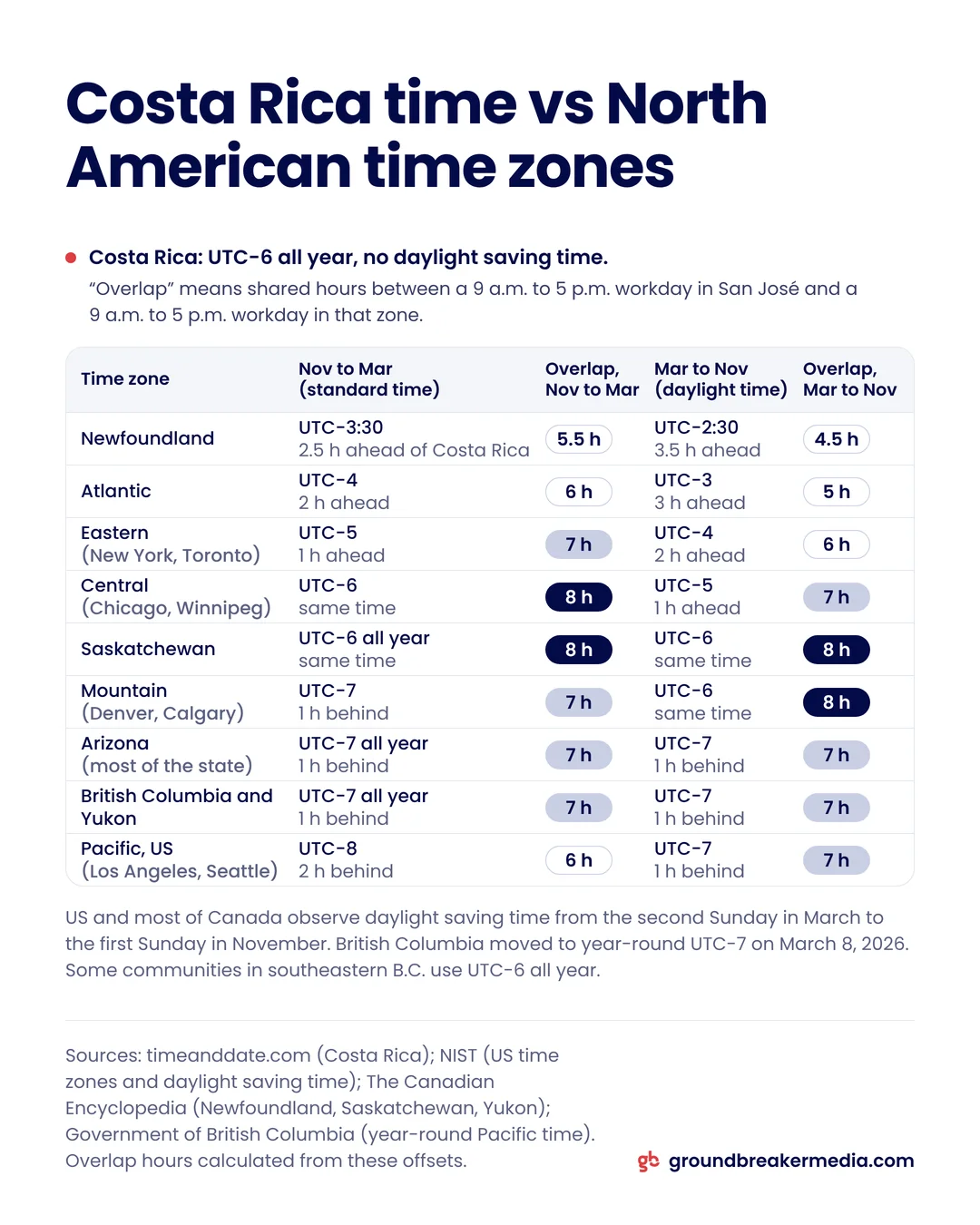
Two hours is the widest gap between San José, Costa Rica, and any contiguous US time zone, because Costa Rica keeps UTC-6 all year. That overlap defines nearshore marketing: a team in a nearby country works your hours, usually in Latin America for agencies in the US or Canada, at labor costs usually below domestic ones.
What is nearshore marketing?
Nearshore marketing is marketing work, such as paid media, SEO, content, analytics or creative, delivered by a team in a nearby country whose working hours overlap with the client’s.
The term comes from nearshoring. In The Geography of Transport Systems, Jean-Paul Rodrigue describes nearshoring as moving activities to a neighboring country that usually has lower costs, such as labor, and notes that shared cultural norms and similar time zones make communication easier. Moving work to another continent brings distant time zones that complicate coordination. For agencies, nearshore usually means a dedicated or white-label team working inside the agency’s own tools and processes.
How is nearshore different from onshore and offshore?
The difference is distance, which shapes time zone overlap, communication and cost.
| Onshore | Nearshore | Offshore | |
|---|---|---|---|
| Team location | Your country | A nearby country | A distant country, often another continent |
| Working hours overlap | Full | Most or all of the day | Limited, varies by country |
| Real-time collaboration | Easy | Easy during business hours | Relies on handoffs |
| Labor costs | Domestic rates | Usually lower than domestic | Usually lower than domestic |
| Fits best | Client-facing and regulated work | Daily collaboration on ongoing accounts | Well-specified work that can run overnight |
Why does time zone overlap matter for agencies?
Overlap decides whether a partner can fix a broken campaign, join a client call or turn around a request the same day.
Costa Rica uses Central Standard Time, UTC-6, and has no daylight saving time clock changes. In the US, NIST lists Eastern time at UTC-5 in standard time and UTC-4 in daylight time, Central at UTC-6 and UTC-5, Mountain at UTC-7 and UTC-6, and Pacific at UTC-8 and UTC-7. Daylight saving time runs from the second Sunday in March to the first Sunday in November. So from November to March, Costa Rica matches US Central time and is one hour behind Eastern. From March to November, it matches Mountain Daylight Time and is two hours behind Eastern.
In Canada, Saskatchewan follows Central Standard Time all year, according to The Canadian Encyclopedia, so it always matches Costa Rica. British Columbia moved to year-round Pacific time at UTC-7 on March 8, 2026, according to the Government of British Columbia, which leaves it one hour behind Costa Rica all year.
GroundBreaker Media runs its nearshore marketing team on that San José clock, serving agencies in both countries.
How does nearshore affect communication and cost?
Communication works much like a remote domestic team, and costs differ mainly because local labor costs differ.
With shared hours, you can hold live calls, give same-day feedback and bring the partner into client work without overnight delays. Rodrigue also points to shared cultural norms, but English level still varies by person.
Lower labor costs are a usual reason to nearshore. The size of any saving depends on roles, seniority, scope and the pricing model, so compare itemized proposals. Count your own management time, tools and review work in the total. A team that needs heavy correction is not cheaper.
Why Latin America, and why Costa Rica?
For US and Canadian agencies, Latin America is the neighboring region, and Costa Rica pairs a fixed UTC-6 clock with an established services export sector.
Costa Rica’s investment promotion agency, CINDE, cites Central Bank data showing $7.3 billion in knowledge-intensive services exports in 2021. Citing the Central Bank and Trademap, it also reports that services make up 43% of total exports, against an OECD average of 27% in 2021. The 2025 annual report of the COMEX-PROCOMER agreement, from the Ministry of Foreign Trade and the export promotion agency PROCOMER, puts services exports, excluding travel, at US$8,785 million through the third quarter of 2025, a provisional figure. Costa Rica also joined the OECD in May 2021 as its 38th member.
What does Costa Rica’s talent and English data show?
Costa Rica scores above the global average for English, with the strongest results in Heredia and San José, but proficiency varies by region and by person.
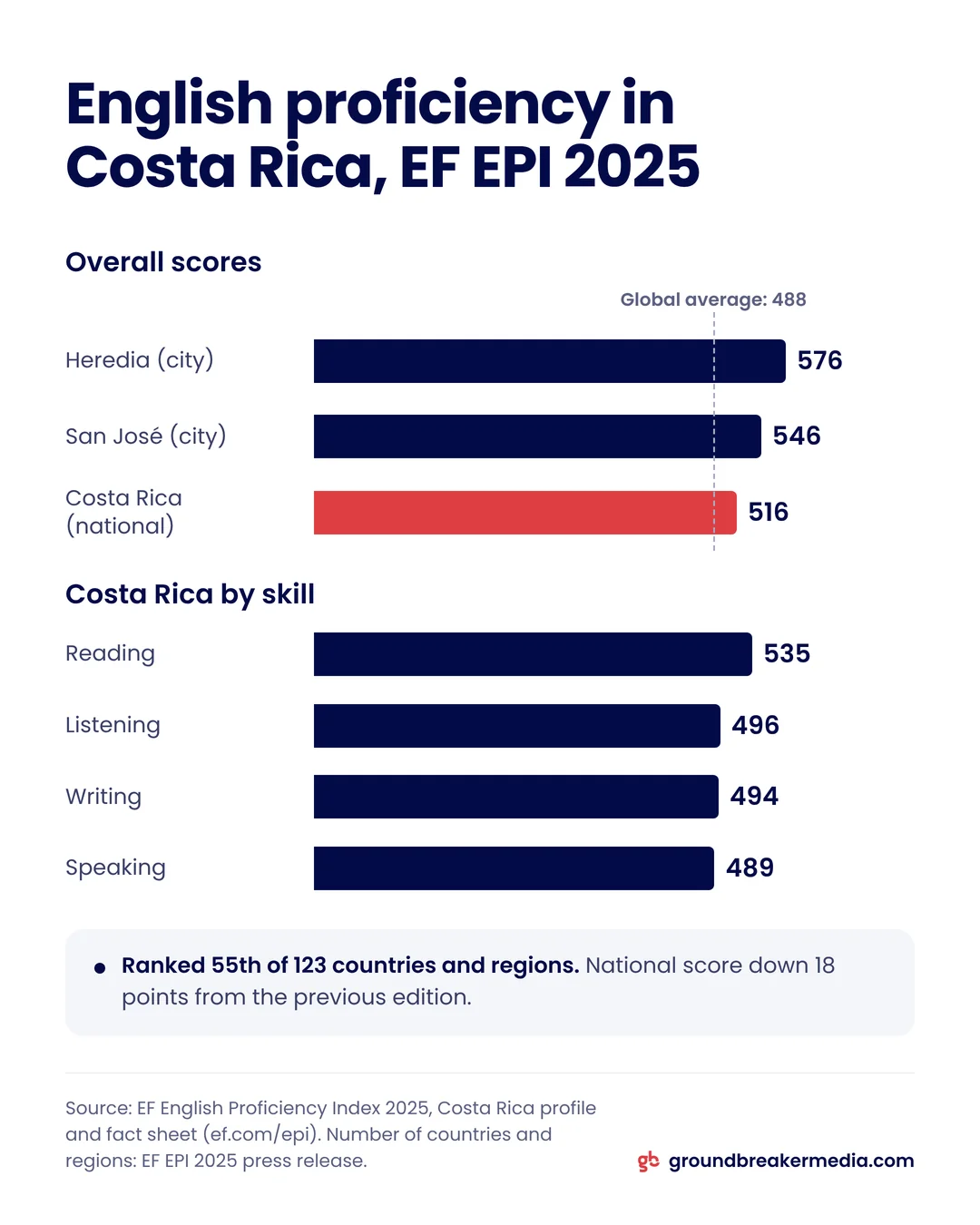
In the EF English Proficiency Index, Costa Rica scored 516 in 2025, above the global average of 488, and ranked 55th of the 123 countries and regions measured. The score fell 18 points from the previous edition. City scores reach 576 in Heredia and 546 in San José. By skill, reading is strongest at 535 and speaking weakest at 489.
The Government of Canada’s Trade Commissioner Service counts 60 universities and about 220,000 university students in Costa Rica, and notes that only 12% of the population is bilingual. In 2018 the government launched a national strategy to expand English teaching. National averages describe a country, not a team, so test the English of the people who will work on your accounts.
How should an agency evaluate a nearshore partner?
Evaluate a nearshore partner as you would a domestic one, then check what changes across borders: hours, language, contracts and payments.
- Hours: confirm the hours the team works in your time zone and its response times.
- English: interview the people who will do the work on a live call, not only the sales lead.
- Process: see how the team onboards a new client, reviews its own work and reports results.
- Ownership: accounts stay in your name or your client’s, with the partner on removable access.
- Contracts: NDA, non-solicitation, ownership of work product, governing law, currency and invoicing.
- Measurement: ask how the team connects ad spend to revenue for your clients.
- References: speak with agencies it works with now.
Contracts, access and red flags for this kind of arrangement are covered in the white-label partner guide.
Frequently asked questions
What time zone is Costa Rica in?
Costa Rica uses Central Standard Time, UTC-6, all year and does not change its clocks for daylight saving time. From November to March it matches US Central time and is one hour behind Eastern. From March to November, while most of the US and Canada observe daylight saving time, it matches Mountain Daylight Time and is two hours behind Eastern.
Is English widely spoken in Costa Rica?
Costa Rica scored 516 in the 2025 EF English Proficiency Index, above the global average of 488, and ranked 55th of 123 countries and regions. Scores are highest in Heredia and San José. Canada’s Trade Commissioner Service notes that only 12% of the population is bilingual, so test the English of the people who will work with you.
How big is Costa Rica’s services export sector?
CINDE reports $7.3 billion in knowledge-intensive services exports in 2021, from Central Bank data, and says services make up 43% of total exports, against an OECD average of 27% in 2021. COMEX and PROCOMER put services exports, excluding travel, at US$8,785 million through the third quarter of 2025, a provisional figure.
Is nearshore marketing cheaper than hiring in the US or Canada?
Often, because labor costs in nearby countries are usually lower, which is a main reason companies nearshore. The size of any saving depends on roles, seniority, scope and pricing model, so ask for itemized proposals and compare them line by line, including your own management time, tools and quality review in the total.
Written by
GroundBreaker Media
A performance marketing agency that connects what you spend to what it brings back. About us
Related insights
All insights


Want one version of the truth? Let's look at your numbers.
A short call, an honest read on what your marketing is producing, and clear next steps.