
White-label partners: what agencies should expect
A good white-label partner signs an NDA, runs onboarding and QA, reports in your template and works only through account access you grant and can remove.
 By GroundBreaker Media6 min read

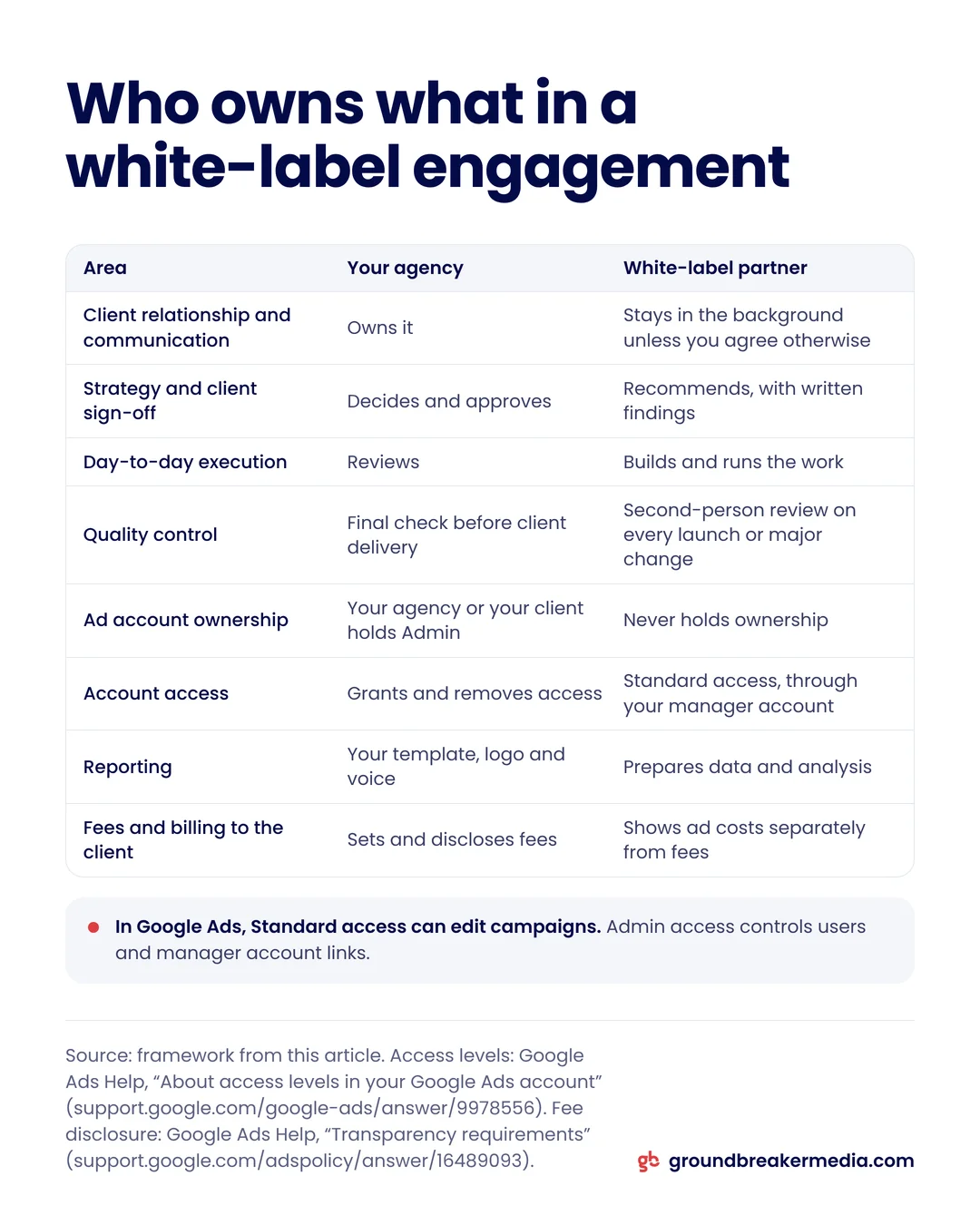
Agencies bring in a white-label partner when clients want more than the in-house team can deliver. Expect strict confidentiality, structured onboarding, quality control before anything reaches your client, and reports in your template. The client relationship and account ownership stay with you or your client, and the partner works only through access you grant and can remove.
What is a white-label marketing partner?
A white-label marketing partner is an outside team that plans and executes work your agency sells and delivers as its own. Your clients see your agency. The partner stays in the background.
White-label marketing: marketing services produced by one company and delivered to clients under another company’s brand, with the producer not visible to the end client.
Agencies use partners to add capacity without hiring, to cover a skill they lack in-house, or to absorb growth. GroundBreaker Media is one such partner, a nearshore white-label team in San José, Costa Rica, that works for US and Canadian agencies.
How do confidentiality and client-facing communication work?
Expect the partner to sign a non-disclosure agreement and a non-solicitation clause before it sees any client information, and to stay invisible to your clients unless you decide otherwise.
An NDA creates a confidential relationship between the parties and protects non-public business information. In a white-label setup it should cover client names, data, pricing and your processes. A non-solicitation clause stops the partner from approaching your clients directly.
Agree on communication rules early: whether partner staff ever join client calls, and under what name and email domain, who answers client questions, and how fast the partner responds to you. Time zones decide that last point, and the nearshore marketing guide shows how a Costa Rica team’s fixed clock lines up with North American working hours.
What should onboarding and quality control look like?
A good partner runs a defined onboarding for every client and a review process that catches errors before your client does.
Onboarding should collect account access, brand guidelines, the client’s goals and targets, past performance, the current tracking setup, approval rules and your reporting calendar. Expect an audit of each account before any changes, with findings written up for your approval.
Quality control should include a second-person review for every launch or major change, checklists for tracking, budgets, targeting and copy, and a change log you can see. Ask how the partner handles mistakes: who is told, how fast, and what changes afterward.
How should reporting work under your brand?
Reports should arrive in your template, with your logo and voice, and with numbers you can defend in front of your client.
The partner prepares the data and the analysis. Your agency decides what the client sees. If you manage Google Ads for clients, Google’s transparency requirements apply to you as the third party. Where a monthly report is required, it must include costs, clicks and impressions at the account level and report Google’s exact charges without your fees, and management fees must be disclosed to customers in writing before the first purchase and on invoices. Your partner should build reports that keep you compliant, not reports that blur ad spend and fees.
Who owns the ad accounts and client data?
Your client or your agency should own every account. The partner should hold only the access you granted and can remove.
A common structure links client accounts to your agency’s manager account and gives partner staff Standard access there, which lets them edit campaigns while Admin stays with you, as the agency hiring checklist explains level by level. Apply the same rule to analytics, tag managers, social ad accounts and CRMs. When an engagement ends, you remove access and nothing has to be transferred.
How do white-label partners price their work?
Most partners use one of four models: a fixed monthly fee per client account, a dedicated team or block of hours, a per-project fee, or a percentage of ad spend.
| Pricing model | How it works | Fits best when | Watch for |
|---|---|---|---|
| Fixed fee per account | Set monthly fee for a defined scope | Scope is stable and repeatable | Unclear scope limits |
| Dedicated team or hours | You reserve people or hours each month | You need ongoing capacity | Paying for unused hours |
| Per project | Quoted fee for one deliverable | Builds, audits, tracking setups | Change requests billed extra |
| Percentage of ad spend | Fee rises and falls with client ad budgets | Paid media with steady budgets | Incentive to raise spend, not results |
Ask what each fee includes, how changes are priced, how much notice you need to add or remove accounts, and whether rates change with volume. Judge partners on what the work you resell actually costs you, not on the rate card.
What are the red flags when choosing a white-label partner?
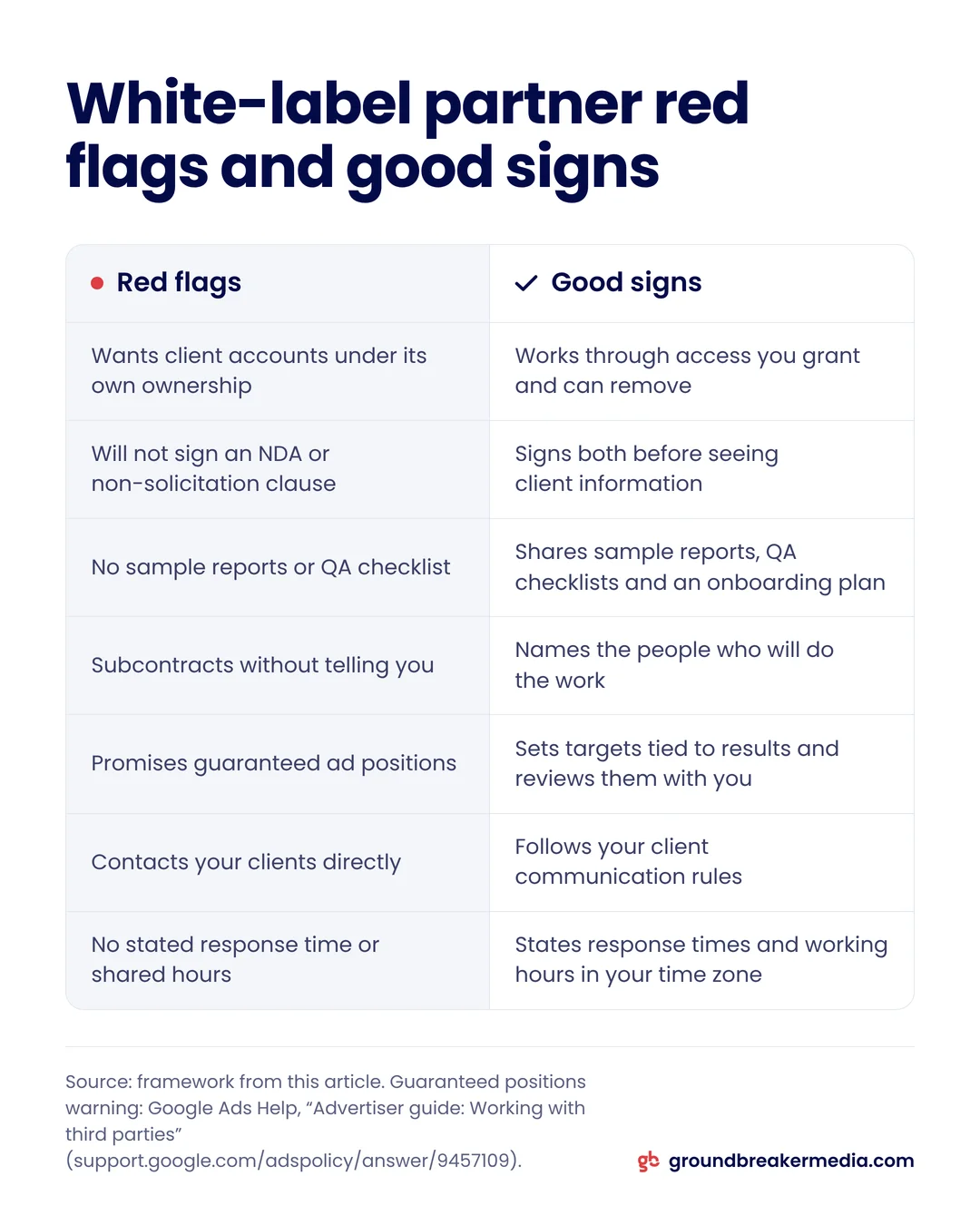
The clearest red flags are vague answers about who does the work, any attempt to own client accounts, and no written process for review or reporting.
Other warning signs come from a partner that:
- Asks to hold client accounts under its own manager account, with ownership.
- Refuses to sign an NDA or a non-solicitation clause.
- Cannot show sample reports, a QA checklist or an onboarding plan.
- Subcontracts work without telling you.
- Promises guaranteed ad positions, a warning sign Google’s advertiser guide names because auctions decide placement.
- Contacts your clients directly.
- Gives no response time, or shares none of your working hours.
Frequently asked questions
Which marketing services can be white-labeled?
Paid search and paid social management, SEO and content, landing pages and web development, conversion tracking and analytics, reporting and dashboards, and ad and social creative are all commonly white-labeled. The arrangement can be a single project, a set of client accounts, or a dedicated team that works as an extension of your agency’s staff.
Will my clients know I use a white-label partner?
Only if you tell them or the partner breaks your rules. Confidentiality depends on the contract and on daily habits: an NDA and non-solicitation clause, reports in your template, and agreed rules on whether partner staff ever join client calls or emails. You can also choose to tell clients you work with specialist teams without naming them.
How should a white-label partner handle mistakes?
Openly and quickly. Before you sign, agree who gets told about an error, how fast, and what changes afterward. The partner’s quality control should already include a second-person review for every launch or major change, checklists for tracking, budgets, targeting and copy, and a change log your agency can see at any time.
How is a white-label partner different from a freelancer?
A freelancer is usually one person with one skill set. A white-label partner is a team with processes for onboarding, quality review, reporting and cover when someone is out, and it is set up to work under another agency’s brand. Freelancers can suit single tasks. Partners suit ongoing delivery across several clients or services.
Written by
GroundBreaker Media
A performance marketing agency that connects what you spend to what it brings back. About us
Related insights
All insights


Want one version of the truth? Let's look at your numbers.
A short call, an honest read on what your marketing is producing, and clear next steps.