
Questions to ask before you hire a marketing agency
Before hiring a marketing agency, find out who owns your ad accounts, how revenue is measured and how you exit, and get each answer in the contract.
 By GroundBreaker Media6 min read

Signing with a marketing agency before you know who owns your ad accounts is the mistake to avoid. Ask that first, then how revenue is measured, who does the work, what the exit terms are, how success is defined, how AI is used, what results they can prove and what conflicts exist. Get specific answers in writing.
| Question | Why it matters | A good answer includes |
|---|---|---|
| Who owns the accounts? | You keep access and history | Accounts in your name, you as Admin |
| How is revenue measured? | Leads alone do not pay bills | Sales tied back to campaigns |
| Who does the work? | Pitch team and delivery team can differ | Named people and response times |
| What are the exit terms? | Leaving should not cost you assets | Clear notice period and handover |
| How is success defined? | Vague goals cannot be judged | Written targets, monthly reviews |
| How is AI used? | Accuracy and data are at stake | Named tasks and human review |
| Any conflicts of interest? | Hidden incentives steer decisions | Rebates and vendor ties disclosed |
Put the same questions to GroundBreaker Media; its solutions page lists what it offers.
Who owns the ad accounts and the data?
You should. Your ad accounts, analytics, tracking and customer data should sit under your business, with you holding the highest access level.
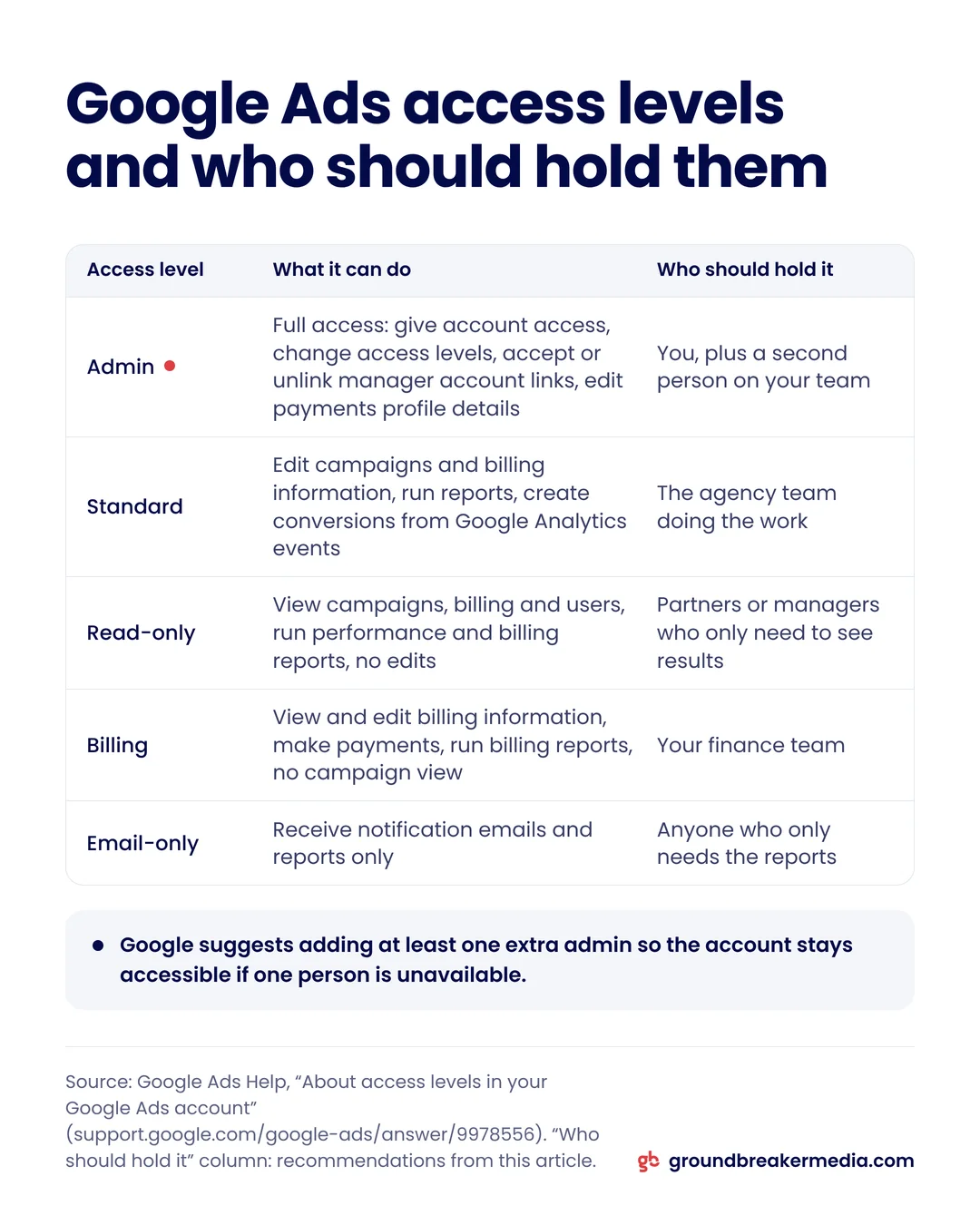
Account ownership: the business holds the top access level to its ad accounts, analytics and tracking, and the agency works through access the business granted and can remove.
Google’s advertiser guide to working with third parties says a partner should create a separate Google Ads account for you, and its third-party policy requires a separate account for each advertiser an agency manages. The Admin access level is the one that grants access and unlinks manager accounts. Keep it, and add a second admin from your team, as Google suggests. Agencies usually work through a manager account, which your admin can unlink at any time.
A good answer sounds like this: the accounts are in your name, you are an admin, and everything stays with you if you part ways.
What will you report, and how will you measure revenue?
Ask for reporting that goes past clicks and leads to sales and revenue, with ad costs and agency fees shown separately.
Google’s guide says that at a minimum you have the right to know the clicks, impressions and total cost of your ads, and that you should understand any fees the partner charges. Its transparency requirements tell third parties to report the exact amount Google charged and to disclose management fees in writing. Revenue needs a link between ad clicks and your sales records, and the explainer on why platforms and CRMs disagree shows how to build it.
Listen for this: your sales data is connected to the ad platforms, and you get monthly cost per sale and revenue by channel, explained in plain language.
Who does the work, and who will I talk to?
You should know who does the work and have one point of contact who knows your account.
Ask whether the people in the sales meeting will work on your account, who builds and reviews campaigns, whether any work is subcontracted, and how fast you can expect replies.
The answer you want names an account lead, a specialist and a senior reviewer, discloses subcontractors and states a response time.
What are the contract length and exit terms?
Know the minimum term, the notice period and what you keep when you leave, before you sign.
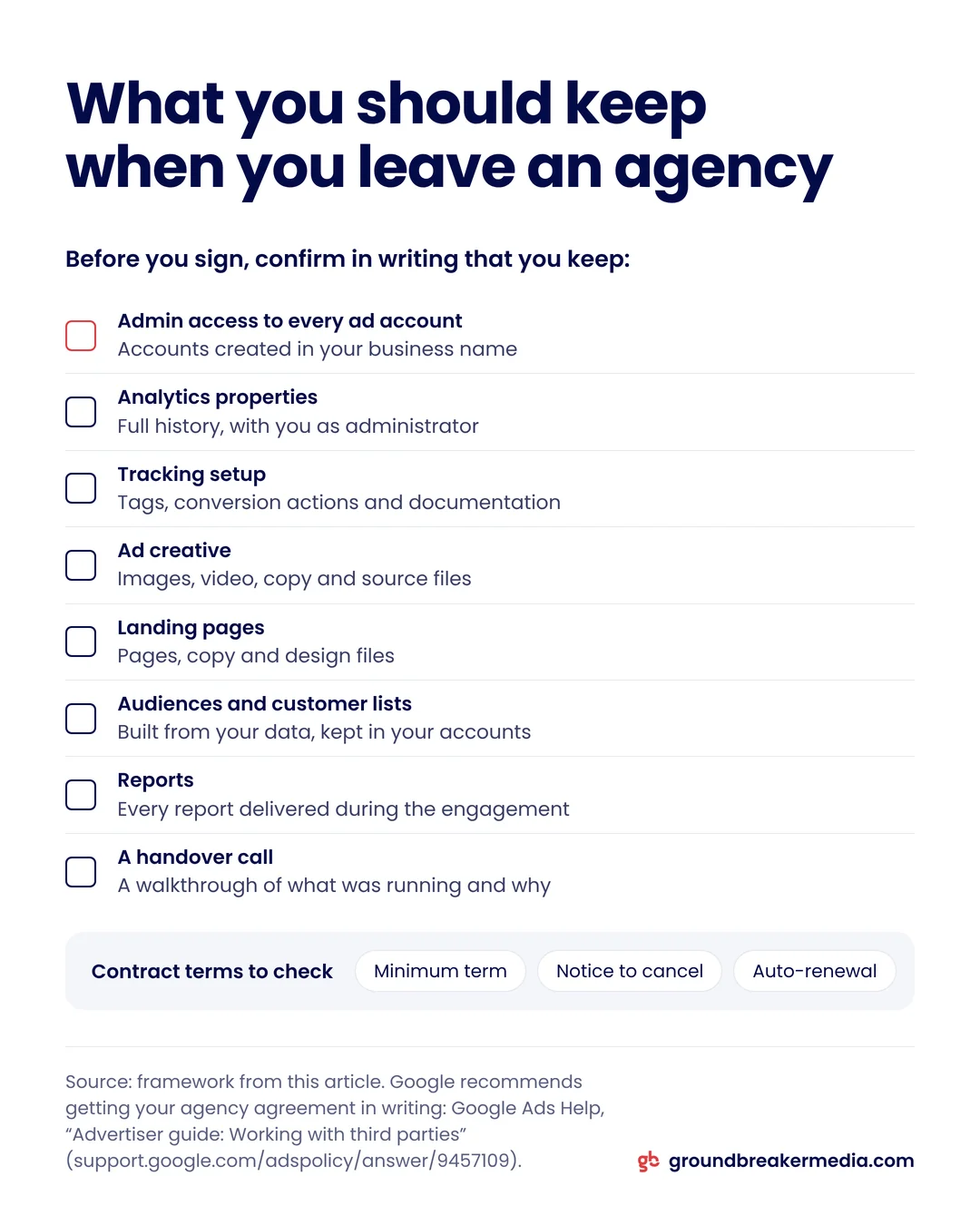
Google’s guide recommends getting your agreement in writing. Check the initial term, auto-renewal, notice to cancel, setup fees, and who owns the creative, landing pages, tracking, audiences and reports. A minimum term can be reasonable, because campaigns need time to gather data, but account ownership should never depend on it. These frequently asked questions cover how engagements are usually structured.
Expect to hear a stated term and notice period, and that on exit you keep admin access, all creative and all tracking, with a handover call.
How will we define success, and can you show real results?
Success should be defined in writing before work starts, in business terms such as cost per sale or revenue, with a review schedule.
Google’s guide suggests monthly reviews that measure return on investment, meaning new customers gained, unless the goal is branding. It warns against promises of guaranteed ad positions, which cannot be guaranteed because placement is set by auction. For proof, ask for references you can call and case studies that show the starting point, the time frame and what changed. Look for results presented with that context.
Good agencies answer with agreed targets, monthly reviews and clients you can speak with.
How do you use AI and automation?
The agency should name the tasks it uses AI for, explain how people review the output, and say what happens to your data.
Google’s guidance on generative AI content allows AI content, but says using it to produce many pages without adding value may violate its spam policy on scaled content abuse, and tells publishers to fact-check AI content before publishing. Ask which tools touch your customer data and who signs off on anything published under your name.
What you want back: AI for drafting and analysis, human review of every output, and customer data kept in approved tools.
Do you have any conflicts of interest?
Ask the agency to disclose in writing any rebates, commissions or vendor incentives, and whether it works for your direct competitors.
A study by K2 Intelligence for the Association of National Advertisers, based on 143 interviews with 150 sources in 2015 and 2016, found non-transparent practices, including cash rebates to media agencies, to be pervasive in US media buying. Smaller conflicts count too: reselling the agency’s own software, referral fees from tools, or managing a competitor in your market.
Look for no rebates or commissions, referral ties disclosed in writing, and notice before taking on a competitor.
Frequently asked questions
Can I remove an agency’s access to my Google Ads account?
Yes, as long as you hold Admin access. In Google Ads, Admin is the level that grants access and unlinks manager accounts, and agencies usually work through a manager account link. Your admin can remove that link at any time, which is why Google suggests a second admin from your own team.
Should agency fees and ad costs appear as separate lines?
Yes. Google’s transparency requirements tell third parties to report the exact amount Google charged and to disclose management fees in writing. Seeing the two apart shows how much reached the ad platforms and how much paid for management, so you can judge cost per sale on media alone and on the full cost.
What should I keep when I leave a marketing agency?
Keep admin access to every ad account, your analytics, the tracking setup, all ad creative, landing pages, audiences built from your data and every report. Ask for a handover call that walks through what was running and why. Confirm each item in writing before you sign, because leaving should not cost you assets.
What should an agency case study show?
It should show the starting point, the time frame and what changed, so you can judge the result against where the account began. Pair case studies with references you can call. Treat any promise of a guaranteed ad position as a warning sign, as Google’s advertiser guide does.
Written by
GroundBreaker Media
A performance marketing agency that connects what you spend to what it brings back. About us
Related insights
All insights


Want one version of the truth? Let's look at your numbers.
A short call, an honest read on what your marketing is producing, and clear next steps.