
Facebook ads vs Google Ads: which to use first, and how to run both
In Facebook ads vs Google Ads, start with Google when people already search for what you sell, with Meta when they do not, and measure both in one CRM.
 By GroundBreaker Media8 min read

Google Ads reaches people who are already searching, while Meta Ads, the system behind Facebook and Instagram ads, reaches people before they search. In the Facebook ads vs Google Ads decision, start with Google when buyers already look for what you sell, start with Meta when they do not, and judge both against one CRM.
Facebook ads vs Google Ads: which should you use first?
Start with Google Ads when enough people already search for what you sell, and with Meta Ads when they do not yet know to look for it.
Search demand is the number of people typing a need into Google, such as a service and a city. Discovery means showing an offer to people who were not looking for it, in the feeds they scroll every day.
Measure search demand before you choose. Google’s Keyword Planner shows "estimates on the number of searches a keyword gets each month," and keywords with "very little to no search history" get a low search volume status that pauses them until searches pick up. A roofer, an immigration lawyer or a towing company usually has searches to capture. A new kind of product or an impulse buy usually has to be shown before anyone searches for it.
Most businesses end up running both, but the first platform needs enough budget to learn before a second one splits the money.
How do people find a Google ad compared with a Meta ad?
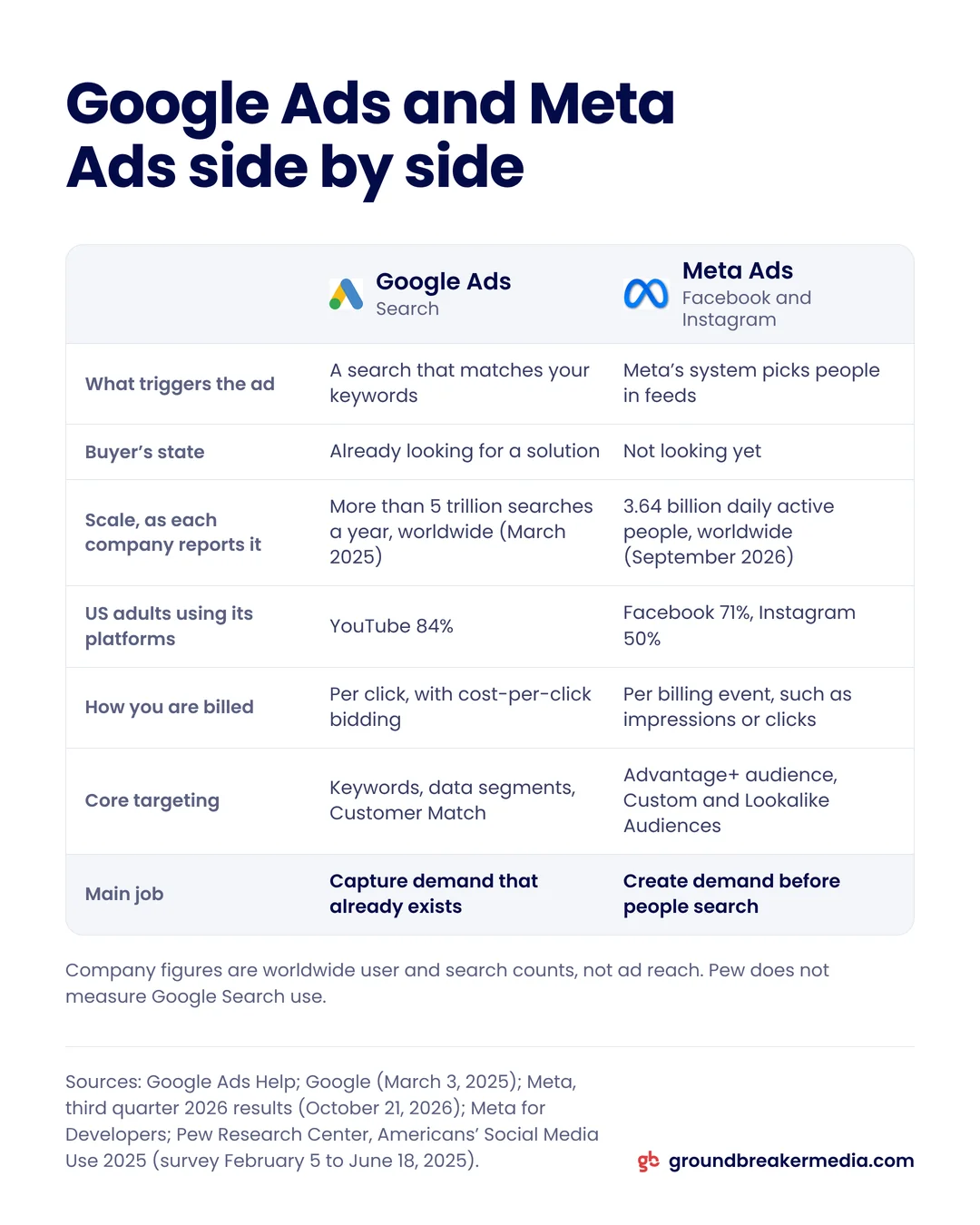
On Google, the person starts by typing a search. On Facebook and Instagram, Meta’s delivery system starts by placing an ad in front of someone who did not ask for it.
Google Ads matches Search ads to queries through keywords, "words or phrases describing your product or service," and Google describes Search campaigns as a way to "show your ads to people actively searching for your products and services" (Google Ads Help). In March 2025, Google said it sees "more than 5 trillion searches on Google annually," a worldwide figure.
Meta Ads spreads ads across Meta’s apps. In Meta’s Marketing API, Advantage+ placements is the default setting, which leaves "all available placements" eligible. Meta’s third quarter 2026 results report 3.64 billion daily active people on average for September 2026, meaning logged-in users who visited Facebook, Instagram, Messenger or WhatsApp on a given day. That is a worldwide user count, not the number of people your ads can reach.
| Google Ads (Search) | Meta Ads | |
|---|---|---|
| What triggers the ad | A search that matches your keywords | Meta’s delivery system choosing people in feeds |
| Buyer’s state | Already looking for a solution | Not looking yet |
| Scale, as each company reports it | More than 5 trillion searches a year, worldwide (March 2025) | 3.64 billion daily active people, worldwide (September 2026) |
| US adults using its platforms (Pew, 2025) | YouTube: 84% | Facebook: 71%. Instagram: 50% |
| How you are billed | Per click, with cost-per-click bidding | Per billing event, such as impressions or clicks |
| Core targeting | Keywords, your data segments, Customer Match | Advantage+ audience, Custom Audiences, Lookalike Audiences |
| Main job | Capture demand that already exists | Create demand before people search |
Sources: as linked above, plus a Pew Research Center survey of 5,022 US adults, February 5 to June 18, 2025, which does not measure Google Search. YouTube appears because Google Ads sells YouTube ads.
What is Google Ads better at than Meta Ads?
Google Ads is better at reaching a buyer at the moment of need, because the search itself tells you what the person wants.
- Intent you can read. The search terms report lists "the search terms that were used by a significant number of people" and triggered your ads, so you see the words buyers used and can exclude the ones that waste money.
- Payment tied to a click. Under cost-per-click bidding, "you pay for each click on your ads," so a Search ad nobody clicks costs nothing.
- Second chances with past visitors. Your data segments for Search ads adjust bids and ads for past site visitors who search again, once a segment holds 1,000 cookies. Customer Match uses your customer list on Search, the Shopping tab, YouTube, Gmail and Display.
The limit is simple: Google Search cannot create a search that never happens. If few people type your category, a bigger budget has nothing extra to buy.
What is Meta Ads better at than Google Ads?
Meta Ads is better at putting an offer in front of people who would never have searched for it, and at finding more people who resemble your best customers.
- Daily habit at scale. About half of US adults say they visit Facebook at least once a day, and 37% several times a day, according to Pew Research Center data collected in February and March 2025.
- Audience modeling. Lookalike Audiences "target people most like your established customers," built from a source audience of at least 100 people in one country. Advantage+ audience can relax the targeting options you set.
- Visual selling. Image and video ads can show the product in use or a person explaining it. On Meta, the creative does much of the targeting work, so plan a steady supply of new ads, a process the UGC ads guide covers.
The weak spot is lead quality. People who were not looking can fill in a form on impulse, so Meta Ads needs to learn from what happens after the lead, not from the form fill alone.
How do Google Ads and Meta Ads costs compare?
They do not compare well click for click, because a Google click comes from someone who searched and a Meta impression reaches someone who did not.
Google Search campaigns usually charge per click, while Meta charges for the billing event you choose. A cheap Meta click and an expensive Google click can end in the same cost per customer, or the reverse. Compare the two on CRM cost per customer, against the ceiling from the maximum cost per lead calculation. The platform numbers live in their own guides: how much to spend on Google Ads and how much Facebook ads cost.
Do Meta ads lead to more Google searches?
In published agency studies run with Meta’s own lift tools, people who could see Meta ads searched more than a control group who could not. The agencies sell this testing, so treat the results as a reason to test, not as a forecast.
A conversion lift test splits an audience into a group that can see the ads and a control group that cannot, then compares what each group does next.
Search lift = (search visits from the exposed group minus search visits from the control group) ÷ search visits from the control group
| Study | Scope | Reported result |
|---|---|---|
| Brainlabs with Meta, November 14, 2025 | 17 studies for 12 advertisers, markets not stated | 19% more search visits to site than the control group; 71% of the extra visits organic, 29% paid |
| iProspect (dentsu), April 7, 2025 | 64 studies, luxury and fashion ecommerce, UK and EMEA (Europe, Middle East and Africa) | 10.4% average increase in search volume; 11% increase in paid search volume |
In the 9 Brainlabs studies that split paid search by query type, 69% of the extra paid traffic came through non-branded terms, which any competitor can bid on, so a Meta campaign can create searches that someone else’s Google ad collects. Google’s research with The Behavioural Architects, published on Think with Google in July 2020, found that "people loop through these twin modes of exploration and evaluation" before they buy, so one platform rarely sees the whole decision.
How do you run Google Ads and Meta Ads at the same time?
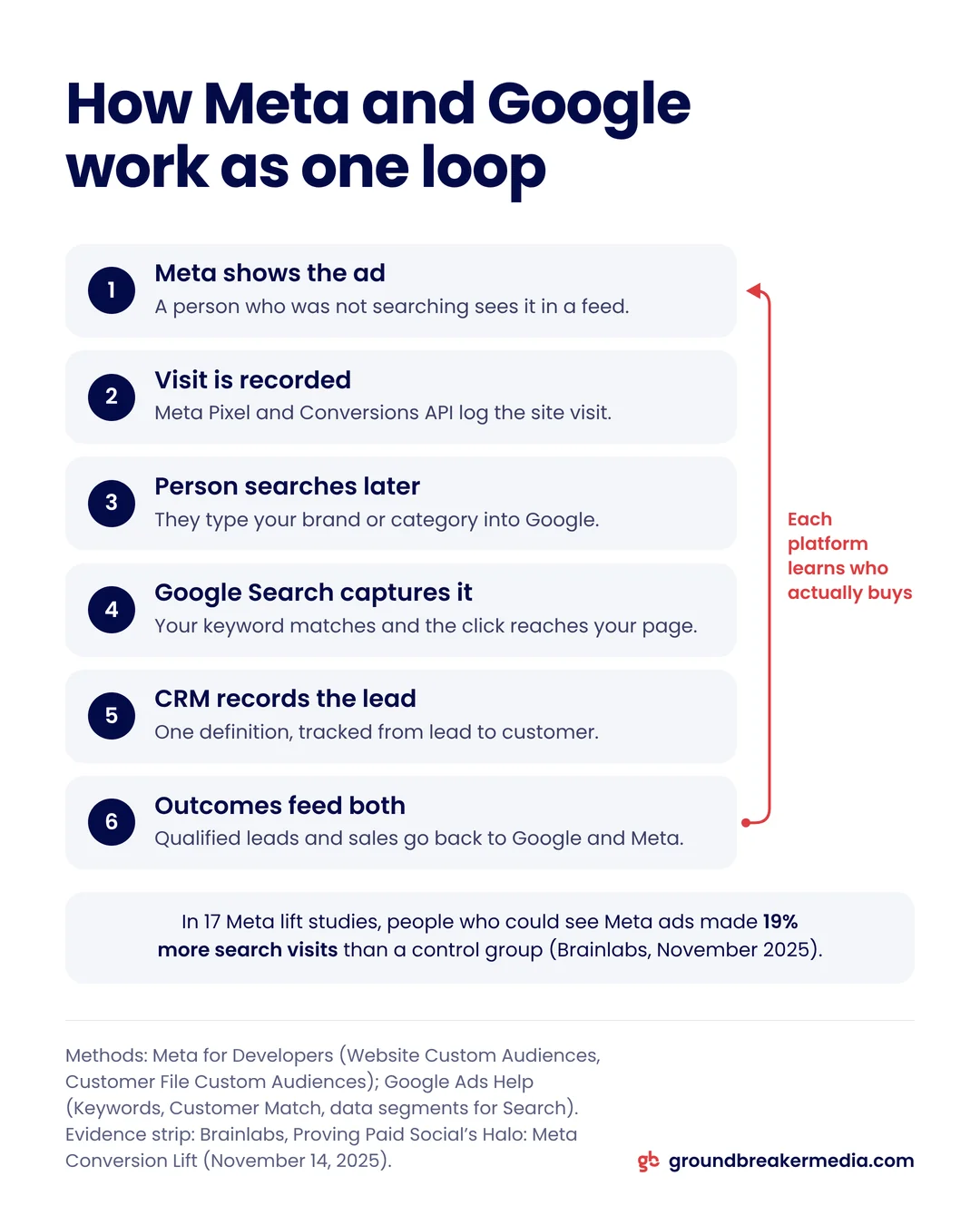
Give each platform the job it does best, connect both to the same tracking and CRM, and let the audiences each one builds feed the other.
- Write one conversion definition. Define a lead, a qualified lead and a customer once, use those definitions on both platforms, and treat your CRM (customer relationship management system) as the record of what sold. Never add platform totals together, as the guide to why platforms and the CRM disagree explains.
- Install each platform’s own measurement. Pair the Google tag with enhanced conversions and the Meta Pixel with the Conversions API, as the tracking guide on privacy changes sets out.
- Let Meta prospect. Run Advantage+ audience, or Lookalike Audiences seeded from your customer list, to reach people who match your buyers.
- Cover the searches Meta creates. Bid on your brand name and main category terms in Google Search, so a person who saw your Meta ad and searched later finds you first.
- Retarget on both. Build website Custom Audiences from Meta Pixel data and data segments for Search from Google tag data, and upload one customer list to both Customer Match and Meta as a customer file Custom Audience.
- Send outcomes back to both. Import qualified leads and sales from the CRM into each platform, so each one learns which people buy.
How should you split a budget between Google Ads and Meta Ads?
Our recommendation, not an industry statistic: fund Google Search until it covers the demand that exists, put the next dollar into Meta Ads, and rebalance every month on cost per customer from your CRM. Two checks set the split before any percentage does.
- Can the budget feed both learning phases? Google’s value-based bidding guidance recommends an optimization goal with at least 15 conversions a month, and a Meta ad set needs about 50 results in seven days to leave its learning phase, as the Facebook ads cost guide explains. If the budget cannot reach both, run one platform properly and give Meta about 10% for retargeting, or point Meta at an earlier step with more volume.
- Is search demand already covered? Search lost impression share (budget) is "the percentage of time that your ads weren’t shown on the Search Network due to insufficient budget." While it is high and cost per customer is on target, more Google budget buys more existing buyers. Once it is near zero on the keywords that meet your target, Meta becomes the place to grow.
| Business | Google / Meta starting split | What the second platform does |
|---|---|---|
| Local services people search for urgently, such as home services, legal or dental | 80 / 20 | Meta retargets site visitors and adds local reach |
| Search demand plus a visual or considered purchase, such as ecommerce, real estate or hospitality | 50 / 50 | Both prospect, with Shopping or Performance Max on Google |
| New product or category few people search for | 30 / 70 | Google covers brand and core terms |
| High-ticket B2B | 85 / 15 | Meta retargets, and LinkedIn is the better second channel |
These are GroundBreaker Media’s recommended starting points when it plans paid media, not benchmarks. Three rules apply to every row. Keep brand search running even when Meta leads, so the searches Meta creates have somewhere to land. Hold back about 10% of the budget for tests. Rebalance on CRM cost per customer, not on each platform’s reported ROAS, because both platforms count the same buyers; where the account qualifies, a lift test settles what Meta adds.
Frequently asked questions
Can Google Ads reach people who are not searching?
Yes. Demand Gen campaigns run on YouTube, including Shorts, Discover, Gmail, Maps and the Google Display Network, and can use lookalike segments to find new audiences. For eligible accounts, Search Lift measures how your ads change the likelihood that people search for your brand. The YouTube ads cost guide covers Demand Gen.
Should I advertise on Facebook or Instagram?
Usually both, from one Meta Ads account. Advantage+ placements is the default in Meta’s Marketing API, so delivery can shift budget across all available placements. Pew Research Center’s 2025 survey found that 71% of US adults use Facebook and 50% use Instagram. Check results by placement, and exclude one only when the data supports it.
Are Google Ads or Meta Ads better for B2B?
Google Ads is usually stronger for B2B services people search for, such as payroll software or commercial cleaning, because the search reveals the need. Meta Ads reaches business owners in the same feeds as everyone else, which suits simple offers with a clear visual hook. When job title defines the buyer, start with the LinkedIn B2B guide.
How often should you change the split?
We review it monthly and move it in steps. A large budget change can send campaigns back into learning, so shift about 10 to 20 percentage points at a time, then judge cost per customer from the CRM over the following month. Change sooner only when one platform misses its cost target by a wide margin for several weeks.
Written by
GroundBreaker Media
A performance marketing agency that connects what you spend to what it brings back. About us
Related insights
All insights


Want one version of the truth? Let's look at your numbers.
A short call, an honest read on what your marketing is producing, and clear next steps.