
What a performance marketing agency does
A performance marketing agency runs paid media, creative, tracking, landing pages and reporting, paid by retainer, share of spend, results or a hybrid.
 By GroundBreaker Media6 min read

A performance marketing agency plans, buys and improves advertising that is judged by measurable results such as qualified leads, customers and sales. It runs paid media, produces ads, builds tracking and landing pages, and reports what the spend brought back. A good one answers for those numbers without promising outcomes it cannot control.
What is performance marketing?
Performance marketing is advertising that is planned, bought and judged by measurable actions, such as leads, calls and purchases, and by the revenue those actions produce. Every dollar should be traceable to a lead, a sale or another outcome the business values.
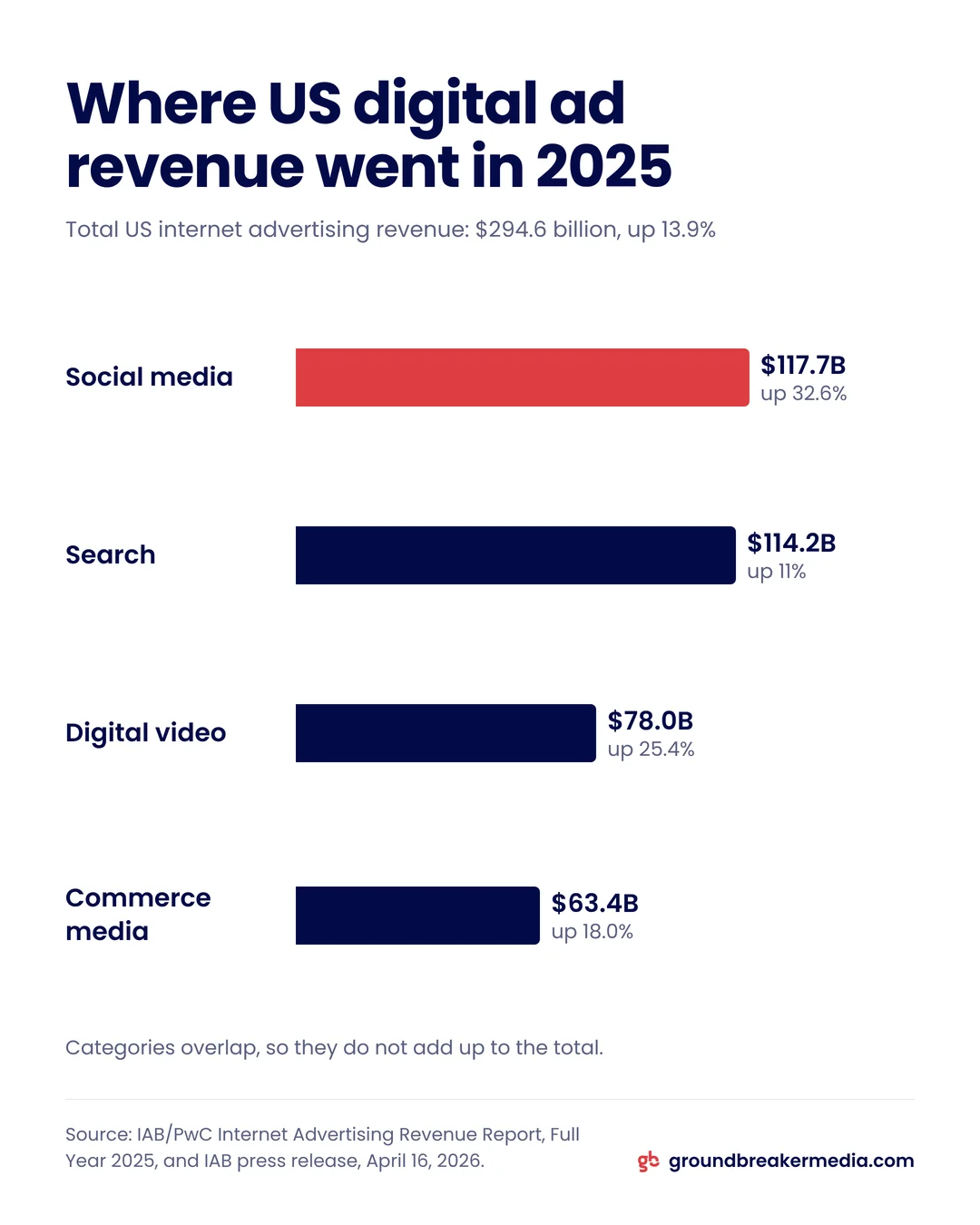
The channels it relies on are large. The IAB/PwC Internet Advertising Revenue Report, released April 16, 2026, put US internet advertising revenue at $294.6 billion for 2025, up 13.9%. IAB’s release reported social media at $117.7 billion, up 32.6%, and search at $114.2 billion. Both sell ads that can be measured down to a click, a lead or a sale.
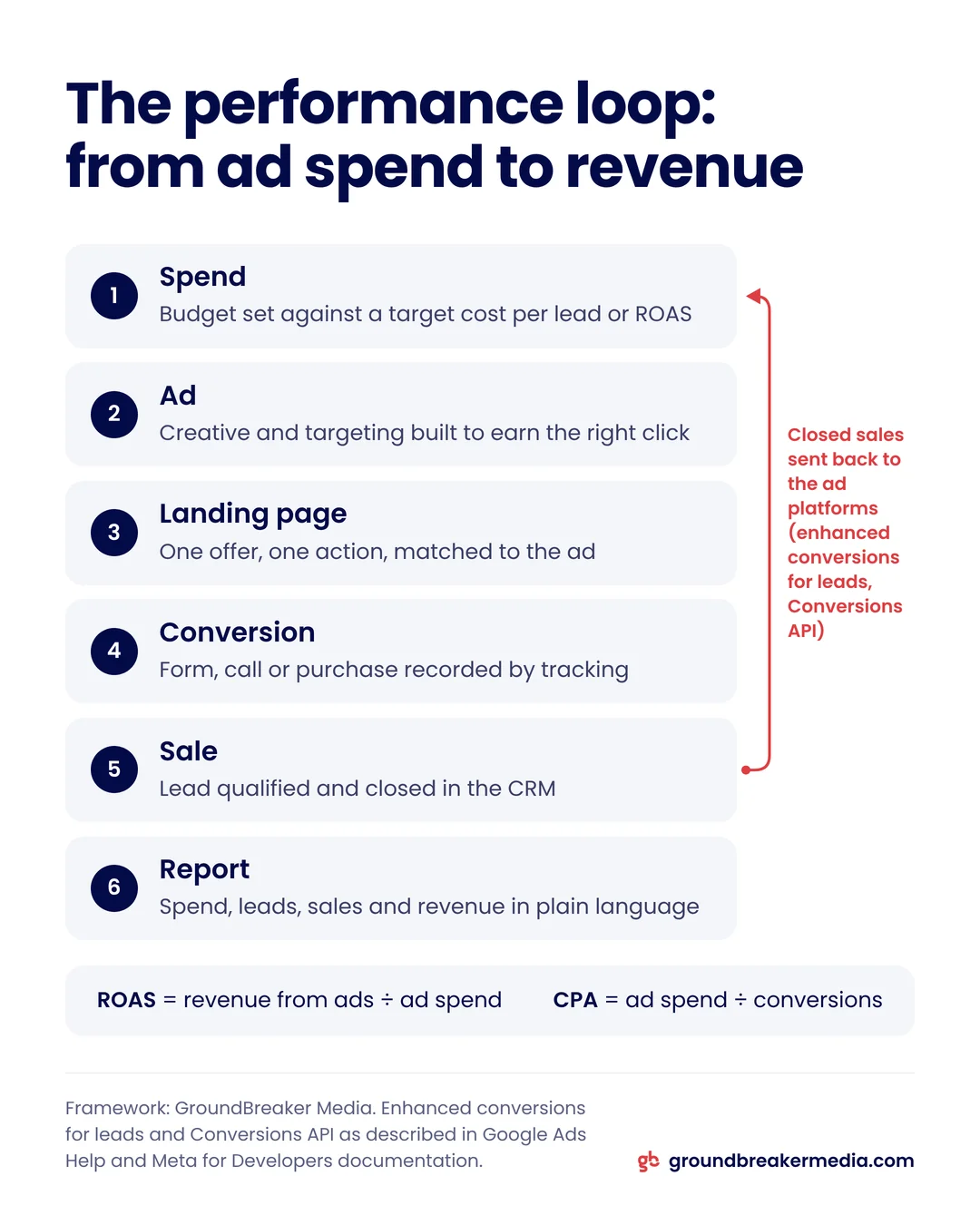
Two numbers anchor most performance work. Return on ad spend (ROAS) is revenue from ads divided by ad spend, and the five-minute report guide shows how it differs from ROI. The other is cost per acquisition:
Cost per acquisition (CPA) = ad spend ÷ number of conversions
How is a performance agency different from a traditional or creative agency?
A performance agency is judged on measurable outcomes and adjusts week to week. Traditional and creative agencies are usually judged on reach, brand impact and the quality of the work.
| Performance agency | Traditional agency | Creative agency | |
|---|---|---|---|
| Main job | Turn ad spend into leads and sales | Plan and buy reach across media | Build brand ideas and assets |
| Judged on | Cost per lead, cost per sale, ROAS | Reach, frequency, awareness | Quality and impact of the work |
| Typical channels | Search, social, video, marketplaces | TV, radio, print, outdoor, digital | Any, as concepts and assets |
| Pace of change | Weekly tests and budget shifts | Planned campaign flights | Project by project |
| Reporting | Spend tied to conversions and revenue | Delivery and audience estimates | Creative deliverables |
Many businesses use more than one type, each for a different job.
What work does a performance marketing agency actually do?
Five connected jobs: paid media, creative, tracking, landing pages and reporting. If one is weak, the rest underperform.
- Paid media. Campaigns on platforms such as Google, Meta, YouTube, LinkedIn and Microsoft Ads: targeting, bidding, budgets and testing.
- Creative. Copy, images and video that earn the click, with variations to test.
- Tracking. Conversion tracking on the site, plus a route for offline sales: Google’s enhanced conversions for leads feed Google Ads, Meta’s Conversions API feeds Meta, and the walkthrough of CRM and ad platform revenue shows the full loop.
- Landing pages. Pages built for one offer and one action. Google names landing page experience, "how relevant and useful your landing page is to people who click your ad", as one of three Quality Score components.
- Reporting. Plain-language reports that connect spend to leads, sales and revenue, with a recommendation attached.
GroundBreaker Media handles this work, from tracking through to the monthly report, within its solutions.
How do performance marketing agencies charge?
Most use a monthly retainer, a percentage of ad spend, a performance fee or a hybrid. Each model rewards different behavior, so the structure matters as much as the price.
| Model | How it works | Fits when | Watch for |
|---|---|---|---|
| Monthly retainer | Fixed fee for a defined scope | Scope is clear and spend is steady | Scope creep on either side |
| Percentage of ad spend | Fee moves with the media budget | Spend changes month to month | A pull toward spending more, not better |
| Performance fee | Paid per lead, per sale or on revenue | Tracking is reliable and "qualified" is defined | Disputes over attribution and lead quality |
| Hybrid | Base fee plus a performance bonus | Both stability and shared upside matter | Vague or easily gamed bonus targets |
Pure performance pricing is less common than the name suggests. The ANA’s Trends in Agency Compensation study, published December 13, 2022, found 41% of the client-side marketers surveyed used performance incentives, down from 61% in 2013, while 82% used fee-based models.
Ad spend is normally paid to the platform, separate from the agency fee. Google’s third-party policy asks agencies to be "honest and transparent" about costs and expected results.
What results should you expect, and how fast?
Expect a setup period, then steady improvement against agreed numbers. The first weeks go to tracking, structure and learning.
Google’s bidding needs a learning period, and the Google Ads budget guide covers how long it lasts and the conversion volume it needs. Google’s learning period page adds that tight targets, low daily budgets and narrow targeting slow the ramp-up, and that new bid strategies or major goal changes start a new learning period. A conversion cycle is the time from click to conversion, so long sales cycles mean a longer wait.
Reasonable expectations are accurate tracking first, a written baseline, then monthly movement on cost per qualified lead or cost per sale. Google’s partner policy warns against "false, misleading, or unrealistic claims" about expected results, so treat a guaranteed return as a warning sign. Real examples with context, like those on the results page, are a better guide than promises.
What should you ask a performance agency before signing?
Ask what gets measured, what the fee covers and how the agency decides to stop spending. The answers show whether it answers for revenue or only for activity.
- Which conversions count, and how will sales that close offline be tied back to ads?
- Is ad spend billed separately from the fee?
- What will the first 90 days deliver, in writing?
- How do you decide to stop a campaign that is not working?
Account ownership belongs on the list too, and the full agency hiring checklist starts there.
Frequently asked questions
Is performance marketing the same as digital marketing?
No. Digital marketing covers everything online, including organic social, email and content. Performance marketing is the part that is bought and judged by measurable actions such as leads, calls and sales. Most performance work runs on digital channels because they report results down to the click, but not every digital campaign is run for performance.
Is ad spend included in a performance agency’s fee?
Usually not. Ad spend is normally paid to the platform, separately from the agency fee, whether that fee is a retainer, a percentage of spend, a performance fee or a hybrid. Google’s third-party policy asks agencies to be honest and transparent about costs, so expect media and fees to appear as separate lines.
Which channels does a performance marketing agency use?
Mostly platforms that report results down to the click, such as Google, Meta, YouTube, LinkedIn and Microsoft Ads, with video and marketplaces alongside. In 2025, according to IAB and PwC, social media brought in $117.7 billion of US internet advertising revenue and search $114.2 billion.
Is a pay-per-lead agency a better deal?
Not always. Pay-per-lead pricing works when both sides agree on what counts as a qualified lead and tracking is reliable. Without that, disputes over lead quality and attribution follow, and the agency may favor cheap leads over good ones. Many businesses do better with a fee plus clear targets for cost per qualified lead or cost per sale.
Written by
GroundBreaker Media
A performance marketing agency that connects what you spend to what it brings back. About us
Related insights
All insights


Want one version of the truth? Let's look at your numbers.
A short call, an honest read on what your marketing is producing, and clear next steps.