
How much do Facebook ads cost, and what sets the price?
Facebook ads cost a median $27.39 per lead and $0.60 per traffic click in the US (WordStream, 2026); Meta's auction, your bid and your ad set your price.
 By GroundBreaker Media7 min read

Facebook ads have no list price. Meta sells each impression in an auction, so you set the budget and the auction sets what a click or a lead costs. As a benchmark for how much Facebook ads cost, US lead campaigns paid a median $27.39 per lead and traffic campaigns $0.60 per click in WordStream by LocaliQ’s 2026 report.
How does Meta charge for Facebook and Instagram ads?
Meta charges for a billing event, such as an impression or a click, at a price the auction decides, and it spends against a daily or lifetime budget that you choose.
The bidding overview from Meta for Developers describes billing events as the "events you want to pay for such as impressions, clicks, or various actions." The optimization goal is a separate setting: it is the result you want, and Meta uses it "to decide which people get your ad." An ad set can pay per impression while it optimizes for leads.
Budgets come in two forms. A daily budget is the average you are willing to spend each day. A lifetime budget covers the whole run of an ad set or campaign, and Meta’s budgets documentation says you will not be charged more than it "unless you change your delivery settings."
Three terms carry the rest of this article:
- CPM is the cost per 1,000 impressions, the raw price of attention in the auction.
- Click-through rate is the share of impressions that become clicks.
- Cost per result is the average Meta reports you paid for each action the ad set optimizes for, such as a lead or a purchase.
Cost per click = CPM ÷ (1,000 × click-through rate)
Example (hypothetical numbers): an ad set pays a $12 CPM and 1.5% of impressions become clicks. Each click costs $12 ÷ (1,000 × 1.5%) = $12 ÷ 15 = $0.80. Double the click-through rate with a better ad and the same CPM buys clicks at $0.40.
How does the Meta ad auction decide what you pay?
The Meta ad auction does not simply sell to the highest bidder. It weighs your bid against how likely the person is to act on your ad and how good the ad is, so a lower bid with a stronger ad can win.
Jon Loomer, a long-time Meta ads educator, names the three inputs in The Pubcast with Jon Loomer (September 17, 2025): your bid, the estimated action rate, meaning Meta’s estimate of "the likelihood that a given person will perform the action you want," and ad quality, which "is determined by user feedback and automated processes." Meta’s own bidding overview says it evaluates "your bid_strategy, bid_amount, and the probability of acquiring your optimization_goal" to set an effective bid, so that you "only win auctions" where you are likely to hit your goal within your cost limits.
That design has three practical effects on Meta ads cost:
- Creative changes price. An ad that people click and act on raises its estimated action rate, so it wins more auctions for the same bid. Testing new ads is a cost lever, covered in the UGC ads and creative testing guide.
- The optimization goal changes who you reach. Asking Meta for leads sends the ad to people it predicts will submit a form, which is one reason lead campaigns pay more per click than traffic campaigns in the benchmarks below.
- The market moves without you. In its third quarter 2026 results (October 21, 2026), Meta reported that ad impressions across its apps rose 10% year over year while the average price per ad rose 14%.
Which Meta bid strategy should you choose?
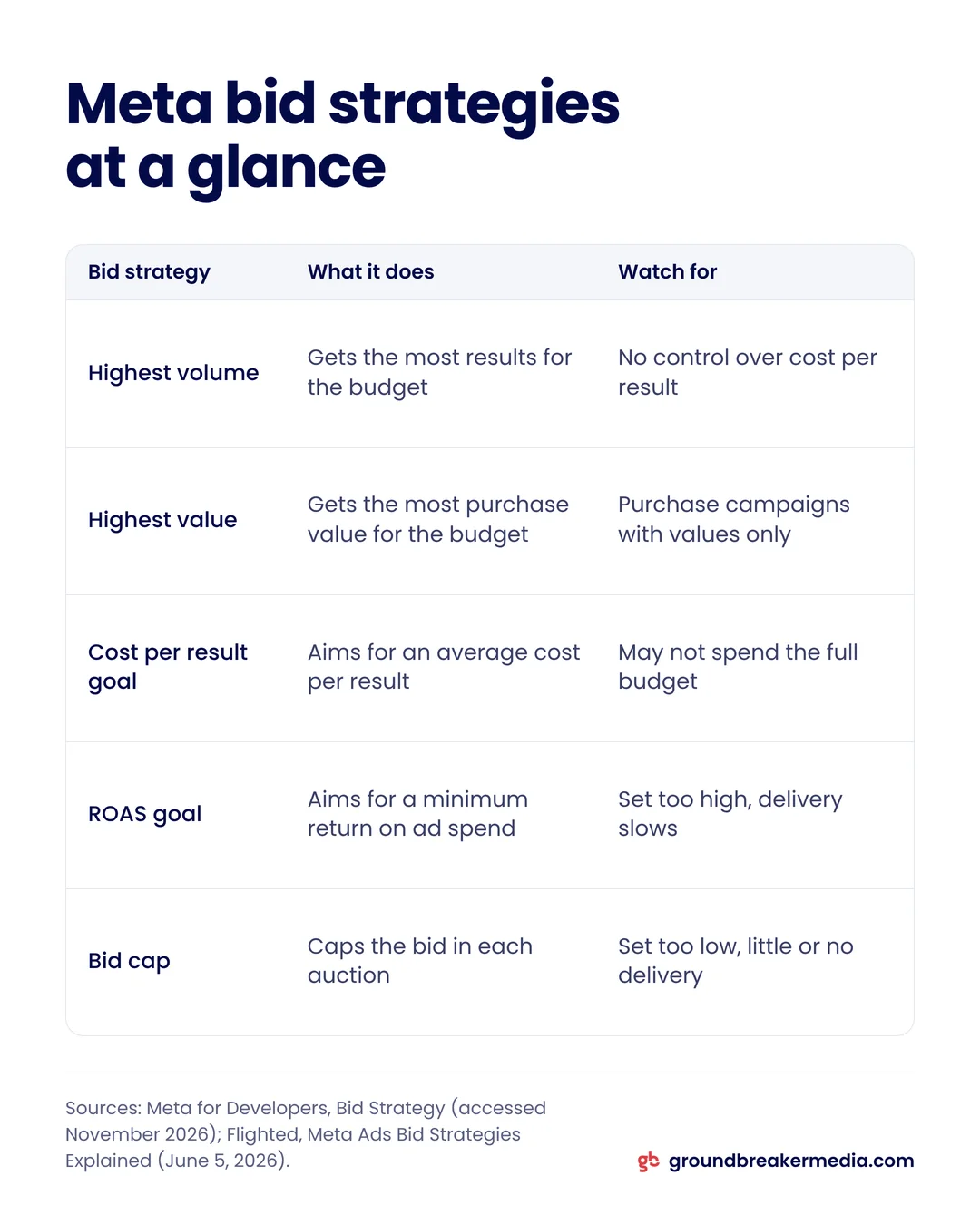
Start a new ad set on highest volume, and add a cost per result goal or a ROAS goal only once you know the cost a customer can bear and the ad set has steady conversion data.
| Bid strategy | Type | What it does | Watch for |
|---|---|---|---|
| Highest volume | Spend-based | Gets the most results for the budget | No control over cost |
| Highest value | Spend-based | Gets the most purchase value for the budget | Purchase campaigns with value optimization only |
| Cost per result goal | Goal-based | Aims for an average cost per result you set | May not spend the full budget |
| ROAS goal | Goal-based | Aims for a minimum return on ad spend | Set too high, delivery slows |
| Bid cap | Manual | Caps the bid in each auction | Set too low, little or no delivery |
Sources: Meta for Developers, Bid Strategy, and Flighted (June 5, 2026) for the Ads Manager names.
Goals are targets, not guarantees. Meta’s developer documentation says "adherence to cost cap limits is not guaranteed," and a cost per result goal is an average, so single results will land above and below it. We set any cost goal from the maximum cost per lead the business can afford, never from a benchmark, because a goal below what the auction will clear simply stops delivery.
How much do Facebook ads cost in 2026?
In WordStream by LocaliQ’s 2026 benchmarks, US Facebook lead campaigns paid a median $1.80 per click and $27.39 per lead, and traffic campaigns paid a median $0.60 per click.
The 2026 report is based on 1,892 US-based social advertising campaigns running from April 1, 2025 to June 30, 2026, and its averages "are technically median figures to account for outliers."
| Metric (2026 report) | Traffic campaigns | Lead campaigns |
|---|---|---|
| Median click-through rate | 1.93% | 2.70% |
| Median cost per click | $0.60 | $1.80 |
| Median conversion rate | Not reported | 8.54% |
| Median cost per lead | Not reported | $27.39 |
| Change from 2025 report | Cost per click down from $0.70 | Cost per lead down 0.98% |
Source: WordStream by LocaliQ, Facebook Ads Benchmarks 2026.
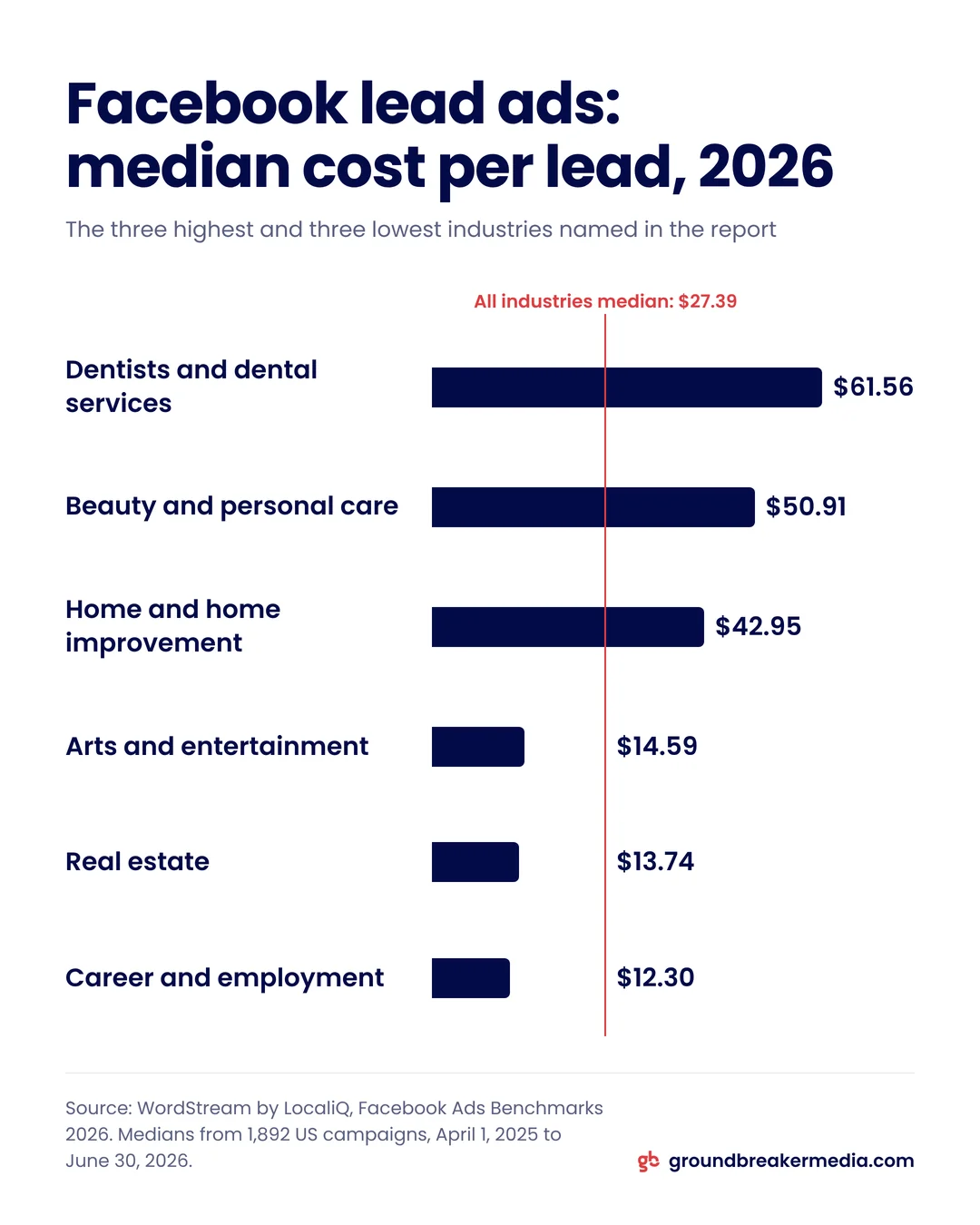
Industry spread matters more than the overall figure. Median cost per lead ran from $12.30 in career and employment, $13.74 in real estate and $14.59 in arts and entertainment, up to $42.95 in home and home improvement, $50.91 in beauty and personal care and $61.56 for dentists and dental services. The report also found that cost per lead fell for 12 of its 14 industries.
Two cautions apply. First, these medians do not multiply into each other: $1.80 ÷ 8.54% gives $21.08, not $27.39, because each median comes from a different campaign in the middle of its own list. Second, the sample is US-only, so Canadian advertisers should treat it as a rough reference.
What is the minimum budget for Meta ads?
Meta’s technical minimum is small and set per currency, but the practical minimum is the budget that buys enough results for an ad set to finish the learning phase.
Meta for Developers’ minimum budgets reference lists separate minimum daily budgets, by currency, for ad sets optimized for impressions, for video views, for "high frequency actions like clicks and likes" and for "low frequency actions like mobile app installs." Rarer actions carry a higher floor.
The learning phase is the period after launch or a significant edit when Meta’s delivery system is still working out who should see an ad set. PPC Land (September 23, 2026), citing Meta’s Business Help Center, reports that an ad set "generally needs about 50 optimisation events within seven days" to exit it. Ad tool vendors reported lower thresholds for some campaign types in 2024 and 2026, but PPC Land notes that "neither report was accompanied by public Meta documentation," so plan on 50.
Weekly budget to exit learning = 50 × expected cost per result
Example (hypothetical numbers): a business expects leads at about $30. Exiting learning takes 50 × $30 = $1,500 a week, or about $214 a day. At $70 a day, the ad set buys roughly 16 leads a week and stays in learning.
When the budget cannot reach that volume, there are three honest options:
- Optimize for a more frequent event, such as landing page views, and judge lead quality in the CRM.
- Put the budget into fewer ad sets, so one learning process gets all the data.
- Accept a slower, noisier test and read results over several weeks.
Are Facebook ads worth it for your business?
Facebook ads are worth it when the cost per customer they produce stays below what a customer is worth to you, measured in your CRM rather than in Ads Manager.
Compare Meta’s cost per lead with the maximum cost per lead your margins allow, the ceiling that the cost per lead guide builds from customer value, close rate and target margin share. A $27.39 median is irrelevant if Meta leads close at half the rate of your search leads, so track them as a separate source and compare cost per customer. The backward budget math in the ad budget guide works on Meta too, with the 50-event learning check as the volume test.
Measurement decides the answer. Ads Manager counts conversions inside its own attribution window, so its totals rarely match the CRM, which the platform and CRM revenue guide explains. Sending events from your server with Meta’s Conversions API, set up as described in the privacy-proof tracking guide, gives the auction better data to optimize on. For the choice between Google Ads and Meta, or running both, see Google Ads vs Meta Ads.
GroundBreaker Media plans Meta campaigns against CRM cost per customer targets as part of its Demand and Creative Strategy work.
Frequently asked questions
Is a lower cost per click on Facebook always better?
No. In WordStream by LocaliQ’s 2026 benchmarks, traffic campaigns paid a median $0.60 per click and lead campaigns $1.80, because a leads objective asks Meta for people likely to submit a form, not for cheap clicks. A pricier click that converts can produce a lower cost per lead. Judge Meta campaigns on cost per lead and cost per customer.
Do Facebook ad benchmarks apply to Canadian advertisers?
Only as a rough check. WordStream by LocaliQ’s 2026 Facebook benchmarks come from 1,892 US-based campaigns, and Meta’s quarterly results report price changes for its apps worldwide, not by country. Canadian advertisers compete for a different audience, so treat the first month of your own account data as the baseline and set targets from your margins.
Why do costs jump after I edit an ad set?
A significant edit can send the ad set back into the learning phase, when delivery is less stable. Meta for Developers’ learning stage data records "the last significant edit that caused ad set to reenter the learning phase." Batch your changes, make them less often, and judge results only after the ad set has had a stable week.
Does a bid cap set the price I pay?
No. A bid cap limits what Meta bids for you in each auction. Meta’s developer documentation states that the bid "is not the cost you’ll see in reporting," and that actual cost per result is usually around or below the bid amount. Set a bid cap too low and the ad set may barely deliver, so start with highest volume.
Written by
GroundBreaker Media
A performance marketing agency that connects what you spend to what it brings back. About us
Related insights
All insights


Want one version of the truth? Let's look at your numbers.
A short call, an honest read on what your marketing is producing, and clear next steps.