
How much do YouTube ads cost, and how are they charged?
YouTube ads cost what the auction sets per view, per 1,000 impressions or per conversion goal; Google suggests Demand Gen budgets of 10x target CPA a day.
 By GroundBreaker Media7 min read

Google’s firmest number on what YouTube ads cost is a budget rule: a Demand Gen campaign on target bidding should spend at least 10 times its target cost per acquisition each day. The rest depends on how you pay, per view, per 1,000 impressions or toward conversions, and on what the auction charges for your audience.
How are YouTube ads charged?
YouTube ads are charged per view, per 1,000 impressions, or per impression inside a campaign that bids toward conversions, depending on the format and the bid strategy you pick.
Cost per view (CPV) is the price you pay each time YouTube counts a view. Google Ads Help’s CPV bidding page says an in-stream view counts "when someone watches 30 seconds of your video ad (or until the end of the ad if it’s shorter than 30 seconds)," or when the viewer interacts with the ad, whichever comes first. For in-feed ads, a view is a thumbnail click or 10 seconds of autoplay. For Shorts ads, it is 10 seconds of watching or a click on the call to action. Target CPV bidding lets you set "the average amount that you’re willing to pay for each TrueView view."
Impression pricing, or cost per 1,000 impressions (CPM), applies to formats that cannot be skipped. Google Ads Help’s video ad formats page says bumper ads and non-skippable in-stream ads "use Target CPM bidding, so you pay based on impressions."
Conversion bidding changes the goal but not always the bill. The same page says skippable in-stream ads running on Target CPA or Maximize conversions bidding are charged per impression. Cost per acquisition is the average ad cost of each conversion; the bid strategy aims at it while the invoice counts impressions.
Because a CPV campaign and a CPM campaign report different units, convert one into the other before comparing them:
Effective CPM = cost per view × view rate × 1,000, where view rate = views ÷ impressions
Example (hypothetical numbers): a skippable in-stream campaign pays $0.04 per view and 25% of impressions become views. Its effective CPM is $0.04 × 25% × 1,000 = $10, which you can now set beside a bumper campaign’s CPM.
Which YouTube ad formats are there, and what do you pay for?
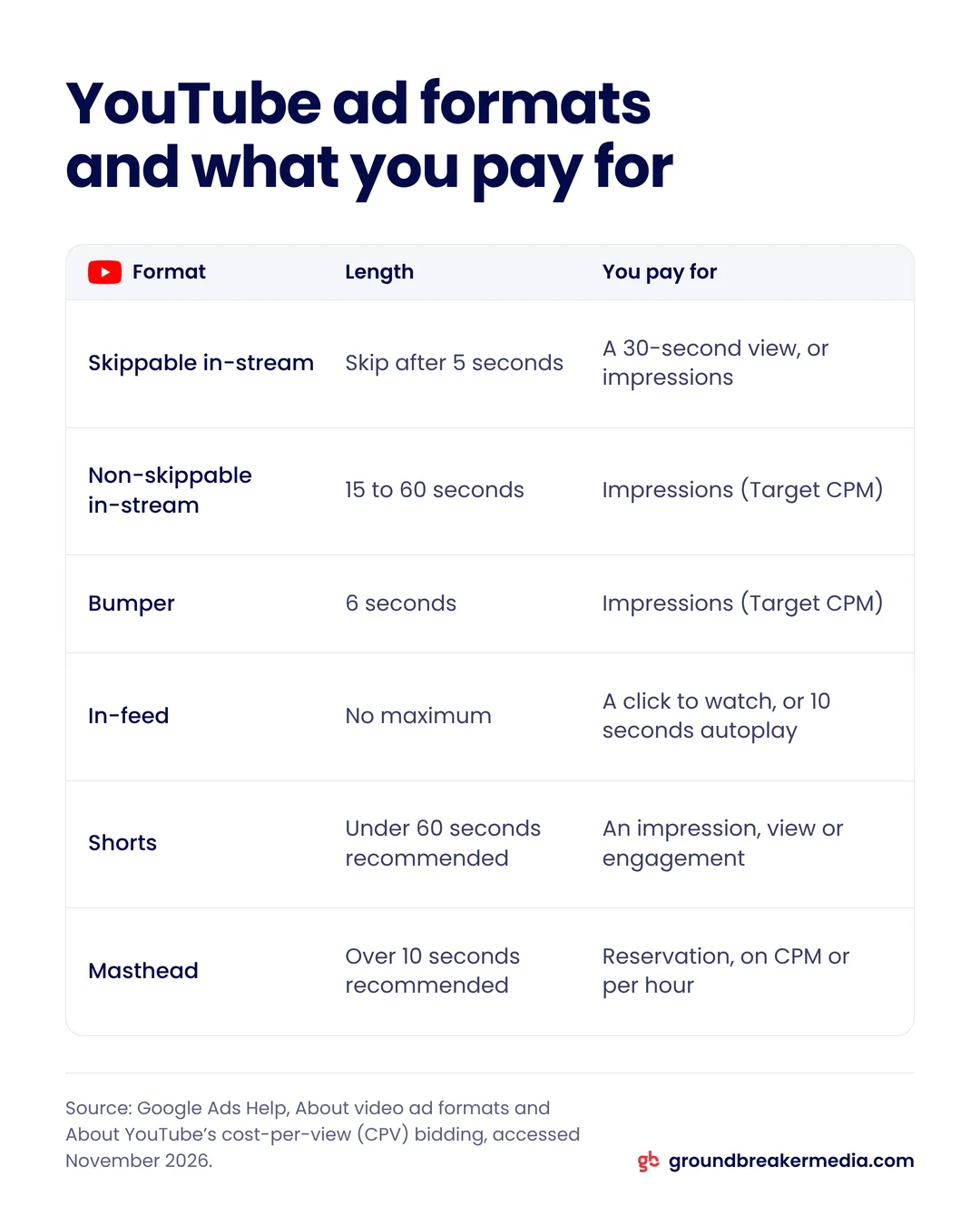
Google Ads Help lists six main YouTube formats, and each has its own length rules and billing.
| Format | Length | What you pay for |
|---|---|---|
| Skippable in-stream | Skip after 5 seconds; under 3 minutes recommended | A view with CPV bidding; impressions with Target CPM, Target CPA or Maximize conversions |
| Non-skippable in-stream | 15 to 60 seconds, by campaign subtype | Impressions (Target CPM) |
| Bumper | 6 seconds, 5 seconds minimum | Impressions (Target CPM) |
| In-feed | No maximum | A click to watch, or 10 seconds of autoplay in Video view campaigns |
| Shorts | Under 60 seconds recommended | An impression, a view or an engagement, by bid strategy |
| Masthead | Over 10 seconds recommended | Reservation only, on CPM or cost per hour |
Source: Google Ads Help, About video ad formats and About YouTube’s cost-per-view (CPV) bidding, accessed November 2026.
Placement matters as much as length. In-stream ads play before, during or after other videos on YouTube and on Google video partners. In-feed ads appear in the Home feed, search results and Watch Next. Google says Shorts ads serve "on desktop, tablets, mobile (web and apps), and connected devices," so a vertical ad can reach a television screen.
How much do YouTube ads cost in 2026?
No reliable public average exists for YouTube cost per view or CPM in 2026, so treat any single price you read with caution and learn yours from a test.
Google’s help pages explain how YouTube charges but list no typical prices. The gap shows in published benchmarks: Digital Applied withdrew its YouTube industry, format, device and bidding price tables in an October 4, 2026 correction, saying they could not be substantiated from the sources it had cited, and its guide now states, "There is no verified industry price table in this guide."
The trend data is firmer than the price data:
- Tinuiti, an agency that says it manages more than $4 billion in annual ad spend, reports in its Digital Ads Benchmark Report Q3 2026 that it has been 17 quarters since average YouTube CPM increased year over year.
- For the second quarter of 2026, Tinuiti found YouTube spend up 15%, impressions up 19% and CPM down 3%, according to Karooya’s summary of the report (August 11, 2026).
- The same summary reports that Shorts took 17% of YouTube video ad spend and skippable in-stream ads 62%.
These are year-over-year changes for one agency’s clients, not prices you can plan on. A falling CPM also says nothing about what a customer costs, which depends on who watches and what they do next.
What are Google Demand Gen campaigns?
Demand Gen is a Google Ads campaign type that runs video and image ads across YouTube and other Google feeds and bids toward clicks, conversions or conversion value.
Google Ads Help’s Demand Gen overview says the campaigns "capture engagement and action across YouTube (including Shorts), Discover, Gmail, Maps, and the Google Display Network." Demand Gen is now the home for conversion-focused YouTube buying. Google stopped new Video action campaigns in April 2025, began upgrading existing ones to Demand Gen in July 2025 and set April 2026 for the final upgrades, according to its upgrade notice.
Two settings shape what a Demand Gen campaign costs:
- Channels. Channel controls default to "All Google channels," which Google recommends for most advertisers, but "Let me choose" lets you pick YouTube in-stream, in-feed and Shorts on their own.
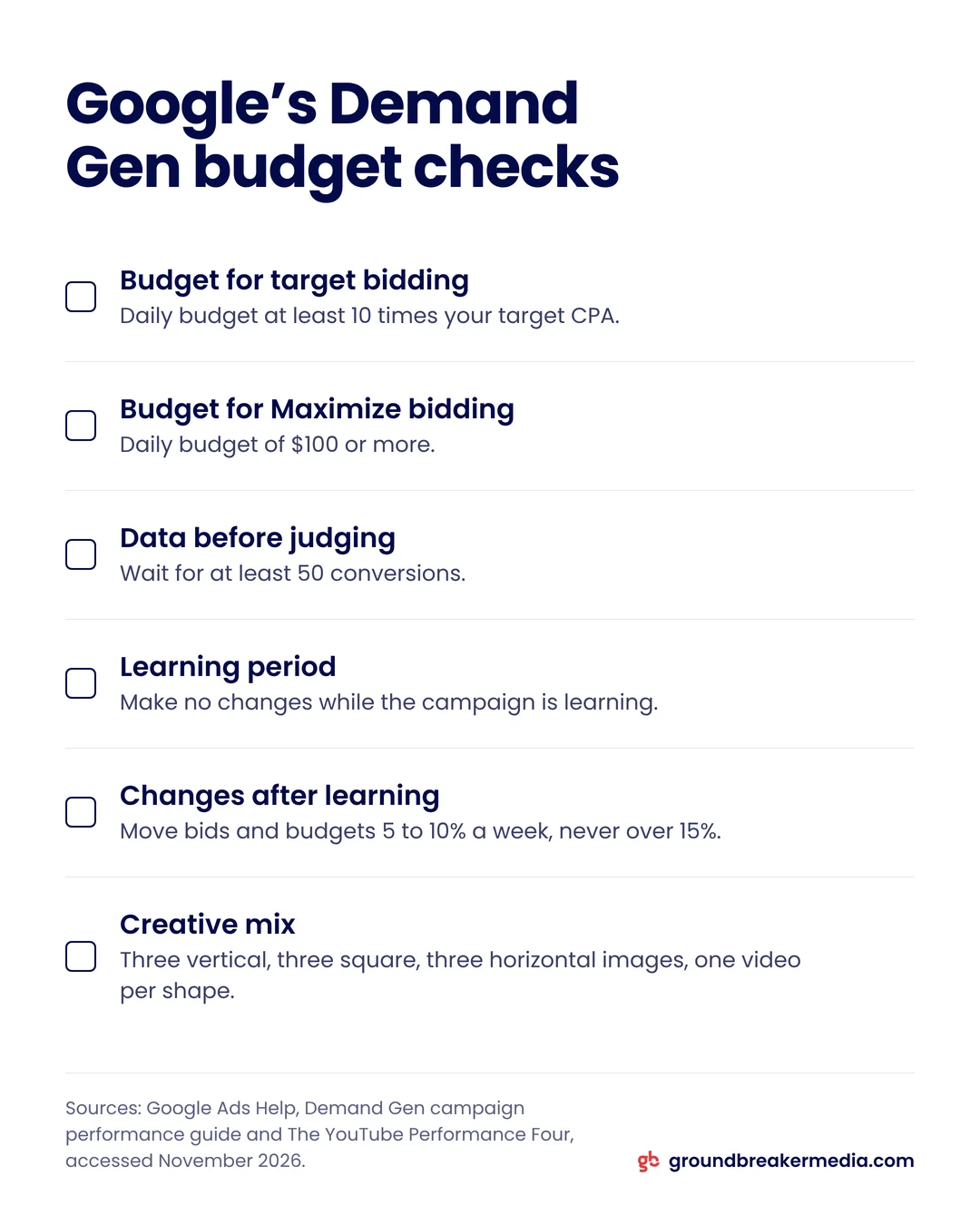
- Assets. Google’s YouTube Performance Four sets a benchmark of at least one ad per campaign with three vertical, three square and three horizontal images, plus one video in each of those shapes.
Google’s own data favors mixed formats: advertisers using both video and image assets "saw 20% more conversions at the same cost per action than those who uploaded video assets only," based on Google internal data from January to February 2024 (Google, September 4, 2024). Performance Max also serves on YouTube, mixed with every other Google channel, which the Performance Max guide covers.
How much budget does a Demand Gen campaign need?
Google recommends a daily budget of at least 10 times your target cost per acquisition for target-based bidding, and $100 or more a day for Maximize strategies.
The Demand Gen performance guide in Google Ads Help is blunt about why: "If there is a low daily budget, that’s usually the top reason a new Demand Gen campaign underperforms." It adds that the campaign "needs to generate at least 50 conversions to get a good foundational understanding," and the YouTube Performance Four says to "slowly flex bids and budgets by 5-10% (and no more than 15%) per week."
Daily Demand Gen budget ≥ 10 × target cost per acquisition
Example (hypothetical numbers): a business can afford $50 per lead, using the ceiling method in the cost per lead guide. Google’s rule puts the daily budget at $500 or more. At a $50 cost per lead, 50 conversions take $2,500 of spend, about five days at that budget, before the first fair read.
If $500 a day is out of reach, there are three workable routes:
- Use Maximize conversions at $100 or more a day and accept a slower path to 50 conversions.
- Count shallower actions as secondary conversions, which Google says gives the system more data to ramp faster, while you bid on the lead.
- Start with search, where the Google Ads budget guide shows how to size spend from your own funnel, and add Demand Gen later.
When are YouTube ads worth the cost?
YouTube ads are worth the cost when you can trace them to cost per customer, or when you buy reach on purpose and judge it by reach rather than by leads.
Decide the job first. Bumper and non-skippable buys, priced per 1,000 impressions, are for putting a message in front of many people. Demand Gen is for action. We judge each against its own goal, because a reach campaign measured on last week’s cost per lead will almost always look like waste.
Then measure past the platform. Google Ads counts conversions inside its own attribution settings, and the platform and CRM revenue guide explains why those totals rarely match closed deals. GroundBreaker Media ties YouTube and Demand Gen conversions to CRM outcomes through its Revenue Infrastructure work.
Finally, plan for creative. Demand Gen wants vertical, square and horizontal versions, and the vertical cut can also feed TikTok campaigns. Creator-style video is often the fastest way to produce enough variety, which the UGC ads guide covers along with creative testing.
Frequently asked questions
Do I pay when someone skips my YouTube ad?
Under cost-per-view bidding, no. Google Ads Help says an in-stream view is counted, and charged, only when someone watches 30 seconds, the whole ad if it is shorter, or interacts with it. Under Target CPM, Target CPA or Maximize conversions bidding, skippable in-stream ads are charged per impression, so a skipped ad can still cost you.
How long should a YouTube ad be?
It depends on the format. Google Ads Help sets bumper ads at 6 seconds, with a 5-second minimum, and non-skippable in-stream ads at 15 to 60 seconds depending on campaign subtype. Skippable in-stream ads have no maximum, though Google recommends under 3 minutes, and it recommends keeping Shorts ads under 60 seconds.
Can a small business buy the YouTube masthead?
Only by reservation. Google Ads Help says masthead ads, which sit at the top of the YouTube Home feed on desktop, mobile and TV, are "only available on a reservation basis," bought on CPM or cost-per-hour terms. For small and mid-sized budgets, we start with in-stream, in-feed and Shorts placements bought in the auction instead.
Can a Demand Gen campaign run only on YouTube?
Yes. Demand Gen channel controls include a "Let me choose" option where you select YouTube in-stream, in-feed and Shorts and leave out Discover, Gmail, Maps and the Google Display Network. Google recommends "All Google channels" for most advertisers, so run a YouTube-only campaign as a test against that default before you commit budget.
Written by
GroundBreaker Media
A performance marketing agency that connects what you spend to what it brings back. About us
Related insights
All insights


Want one version of the truth? Let's look at your numbers.
A short call, an honest read on what your marketing is producing, and clear next steps.