
Outsourced marketing: how to choose an agency, white-label partner or nearshore team
Choose an agency, white-label partner or nearshore team by the gap it fills, keep every account in your name and judge results against a written baseline.
 By GroundBreaker Media16 min read

Choose outside marketing help by matching it to what you lack: an agency or specialist for missing skills, a nearshore team or, for agencies, a white-label partner for extra capacity. Then keep every account in your company’s name, compare proposals on the same scope over 12 months and judge results against a written baseline from your own records.
What is outsourced marketing?
Outsourced marketing is any marketing job, from running ads and SEO to building tracking or writing reports, that an outside company or freelancer performs under contract instead of your own employees. You keep the strategy, the budget and the accounts. The outside team supplies the hours and the skills.
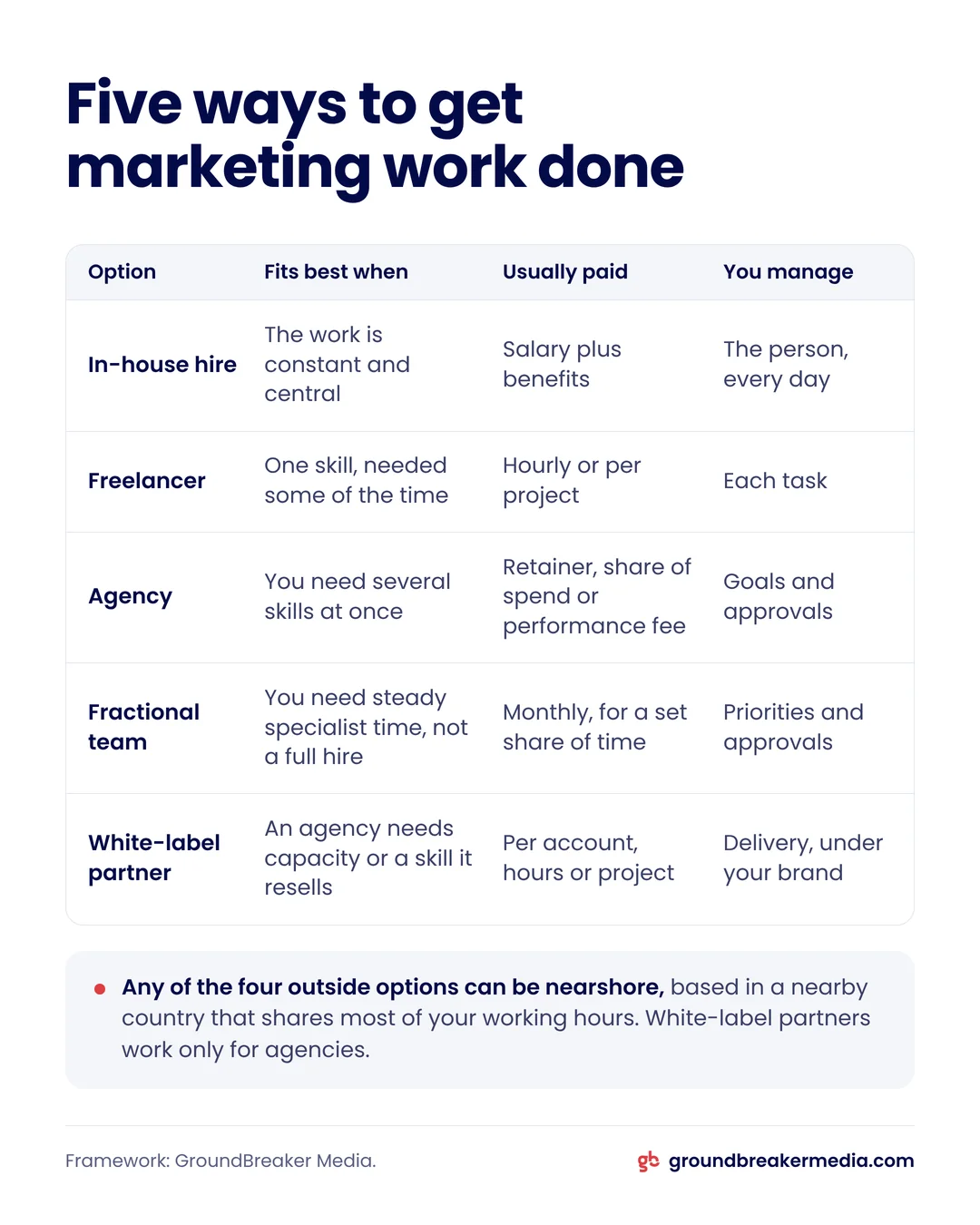
Apart from hiring staff, there are three common ways to buy the work, plus a fourth that only agencies use:
- Freelancer: a single specialist, paid by the hour or the project.
- Agency: a company that sells marketing services directly to the business that pays for them.
- Fractional team: specialists who give your account a set share of their week, often billed monthly.
- White-label partner: a company that does work an agency resells under its own brand. Only agencies hire one.
Any of these can be nearshore, meaning based in a nearby country that shares most of your working hours.
Large companies mix in-house teams with outside help. A 2023 survey of 162 members of the Association of National Advertisers (ANA) found that 82% of respondents had an in-house agency, up from 78% in 2018, yet 92% still used outside agencies. The two main reasons were bandwidth and capabilities the in-house team lacked. Deloitte’s 2024 Global Outsourcing Survey of more than 500 executives found that half were using outsourced services for front-office work such as sales and marketing, and 40% expected to increase their investment in third-party outsourcing.
Should you hire in-house or outsource your marketing?
Hire in-house when the work is constant and central to your business and needs someone on hand every day. Outsource when you need skills you would use only part of the time, when you need capacity faster than you can hire or when the job requires a team rather than one person.
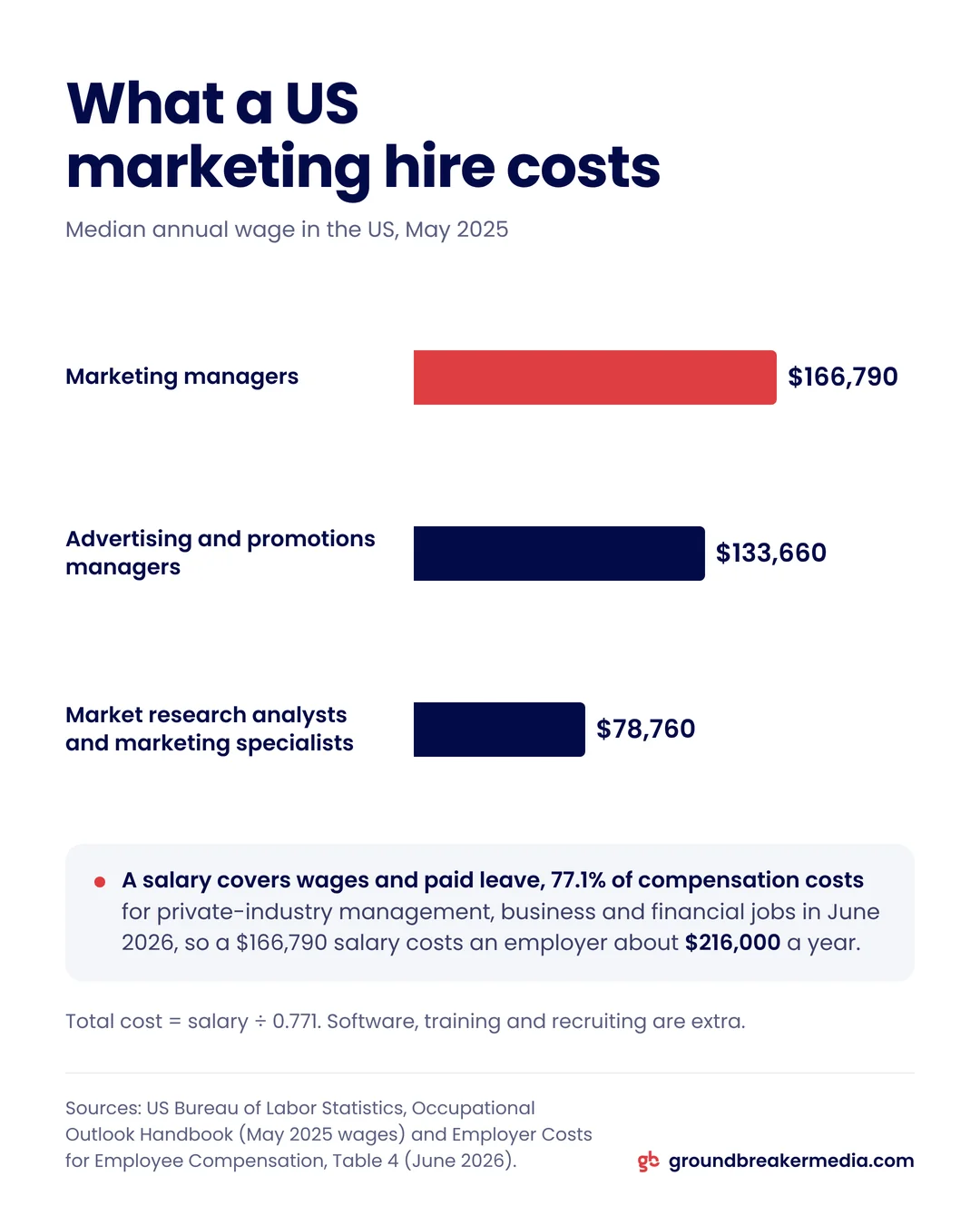
Start with what a hire really costs. The US Bureau of Labor Statistics (BLS) put the median annual wage for marketing managers at $166,790 in May 2025, for advertising and promotions managers at $133,660 and for market research analysts and marketing specialists at $78,760. Wages are only part of the bill. In June 2026, wages and salaries made up 67.5% of compensation costs for private-industry workers in management, business and financial occupations, the group that includes these jobs, and paid leave another 9.6%, according to the BLS Employer Costs for Employee Compensation release. A salary already pays for vacation and holidays, so it covers about 77.1% of the total, and a $166,790 salary costs an employer about $216,000 a year ($166,790 ÷ 0.771) before software, training and recruiting.
Total cost of a hire = annual salary ÷ (wage share + paid leave share of compensation), or 0.771 for this group in June 2026
The same math works for a specialist. One market research analyst or marketing specialist at the BLS median of $78,760 comes to about $102,200 a year, or roughly $8,500 a month, before tools and management time. That monthly figure is a useful yardstick when you compare an agency proposal with a hire. These are US figures in US dollars. In Canada, the federal Job Bank puts the median wage for marketing managers at C$57.69 an hour for 2024 to 2025 and publishes figures for each region.
A single person rarely covers paid search, paid social, tracking, landing pages and reporting at the same depth. A business that needs all five either hires several people or buys some of the work from outside. For a small or midsize business, buying part of the work can cost less than a full team. It works only if someone inside still owns the goals and the budget, so decide which parts of the work need daily presence and which need specialist depth, then staff the first and outsource the second.
When is a performance marketing agency the right kind of outside help?
A performance marketing agency is the right kind of outside help when you buy advertising and want it judged on leads your sales team accepts, new customers and revenue. Its work covers paid media, ad creative, conversion tracking, landing pages and reporting, and it should answer for cost per customer (ad spend divided by new customers), not for clicks or impressions.
Where a creative agency is hired for ideas and reach, a performance agency moves budgets, bids and ads during the month to bring cost per customer down and revenue up.
Tracking decides how such an agency can be paid: a fee tied to leads or sales works only when those leads and sales are measured. The work, the fee models and what to expect in the first months are covered in what a performance marketing agency does. The platforms themselves, with what each one costs, are laid side by side in online advertising for small businesses.
What does outsourced marketing cost?
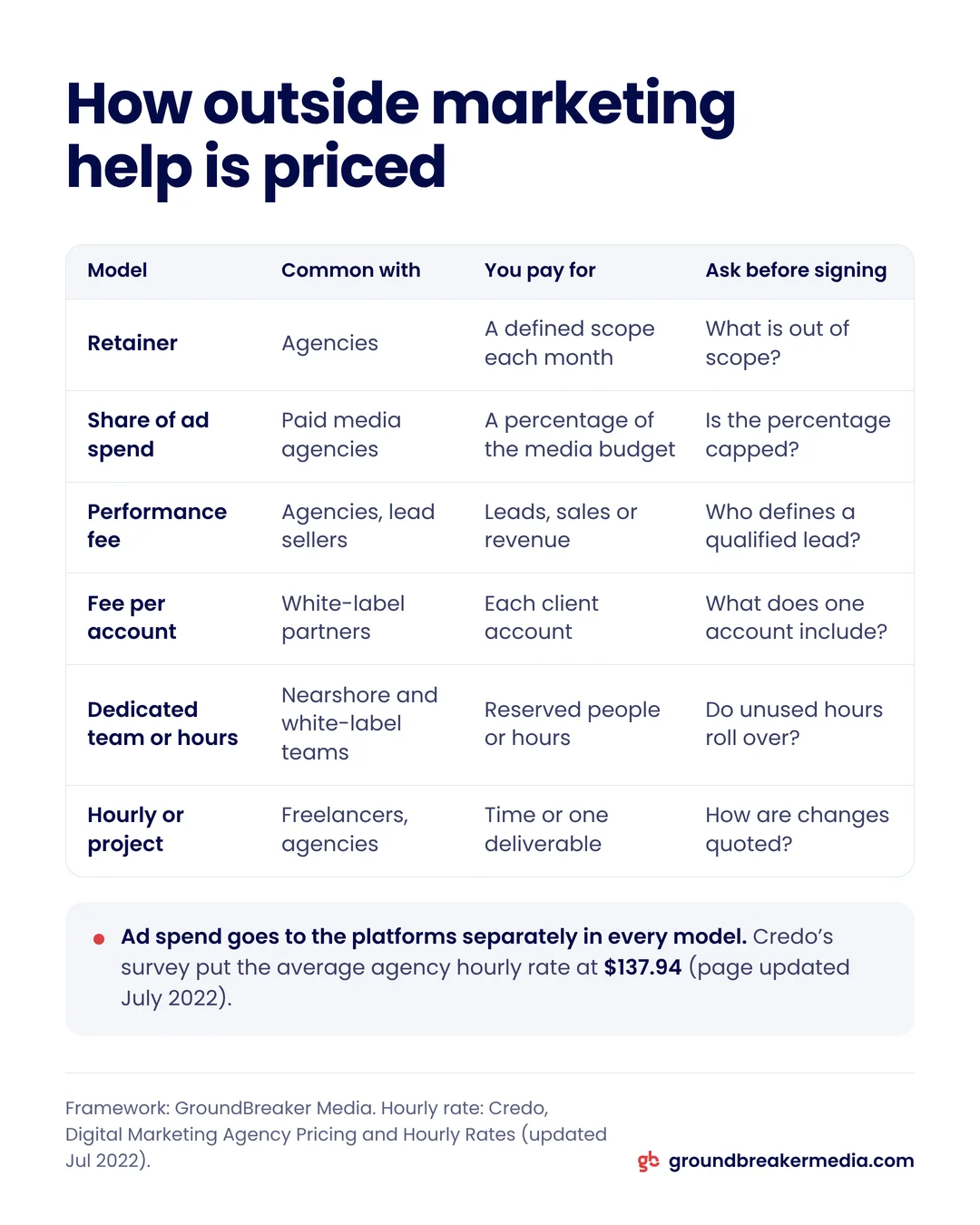
Outsourced marketing costs a provider’s fee plus the ad spend, which almost always goes straight to the platforms. In Credo’s pricing survey, on a page last updated in July 2022, the average agency charged $137.94 an hour, and about half set retainer minimums of $2,000 a month or less.
The same survey found that 13.5% of agencies set minimums above $5,000 a month and 49.88% did not bill by the hour. The survey is several years old, so use these figures as a starting point, not a quote.
Fee models shape what the provider is paid to do:
- Retainer: a fixed monthly fee for a defined scope. It works when the scope is stable and written down.
- Share of ad spend: the fee tracks the media budget, so the provider earns more when you spend more, even if sales do not rise.
- Performance fee: payment per lead, per sale or as a share of revenue. It needs reliable tracking and a written definition of a qualified lead.
- Fee per account: one price for each client account, the way many white-label partners charge agencies.
- Dedicated team or block of hours: reserved people each month, which suits ongoing work across several accounts.
- Hourly or per project: best for audits, builds and one-off fixes.
Ask for a written scope for each fee and a price list for work outside it, then compare proposals on the 12-month total for the same scope, including your own time spent managing the work. Fee models for performance work are compared in how a performance marketing agency charges, and the ad budget itself in how much to spend on Google Ads.
Which kind of outside help fits your situation?
The right kind of outside help depends on who is buying and what is missing: a business usually needs an agency or a specialist for the skills it lacks, while an agency usually needs a white-label or nearshore team for capacity. Match the option to the gap, not to the size of the provider.
| Your situation | Start with | Why |
|---|---|---|
| A small business with no marketer, running one ad channel | A performance agency or a freelancer for that channel | You need specialist hours, not a full-time salary |
| A business with one marketer who is stretched | Specialists for the work that person cannot cover | Your marketer keeps strategy and approvals |
| A business running several channels at once | An agency that runs tracking and reporting across all of them | One team answers for cost per customer across channels |
| An agency with more client work than staff | A white-label partner | Capacity under your brand, without new hires |
| An agency that needs extra hands during its own workday | A nearshore team, often working white-label | Shared hours for live calls and same-day fixes |
| Any company whose marketing work is constant and central | An in-house hire, with outside specialists around them | Daily presence matters more than breadth |
Many companies end up with a mix. A common pattern is one person inside who owns the goals, the budget and the customer, with outside specialists doing the channel work, and a written scorecard that both sides read the same way.
Which questions matter most before you sign with an agency?
The questions that matter most before you sign with an agency are who owns the ad accounts and data, how revenue will be measured and what you keep if you leave. Get each answer in writing.
Ownership comes first because it is the hardest problem to fix later. Open every account in your company’s name and add the agency as a user you can remove.
The answers show whether the agency is paid to produce sales or only to stay busy. Reporting should reach sales and revenue, not stop at leads. You should also know who will do the work, since the people in the sales meeting may never touch your account. The contract should list what you keep on exit: accounts, creative, tracking and reports.
Google’s advice on hiring an SEO is a useful second check, and much of it carries over to other marketing providers. Its Search Central guide says that "No one can guarantee a #1 ranking on Google," and suggests asking for examples of previous work, the results the provider expects and in what time frame, and its experience in your industry.
The full list of questions, with what a good answer sounds like for each, is in questions to ask before hiring a marketing agency.

How do white-label partners help agencies grow?
White-label partners let an agency sell more services, or serve more clients, without hiring for every new account. The partner plans and delivers the work, and the agency presents it to its clients under its own brand.
Brands, not agencies, answered the ANA survey, but agencies bring in partners for similar reasons: capacity and skills the team lacks.
The partnership depends on four things working from the first day. Confidentiality needs a signed NDA plus a clause that bars the partner from approaching the agency’s clients. Onboarding needs a written checklist for every new client. Quality control needs a second person to review each launch. Reporting needs to arrive in the agency’s template and voice.
What to expect from a partner on confidentiality, onboarding, reporting, pricing and red flags is covered in white-label marketing partners.
When does a nearshore team beat an offshore one?
A nearshore team beats an offshore one when the work needs live calls, same-day fixes and daily collaboration rather than overnight handoffs. Nearshore marketing is outsourced marketing done from a nearby country whose workday overlaps most of yours, which for US and Canadian companies usually means Latin America.
Time zones decide most of the difference. Costa Rica keeps UTC-6 all year with no daylight saving time, so it is one hour behind New York and Toronto in winter and two hours behind in summer. An offshore team on another continent can be well run, but a campaign that breaks at 10 a.m. in New York may wait until the next morning for a fix.
Cost is no longer the main reason companies outsource. In Deloitte’s 2024 survey, 34% named cost savings as the main reason, down from 70% four years earlier, and improved access to talent, at 42%, was the most cited driver. Any saving only shows in an itemized proposal, once seniority and the time spent correcting work are counted. Language is the other check: talk with the specialists who would work on your account before you sign.
The time zone table, the onshore and offshore comparison, the English proficiency data and a checklist for evaluating a team are in nearshore marketing.

How do you keep control of your accounts, data and clients when you outsource?
Keep ownership of every account in your name, give the outside team only the access it needs and put confidentiality, data and handover terms in the contract. Control comes from how the accounts are set up, not from trust.
For a business, that means your company is the admin on Google Ads, Meta, Google Analytics, the tag manager and the CRM, and the provider gets a user role or a manager account link you can revoke. For an agency hiring a white-label partner, the agency or its client holds ownership, and the partner works with access the agency grants and can remove, often through the agency’s manager account.
Customer data needs the same care. Before an outside team opens your CRM, agree in writing what it may access, where the data is stored and how it is deleted when the work ends. Under PIPEDA, Canada’s federal private-sector privacy law, a business stays responsible for personal information it transfers to a third party for processing and must use contracts or other means to give it comparable protection, according to the Office of the Privacy Commissioner of Canada. The California Consumer Privacy Act requires the businesses it covers to sign an agreement with service providers that receive consumers’ personal information.
Money needs to be just as clear. Google’s rules for third parties that manage Google Ads call for Google’s exact charges to be reported apart from any fees and for management fees to be disclosed in writing, so ask for ad spend and fees on separate lines in every report and invoice, whatever the platform.
Clients need protecting too. An agency that brings in a partner should agree in writing whether partner staff ever speak to clients, under what name and what happens if a client asks to work with the partner directly. Which access level to keep, and what to hold on to when you leave, is covered in who should own your ad accounts.
How should you onboard an outside marketing team?
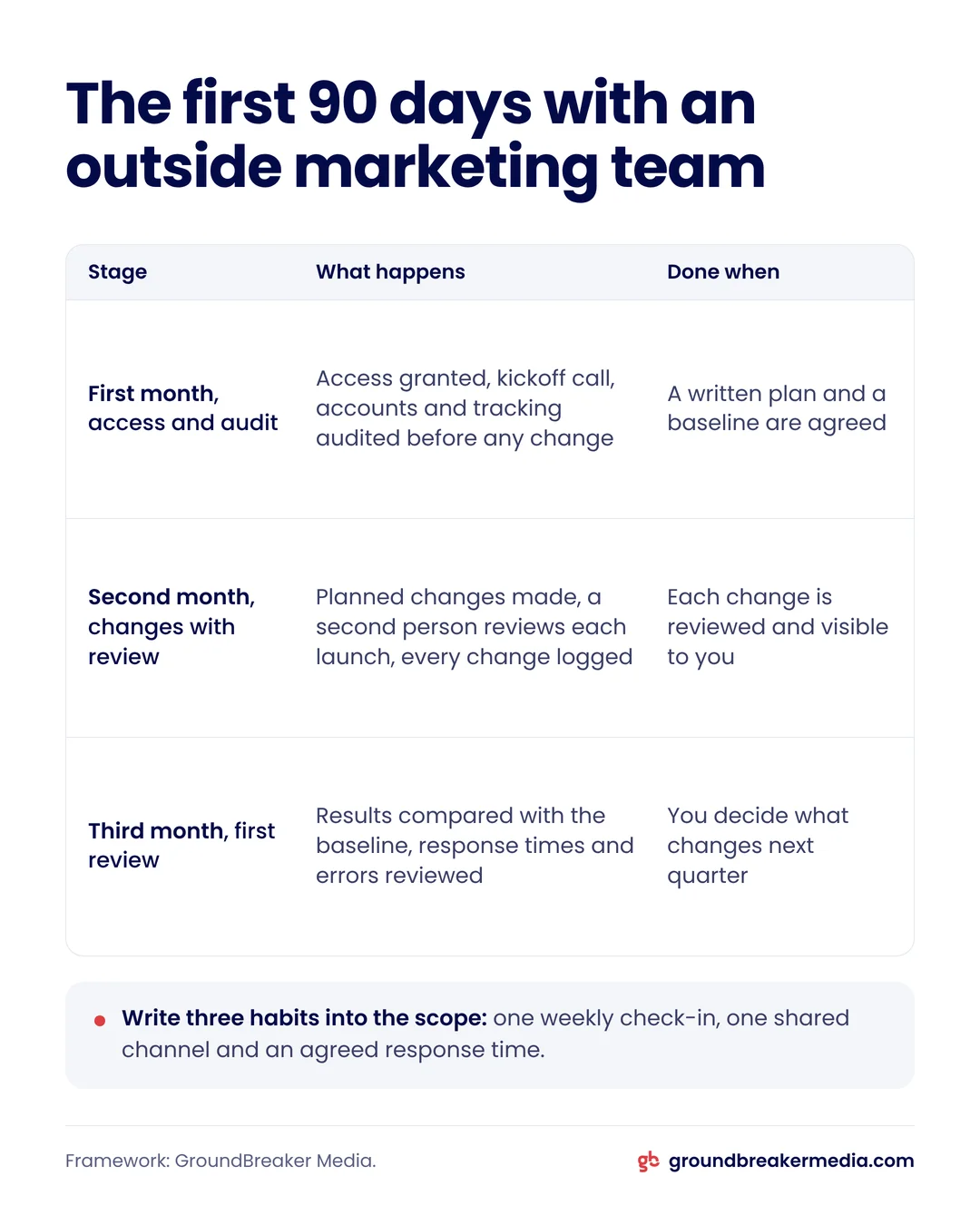
Onboard an outside team in three stages over the first 90 days: access and an audit in the first month, changes with review in the second and a first comparison against the baseline in the third. Skipping the audit is how a new provider ends up breaking something that was working.
- First month, access and audit. Grant access, hold a kickoff call and share the goals, the budget, past results and the approval rules. The provider audits the accounts and the tracking before changing anything and writes up what it found. The month ends with a written plan and a baseline: the numbers every later month is compared with.
- Second month, changes with review. The provider makes the changes in the plan, with a second person reviewing each launch and every change logged where you can see it. You approve anything that touches budget, offers or brand.
- Third month, first review. Compare the results with the baseline, review response times and errors, and agree what changes for the next quarter. Google Ads says a Smart Bidding strategy enters a learning period after major changes, such as new conversion goals, and can take one to two conversion cycles to settle, so judge the trend, not a single week.
Write three habits into the scope: one weekly check-in, one shared channel for questions and an agreed response time.
How do you know if outsourced marketing is working?
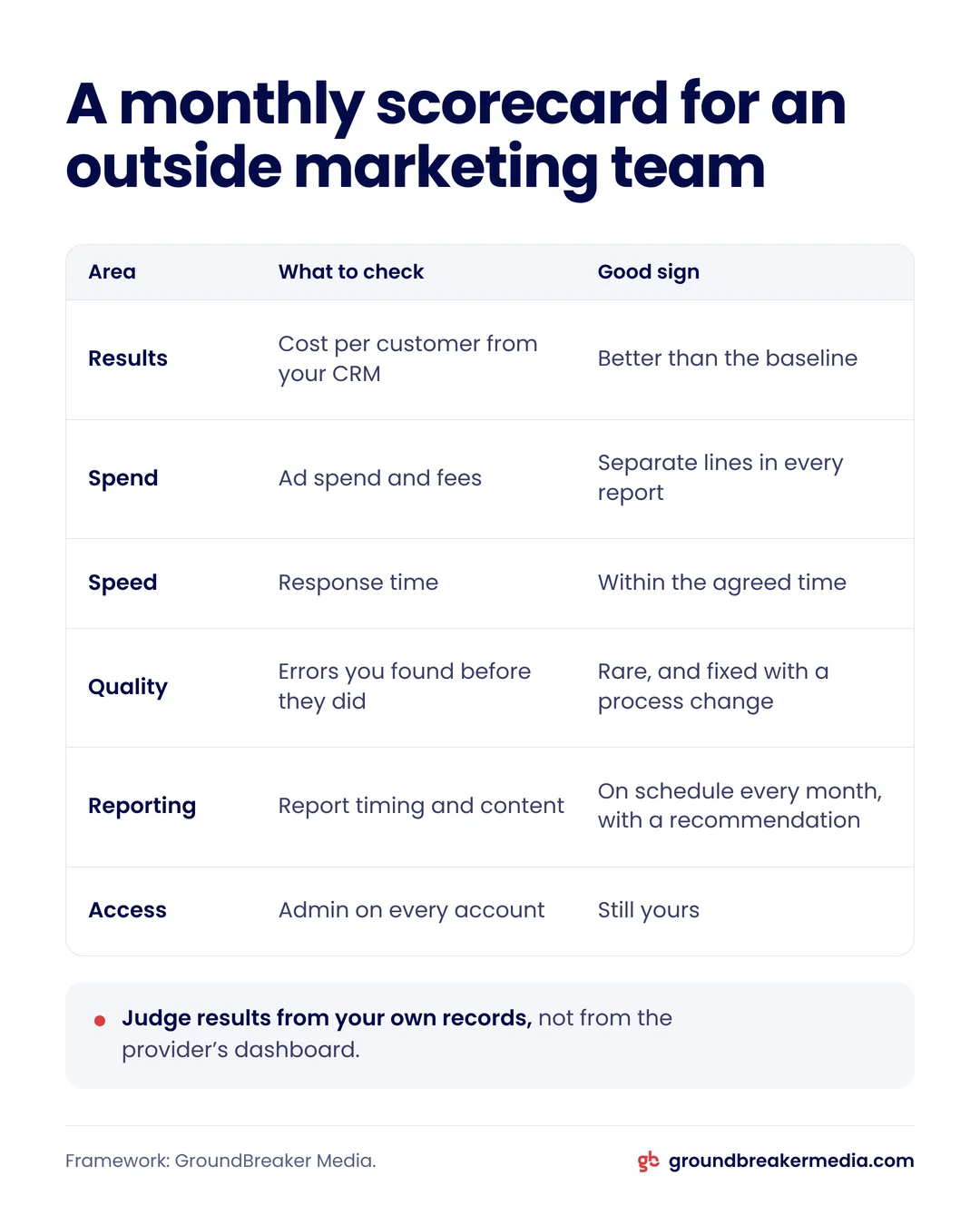
Outsourced marketing is working when your cost per customer improves against the baseline and the provider meets the service terms you agreed. Activity, such as posts published or campaigns launched, is not a result.
Judge results from your own records, not the provider’s dashboard. Use the ad platforms’ invoices for spend and your CRM for leads, customers and revenue. If a provider reports more conversions than your sales team can find, the gap needs an explanation before the next invoice. The setup that makes those numbers reliable is explained in marketing analytics for small businesses, and the numbers that belong in front of an owner are in how to read a marketing report.
Service counts as well. Track how fast the provider answers, how many errors you find before they do and whether reports arrive on schedule with a recommendation. Also check that you still hold admin access everywhere. A provider that hits its numbers but needs constant correction costs more than its invoice shows.
What are the warning signs of a bad marketing agency or partner?
Three warning signs stand out in a marketing agency or partner: a guarantee of rankings or results, a request to register your ad accounts in its own name and no clear answer on who will do your work. A guarantee ignores how auctions and rankings work, and the other two take control away from you.
Google’s Search Central guide lists several more: providers that email you out of the blue, a requirement that your website link to the provider’s site and companies that are secretive or will not clearly explain what they intend to do. Other signs to watch for:
- Reports that show clicks and leads but never sales or revenue.
- Ad spend and fees combined in one number.
- No written onboarding plan, review process or change log.
- Subcontracting that you learn about after the fact.
- A long minimum term with no exit terms for accounts, creative and tracking.
Red flags specific to white-label partners are listed in choosing a white-label partner.
Where should a business or agency start with outsourced marketing?
Start by writing down what you need done, what you will keep in-house and how you will judge the result, then talk to two or three providers with that brief in hand. A clear brief makes proposals comparable and exposes the providers who would rather sell you a package.
- List the work. Name the channels and tasks, the hours each needs and the skills involved.
- Decide what stays in-house. Usually goals, budget, approvals and the customer relationship.
- Set the scoreboard. Choose the numbers you will judge, such as cost per customer, with a baseline.
- Put the accounts in your name. Do it before anyone new gets access.
- Compare proposals on the same scope. Look at the fee model, the 12-month total and the exit terms.
- Start with a 90-day plan. Review it at the end before you commit to more.
If you are an agency weighing a partner, the nearshore marketing services page describes how GroundBreaker Media’s team works with agencies.
Frequently asked questions
What should an outsourced marketing contract include?
Include a written scope, the fee model and the price of extra work, ad spend billed apart from fees, every account in your name, confidentiality and data terms, a notice period and a handover list for accounts, creative and tracking. An agency hiring a white-label partner should also set rules on whether the partner ever talks to clients.
Can you outsource only part of your marketing?
Yes, and many companies do. A common split keeps strategy, budget, approvals and customer contact in-house and outsources specialist work such as paid media, tracking, landing pages or SEO. The ANA’s 2023 survey found that companies with in-house agencies still used outside agencies, mainly for capacity and skills their own teams lacked.
What is the difference between an agency and a white-label partner?
An agency works directly for the business that pays it, under the agency’s own name. A white-label partner sells to agencies, and the agency resells the work to its clients under the agency’s brand. The partner should not deal with those clients unless the agency agrees to it in writing.
How long does it take to see results from an outsourced marketing team?
Expect about 90 days for a first fair read on paid media, and longer for SEO or long sales cycles. The first month goes to access, an audit and a baseline, the second to changes and platform learning. If deals take longer than 90 days to close, judge the early months on qualified leads, then on cost per customer.
Written by
GroundBreaker Media
A performance marketing agency that connects what you spend to what it brings back. About us
Related insights
All insights


Want one version of the truth? Start with a free audit.
Answer 10 quick questions and get a written audit within 2 business days: what your marketing is producing, what's holding it back, and what to fix first.