
Online advertising for small businesses: platforms, costs and where to start
What Google, Microsoft, Meta, YouTube, TikTok, Reddit and LinkedIn ads cost, what each needs to learn, and where a small business should start.
 By GroundBreaker Media21 min read

Online advertising for a small business means paying Google, Microsoft, Meta, YouTube, TikTok, Reddit or LinkedIn to show your ads to likely buyers. None sells at a fixed price, and each needs a steady flow of results before its bidding works. Start on the platform where your buyers already look, fund it properly and judge it by cost per customer.
What is online advertising, and which platforms can a small business use?
Online advertising is paid placement of your ads in search results, social feeds and videos, priced in an auction each time an ad could show. Many people call it PPC advertising, short for pay-per-click, but only some platforms charge per click: others charge per 1,000 impressions, and Google Local Services Ads charge per lead.
The platforms fall into three groups, set by what the buyer is doing when the ad appears:
- Search ads reach people who typed a need into a search box: Google Ads search campaigns, Google Local Services Ads and Microsoft Advertising.
- Social ads reach people scrolling a feed, chosen by the platform’s delivery system: Meta (Facebook and Instagram), TikTok, Reddit and LinkedIn.
- Video ads reach people watching: YouTube, bought through Google Ads.
That split decides more than the price. A search ad answers demand that already exists, so it tends to bring buyers who are ready to act. A social or video ad has to create interest before anyone searches, which takes more impressions and better creative. Our comparison of Google Ads and Meta Ads shows how the two modes feed each other.
| Platform | Where the ad appears | Usually charged per | Reach, as reported |
|---|---|---|---|
| Google Ads search | Google search results | Click | More than 5 trillion Google searches a year, worldwide (Google, March 2025) |
| Google Local Services Ads | Top of Google results for local services | Lead | Eligible service categories and countries only |
| Microsoft Advertising | Bing and Microsoft’s search network | Click | 1 billion Bing monthly active users, worldwide (Microsoft, April 2026) |
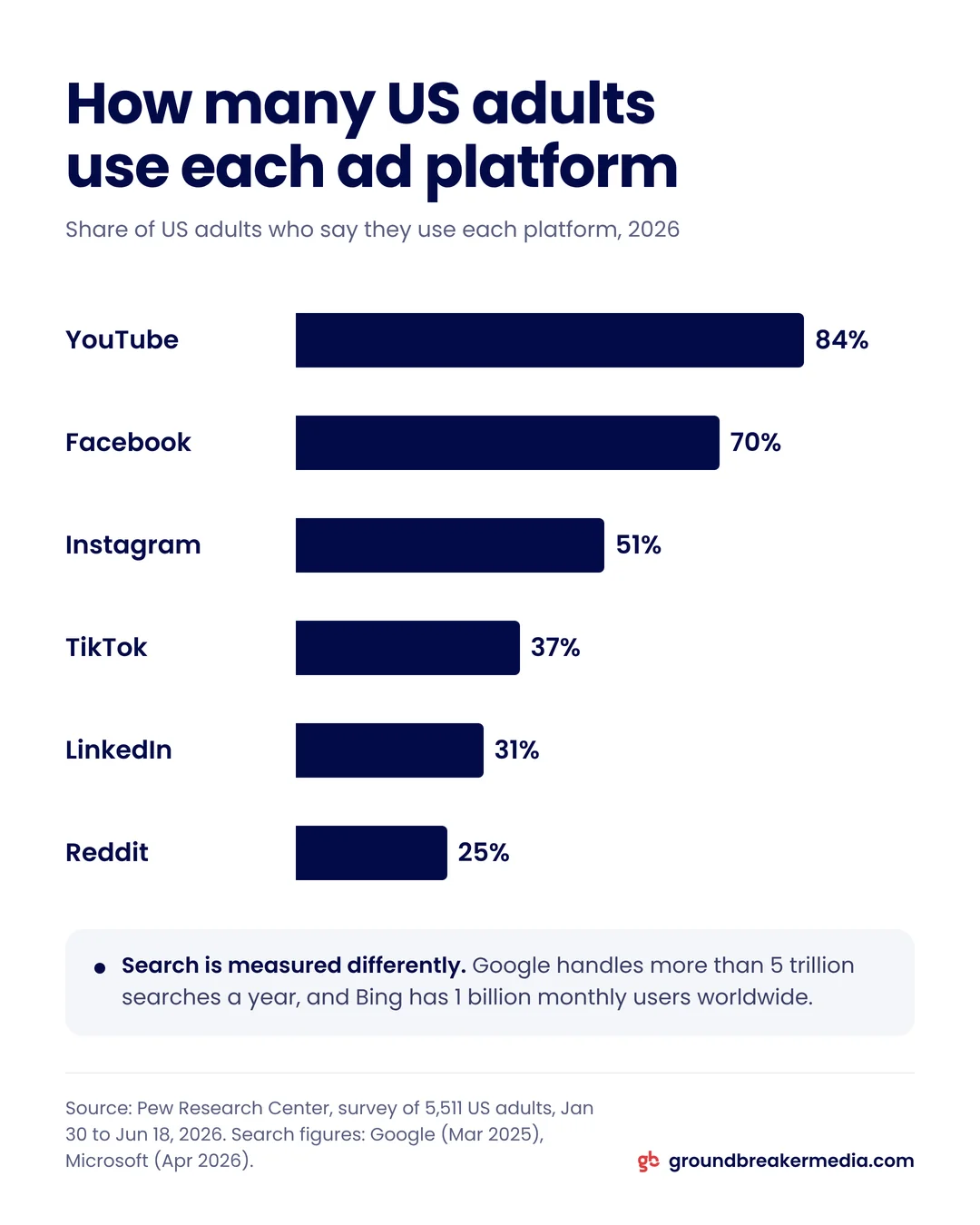
| Meta | Facebook and Instagram feeds, Stories and Reels | The billing event you choose, such as impressions or clicks | Facebook 70%, Instagram 51% of US adults (Pew Research Center, 2026) |
| YouTube | Before, during and beside videos, and in Shorts | View or 1,000 impressions | 84% of US adults (Pew Research Center, 2026) |
| TikTok | The For You feed | Impression, in most campaigns | 37% of US adults (Pew Research Center, 2026) |
| Feeds and conversation threads in communities | Impression or click, by objective | 25% of US adults (Pew Research Center, 2026) | |
| The LinkedIn feed and inbox | The event tied to your objective | 31% of US adults (Pew Research Center, 2026) |
The reach figures come from different sources and measure different things, so read them as a sense of scale, not a ranking. The Pew Research Center figures are the share of US adults who say they ever use each platform, from a survey of 5,511 adults between January 30 and June 18, 2026.
How much does online advertising cost?
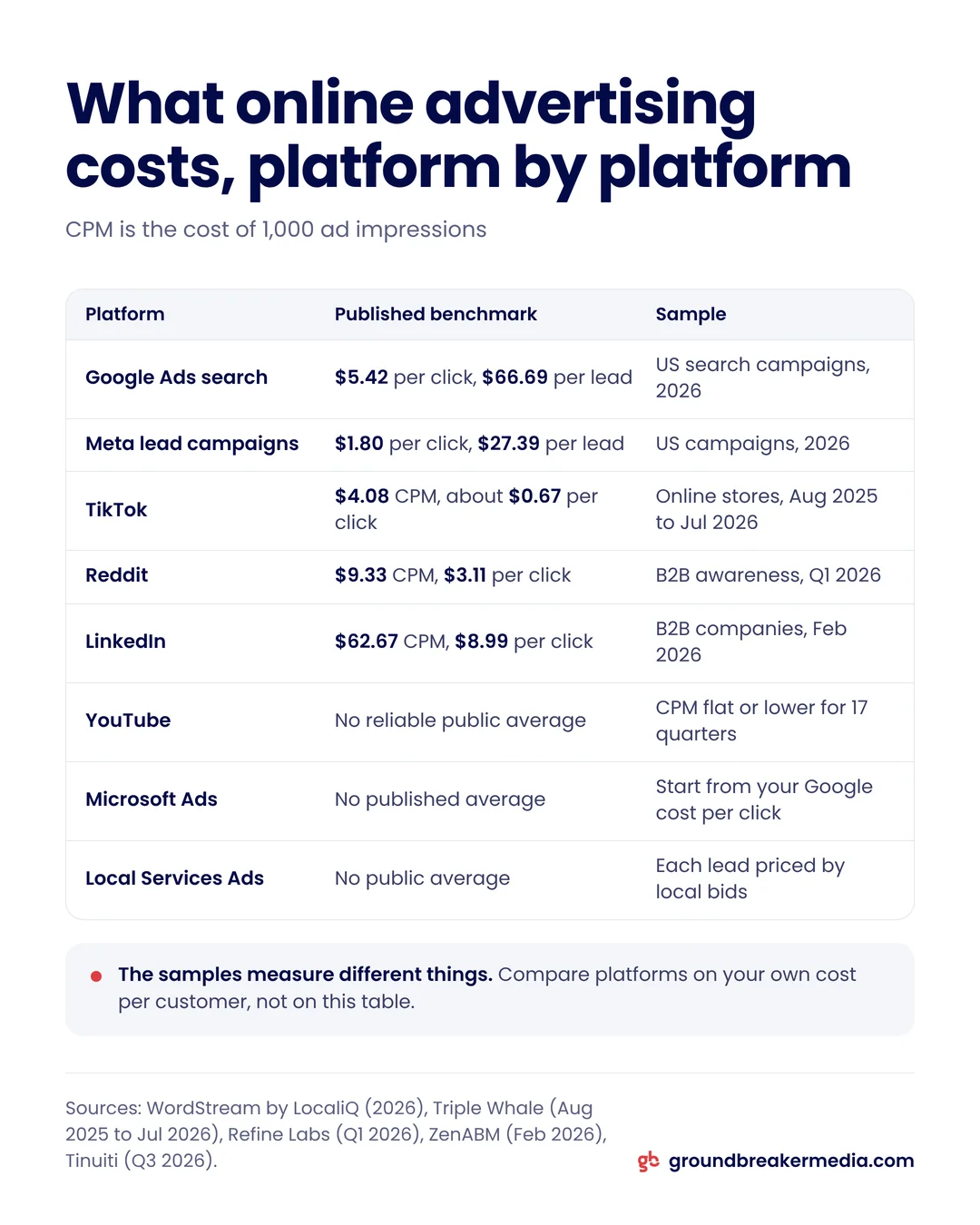
Online advertising costs what the auction sets for your audience on the day, and the latest public medians put a US Google search click at $5.42 and a Meta lead at $27.39 (WordStream by LocaliQ, 2026). No platform publishes a price list, and for three of them, Microsoft, YouTube and Local Services Ads, there is no reliable public benchmark either.
Every platform runs an auction, but each one weighs different things. Microsoft says the price of a click depends on your bid, the competition and how relevant your ad is. Meta’s auction weighs your bid, its estimate of how likely a person is to take the action you want, and ad quality. On Local Services Ads, the price of a lead is set by what similar local businesses bid for the same kind of lead. A relevant ad that people act on can win auctions for less than a weaker ad with a higher bid.
| Platform | Published benchmark | Source and sample |
|---|---|---|
| Google Ads search | $5.42 median cost per click; $66.69 median cost per lead | WordStream by LocaliQ 2026: 13,474 US search campaigns, April 2025 to March 2026 |
| Meta, lead campaigns | $1.80 median cost per click; $27.39 median cost per lead | WordStream by LocaliQ 2026: 1,892 US campaigns, April 2025 to June 2026 |
| TikTok | $4.08 cost per 1,000 impressions; about $0.67 per click, implied | Triple Whale: 5,900+ ecommerce brands, August 2025 to July 2026 |
| $9.33 per 1,000 impressions; $3.11 per click | Refine Labs: B2B awareness campaigns, Q1 2026 | |
| $8.99 per click; $62.67 per 1,000 impressions | ZenABM: 211 B2B companies, February 2026 | |
| YouTube | No reliable public average; CPM has not risen year over year in 17 quarters | Tinuiti, Q3 2026 |
| Microsoft Advertising | No published average | Microsoft Advertising, 2026 |
| Google Local Services Ads | No public average; each lead priced by local bids | Google, 2026 |
The samples do not line up. The Google and Meta medians come from US advertisers buying clicks and leads, the TikTok figures from online stores, and the Reddit and LinkedIn figures from B2B companies buying awareness. A Reddit click bought for awareness and a Google click bought for leads are different products, so do not rank platforms on this table. Use it to sanity-check the prices you see in your own account.
Cost per 1,000 impressions (CPM) is the price of 1,000 showings of an ad. Platforms that charge by impression report CPM, so convert it to a click price before comparing it with a search platform:
Implied cost per click = CPM ÷ (1,000 × click-through rate)
Industry matters more than platform averages. On Google, median cost per click ran from $1.63 in arts and entertainment to $9.87 for attorneys and legal services in the 2026 WordStream report. On Meta, median cost per lead ran from $12.30 in career and employment to $61.56 for dentists. Prices also move in different directions at the same time: in its third quarter 2026 results, Meta reported a 14% rise in the average price per ad, Reddit’s B2B CPM rose 36.8% year over year in Refine Labs’ data while LinkedIn’s fell 13.7%, and Triple Whale’s TikTok CPM fell from $5.71 to $4.08.
The platform guides go deeper on each price and what sets it: Google Ads, Facebook and Instagram, YouTube, TikTok, Reddit, LinkedIn, Microsoft and Local Services Ads.
What is the minimum budget for each advertising platform?
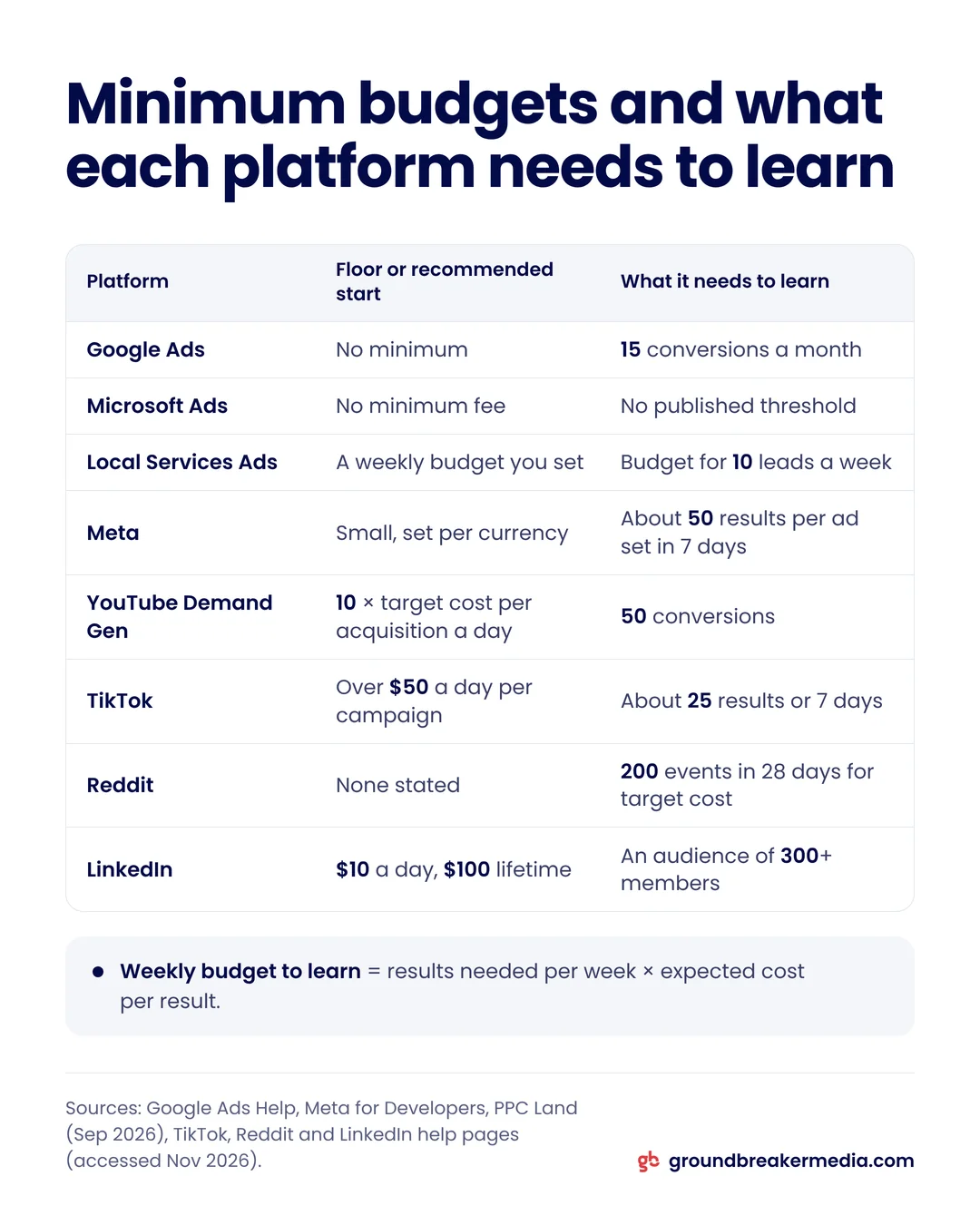
The minimum each platform accepts is low, from no floor at Google and Microsoft to just over $50 a day for a TikTok campaign. The budget that works is higher: it is the one that buys enough results, often 15 to 50 in a set period, for the platform’s bidding system to learn who converts.
| Platform | Floor, or the platform’s recommended start | What the platform says it needs to learn |
|---|---|---|
| Google Ads | No minimum. Performance Max: a daily budget of at least 3 × your target cost per acquisition | At least 15 conversions a month for the goal you bid toward |
| Microsoft Advertising | No minimum fee | No published threshold |
| Google Local Services Ads | A weekly budget you set | A budget for at least 10 leads a week; results settle in about 2 weeks |
| Meta | A small daily minimum, set per currency | About 50 optimization events per ad set within 7 days |
| YouTube (Demand Gen) | 10 × target cost per acquisition a day, or $100+ a day on Maximize | At least 50 conversions |
| TikTok | More than $50 a day per campaign, and more than $20 per ad group | Volatility eases after about 25 results or 7 days |
| No minimum stated; ad groups can overspend by up to 20% | 200 events in 28 days before target cost bidding is available | |
| $10 a day, and $100 lifetime for a new campaign | An audience of at least 300 members; 50,000+ recommended for single image ads |
Turn the learning threshold into a weekly figure before you commit:
Weekly budget to learn = results the platform needs per week × expected cost per result
Example (hypothetical numbers): a home cleaning company expects leads on Meta at $25. One ad set needs about 50 leads in a week to finish learning, so 50 × $25 = $1,250 a week, about $179 a day. With $40 a day, the ad set buys about 11 leads a week and stays in learning.
When the budget cannot reach the threshold, there are three honest choices. Bid toward an earlier step that happens more often, such as landing page views, and check lead quality in your CRM. Put the whole budget into one campaign or ad set, so one learning process gets all the data. Or run one platform properly instead of two platforms poorly.
How do you set an advertising budget for a small business?
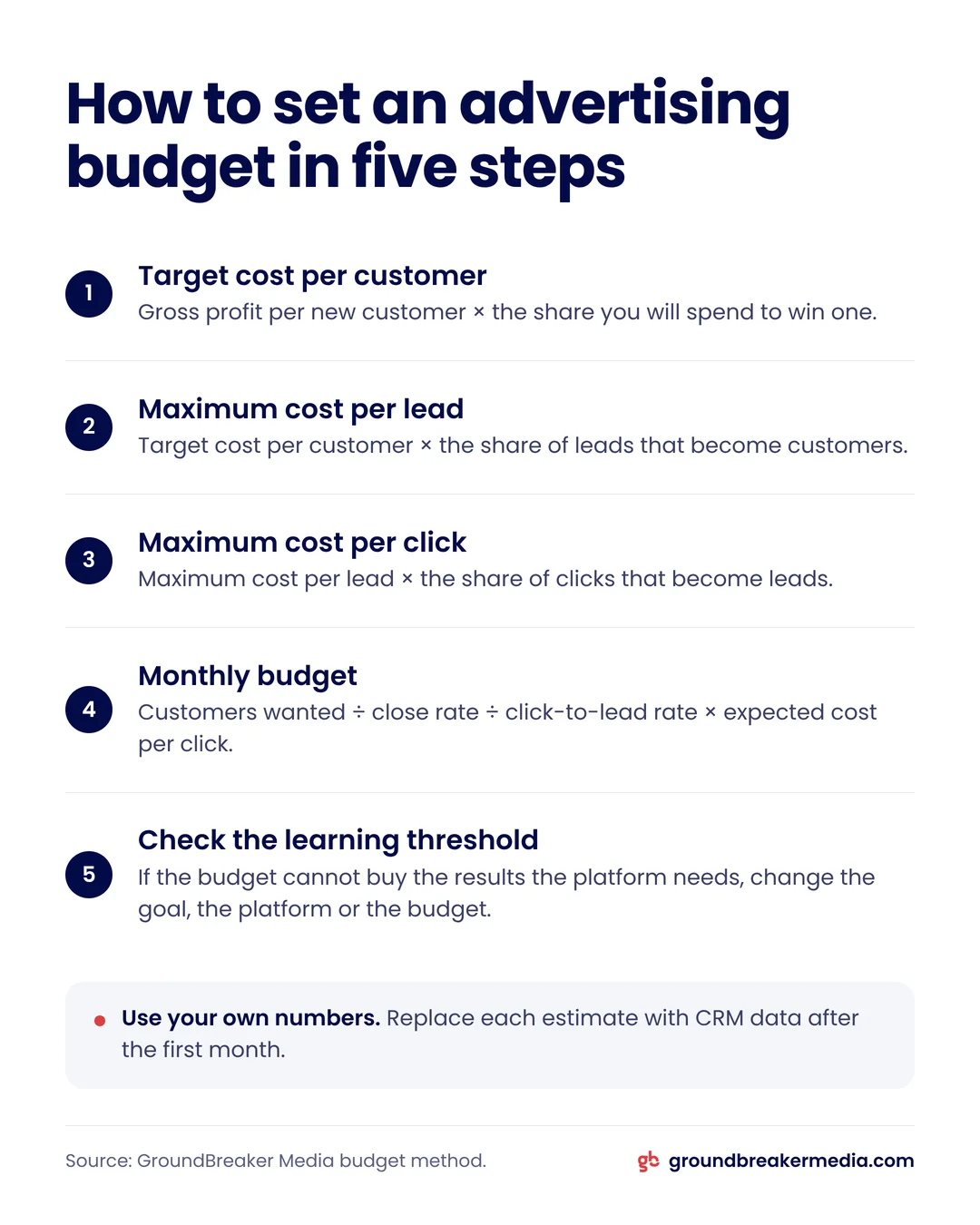
Work backward from what a new customer is worth to you. The most you can pay to win a customer sets the most you can pay for a lead and for a click, and the number of customers you want sets the monthly budget.
- Target cost per customer = gross profit per new customer × the share of that profit you will spend to win one.
- Maximum cost per lead = target cost per customer × the share of leads that become customers. The cost per lead guide explains this step in full.
- Maximum cost per click = maximum cost per lead × the share of clicks that become leads.
- Monthly budget = customers wanted ÷ lead-to-customer rate ÷ click-to-lead rate × expected cost per click. The Google Ads budget guide works through it with industry figures.
- Check the platform’s learning threshold. If the budget cannot buy the results the platform needs, change the goal, the platform or the budget.
Example (hypothetical numbers): a landscaping company earns $1,500 in gross profit from a typical new customer and will spend 20% of it to win one, so its target cost per customer is $300. A quarter of its leads become customers, which caps a lead at $75. One click in ten becomes a lead, which caps a click at $7.50. For 8 new customers a month, it needs 32 leads and 320 clicks. At an expected $6 a click, the budget is $1,920 a month, about $63 a day ($1,920 ÷ 30.4).
The checks matter as much as the sum. At 32 leads a month, the budget clears Google’s 15-conversion guideline, so Google search can learn on it. The same 32 leads would leave a Meta ad set far short of 50 a week, so at this budget Meta would serve as retargeting, not as the main source of leads. And WordStream’s 2026 median for home and home improvement businesses, $8.33 a click, sits above the $7.50 ceiling. That is why the plan uses the prices Keyword Planner shows for the company’s own keywords, and why a better click-to-lead rate on the landing page is worth more than a bigger budget.
Which advertising platform should a small business start with?
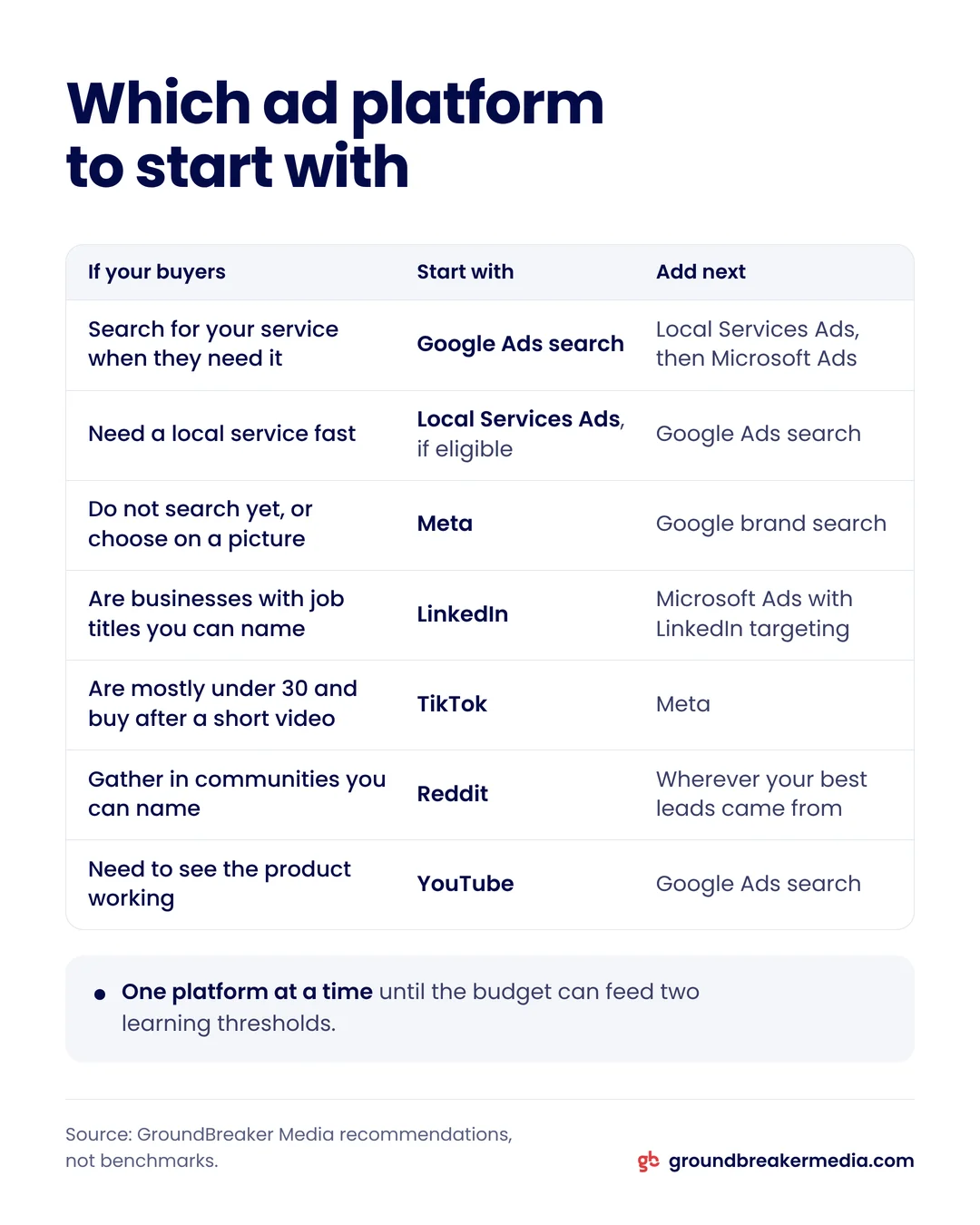
Start with Google search if people already search for what you sell, and with Meta if they do not know to look for it yet. Add a second platform only after the first one brings customers at a cost you accept.
| If your buyers | Start with | Add next |
|---|---|---|
| Search for your service when they need it | Google Ads search | Local Services Ads if you qualify; Microsoft Ads once Google is profitable |
| Need a local service fast, such as a plumber or a lawyer | Local Services Ads, if your category qualifies | Google Ads search |
| Do not search yet, or choose on a picture | Meta | Google brand search, so the interest has somewhere to land |
| Are businesses with job titles you can name, and a deal is worth thousands | Microsoft Ads with LinkedIn profile targeting | |
| Are mostly under 30 and buy after a short video | TikTok | Meta |
| Gather in online communities you can name | The platform your best leads came from | |
| Need to see the product working before they buy | YouTube | Google Ads search |
These are recommended starting points, not benchmarks, and they assume one platform at a time until the budget can feed two learning thresholds. The order follows buyer intent: a platform that reaches people already looking for you usually turns a profit sooner, which pays for the platforms that build demand. When GroundBreaker Media plans paid media for a client, the first platform is the one where buyers already show intent, and the second waits until the first proves itself in the CRM.
For a business that sells both to people who search and to people who need persuading, the Google Ads and Meta Ads comparison suggests starting splits by business type, such as 80/20 for urgent local services and 50/50 for considered purchases like real estate.
What is Google Ads best for?
Google Ads is best for reaching people at the moment they search for what you sell, and on search campaigns it charges only when someone clicks. You choose keywords, write ads and set bids; Google decides when each ad shows based on your bid, the expected click rate, ad relevance and the landing page experience.
Keyword Planner, free inside any Google Ads account, shows the search volume and a top-of-page bid range for your own keywords. The low end of the range is roughly the 20th percentile and the high end roughly the 80th percentile of what advertisers paid over the last 30 days. If your maximum cost per click sits below that range, the fix is margin or conversion rate, not budget.
Three rules from Google shape any budget:
- A bid strategy’s learning period "never lasts more than 7 days," and Google suggests judging results over two conversion cycles or two weeks, whichever is longer.
- Daily spend can reach twice your average daily budget, but the month’s charges stay within 30.4 times it.
- Value-based bidding works best with at least 15 conversions a month for the goal you bid toward.
Performance Max is a Google Ads campaign type that runs one budget across Search, YouTube, Display, Discover, Gmail and Maps, with Google choosing bids, placements and ad combinations. Since 2025, Google has added channel, search term and asset reports, plus campaign-level negative keywords, so far more of it can be seen and steered. Google recommends a daily budget of at least three times your target cost per acquisition, and the campaign needs conversion data you trust, so start with search campaigns and test Performance Max later, as the Performance Max guide explains.

When do Google Local Services Ads make sense?
Google Local Services Ads make sense for an eligible local service business that answers its phone, because they charge for each lead, a call, message or booking request, not for each click. They appear above other Google results with your rating and a Google Verified badge.
Only certain service categories in certain countries qualify, the United States and Canada among them, and Google names plumbers, electricians, HVAC companies, locksmiths, lawyers, real estate agents and health care providers among the businesses it screens. Verification takes three to four weeks on average. There are no keywords: you choose job types and service areas, set a weekly budget and pick a bidding mode, and Google recommends a budget for at least 10 leads a week.
Minimum weekly budget = 10 × expected cost per lead
Missed calls during business hours can lower your ranking, and a missed call that lasts over 20 seconds can still be charged. That makes Local Services Ads a poor fit for a business that cannot answer calls quickly. For one that can, paying per lead removes the risk of paying for clicks that never call. The Local Services Ads guide covers verification, the leads Google charges for and how ranking works.
What do Microsoft Ads add to a Google Ads account?
Microsoft Ads add more searches from the same kind of buyer, at a price your Google data can estimate, plus one thing Google cannot do: bidding up for people by their LinkedIn profile. Microsoft Advertising, once called Bing Ads, charges per click, has no minimum fee and can import your Google Ads campaigns in a few steps.
Bing had 1 billion monthly active users worldwide in April 2026, by Microsoft’s count, and a 4.8% share of worldwide search across devices in October 2026 (StatCounter). On US desktop computers, Microsoft’s network has carried a far larger share: Comscore measured 38.1% of US PC searches on it in March 2023, a figure Microsoft still cites.
LinkedIn profile targeting works as a bid adjustment, not a filter. Your ads still show to everyone who searches your keywords, and you bid more for people whose company, industry or job function matches the buyer you want. For a business that sells to other businesses, that is the strongest reason to test it.
Microsoft does not publish an average cost per click. Use your Google cost per click as the first bid, then adjust once real data comes in. A fair test runs 60 to 90 days on its own budget, with Microsoft’s UET tracking tag in place from the first day, and it is worth starting only once Google already brings customers at a cost you accept. The Microsoft Ads guide covers the import and what changes in it.
What are Facebook and Instagram ads best for?
Facebook and Instagram ads are best for reaching people before they search: buyers who would want your product if they saw it but are not looking for it yet. Meta chooses who sees each ad from your audience settings, your past results and its own prediction of who will act.
You can target with Advantage+ audience, which lets Meta find the people, or narrow delivery with Custom Audiences built from site visitors or customer lists, and Lookalike Audiences built from them. Meta charges per billing event, such as an impression or a click, at a price the auction sets, and that price moves: in its third quarter 2026 results, ad impressions across Meta’s apps rose 10% year over year and the average price per ad rose 14%.
The learning phase sets the real minimum. An ad set generally needs about 50 optimization events within seven days to leave it, according to Meta’s guidance as reported by PPC Land in September 2026, so plan each ad set’s weekly budget at about 50 times your expected cost per lead.
Meta ads also lift Google searches. Across 17 Meta studies run by Brainlabs, advertisers saw 19% more search visits to their sites than control groups, and in the studies that split paid search by query type, 69% of the extra paid traffic came through non-branded terms that any competitor can bid on. Keep a brand search campaign running while Meta builds demand. The Facebook ads cost guide covers bid strategies and budgets in detail.
What do YouTube ads do for a small business?
YouTube ads put your business in front of people while they watch, which suits products that need to be seen working, explained or demonstrated before someone buys. You buy them in Google Ads, and 84% of US adults say they use YouTube, the highest share of any platform in Pew Research Center’s 2026 survey.
How you pay depends on the format. On cost per view bidding, an in-stream view counts after 30 seconds (or the whole ad, if it is shorter) or when someone interacts with it. Bumper ads and non-skippable ads are charged per 1,000 impressions, and skippable ads on conversion bidding are also charged per impression.
There is no reliable public price for a YouTube view in 2026. Digital Applied withdrew its YouTube price tables in an October 4, 2026, correction, saying they could not be substantiated. The firmer data is about direction: Tinuiti reported in Q3 2026 that average YouTube CPM had not risen year over year for 17 quarters.
For campaigns that bid toward conversions, Google Demand Gen campaigns set the budget bar. Google recommends a daily budget of at least 10 times your target cost per acquisition on target bidding, or $100 or more a day on Maximize, and says a campaign needs at least 50 conversions to learn. Google also advises changing bids and budgets by 5 to 10% a week, and no more than 15%. The YouTube ads guide covers formats and Demand Gen budgets.
Which small businesses do well with TikTok ads?
TikTok ads suit businesses whose buyers are young, who sell a product that shows well in a short phone video, and who can produce new videos often. In Pew Research Center’s 2026 data, 37% of US adults use TikTok; in its 2025 breakdown, 63% of adults under 30 did, against 12% of those 65 and older.
TikTok’s floors are a campaign budget above $50 and an ad group budget above $20 a day. Its budget guidance is higher: an ad group should get 10 times your current cost per action for deep conversions such as purchases, or 50 times for shallow events such as page views. With no cost history, TikTok suggests $200 for deep conversions and $100 for shallow ones. Volatility in a new campaign starts to ease after about 25 results or 7 days.
Triple Whale’s data, from more than 5,900 online stores, put TikTok CPM at $4.08 and click-through rate at 0.61% from August 2025 to July 2026, which works out to about $0.67 a click by our arithmetic. Cheap reach is not the same as cheap customers, so the test is cost per customer against your own ceiling.
On TikTok, the video does most of the selling, so plan to make new ones regularly. Spark Ads let you run a creator’s post, from the creator’s account, as your ad once the creator authorizes it. The TikTok ads guide covers formats and how to size a first test.

When should a small business use Reddit ads?
Use Reddit ads when your buyers gather in communities you can name, such as a software category, a hobby or a trade, and when you can track Reddit leads through to sales. Reddit places ads in feeds and inside conversation threads, next to the discussions where people ask for recommendations.
Reddit sat between Meta and LinkedIn on price in Refine Labs’ Q1 2026 B2B awareness data: $9.33 per 1,000 impressions and $3.11 per click, against $4.19 and $2.06 on Meta and $42.29 and $11.24 on LinkedIn. It was also the only one of the three getting more expensive, with CPM up 36.8% and cost per click up 67.3% year over year.
A quarter of US adults use Reddit (Pew Research Center, 2026), and use rises with education: about four in ten adults with a college degree used it in Pew’s 2025 survey. Two rules matter for budgets. Ad groups can overspend their daily budget by up to 20%, and target cost bidding needs at least 200 conversions in the last 28 days before it is available, which puts it out of reach for most small accounts. Reddit’s automated Max campaigns reached general availability in the third quarter of 2026. The Reddit ads guide covers targeting and a first campaign.
When do LinkedIn ads earn their higher price?
LinkedIn ads earn their price when you sell to businesses, a closed deal is worth thousands, and your sales team can follow up with the companies you target. Targeting by job title, function, seniority and company, from members’ own profiles, is what the higher price buys.
Budgets start at $10 a day and $100 lifetime for a new LinkedIn campaign. A B2B click cost $8.99 in ZenABM’s February 2026 benchmarks and $11.24 in Refine Labs’ Q1 2026 awareness data. Thought Leader Ads, sponsored posts from a company’s own people, had the lowest median cost per click in ZenABM’s sample, at $2.29.
B2B sales take time, so LinkedIn results take time to read. Dreamdata’s 2026 report found that the average B2B buyer journey ran 272 days. Judge LinkedIn on the pipeline it creates over months, not on the leads it brings in the first weeks. Audiences need at least 300 members to run, and LinkedIn recommends 50,000 or more for single image ads, so avoid stacking narrow filters. The LinkedIn ads guide works through when the cost per lead holds up.
What do your ads and landing pages need to turn clicks into customers?
Your ads need creative that people stop for and believe, and your landing page needs to turn the click into a qualified lead. A strong platform choice cannot make up for either.
On social platforms, the ad is the creative. UGC ads, named for user-generated content, are videos of real people using a product, often filmed by paid creators. They work when you hold the rights in writing, disclose paid relationships the way the US Federal Trade Commission requires, test one change at a time and replace ads before creative fatigue sets in. Creative fatigue shows when frequency rises, click-through rate falls and cost per result climbs. The UGC ads guide covers rights, disclosure and testing.
Whatever the platform, the landing page decides what a click is worth. The median landing page converted 6.6% of visitors in Unbounce’s 2024 Conversion Benchmark Report, with industry medians from 3.8% for SaaS to 12.3% for entertainment. Two findings from that report apply to almost any page:
- Mobile accounted for 83% of the visits Unbounce analyzed, so design and test on a phone first.
- Pages written at a 5th to 7th grade reading level converted at 11.1%, against 5.3% for professional-level writing.
Count qualified leads, not all leads, when you compare pages: a form with qualifying questions can bring fewer leads and more qualified ones from the same traffic.
Google’s Core Web Vitals set the speed targets: main content loaded within 2.5 seconds, responses to taps under 200 milliseconds and a layout that barely moves while loading. The landing page conversion rate guide explains how to measure and test a page.
How do you know if your online advertising is working?
Judge every platform by cost per qualified lead and cost per customer from your CRM, not by the results each platform reports. Every ad platform counts conversions its own way, and when someone sees your ad on Meta and later clicks your ad on Google, both platforms can count the sale.
Cost per qualified lead is ad spend divided by the leads that meet your sales criteria. Cost per customer is ad spend divided by the customers those leads became. A campaign with cheap leads that rarely close can cost more per customer than one with expensive leads that do, and only your CRM can show which is which. The cost per lead guide works through that comparison.
Three things make those numbers trustworthy:
- Track each lead to its source. Send closed sales back to the ad platforms, so their bidding learns from customers, not form fills. Why ad platforms and your CRM disagree explains the setup.
- Keep tracking working under privacy rules. Consent banners and browser limits hide part of every audience. The conversion tracking guide covers consent mode and server-side tracking.
- Read reports for what they mean. How to read a marketing report defines the measures that matter and the ones to ignore, and the CRM guide covers where the data lives.
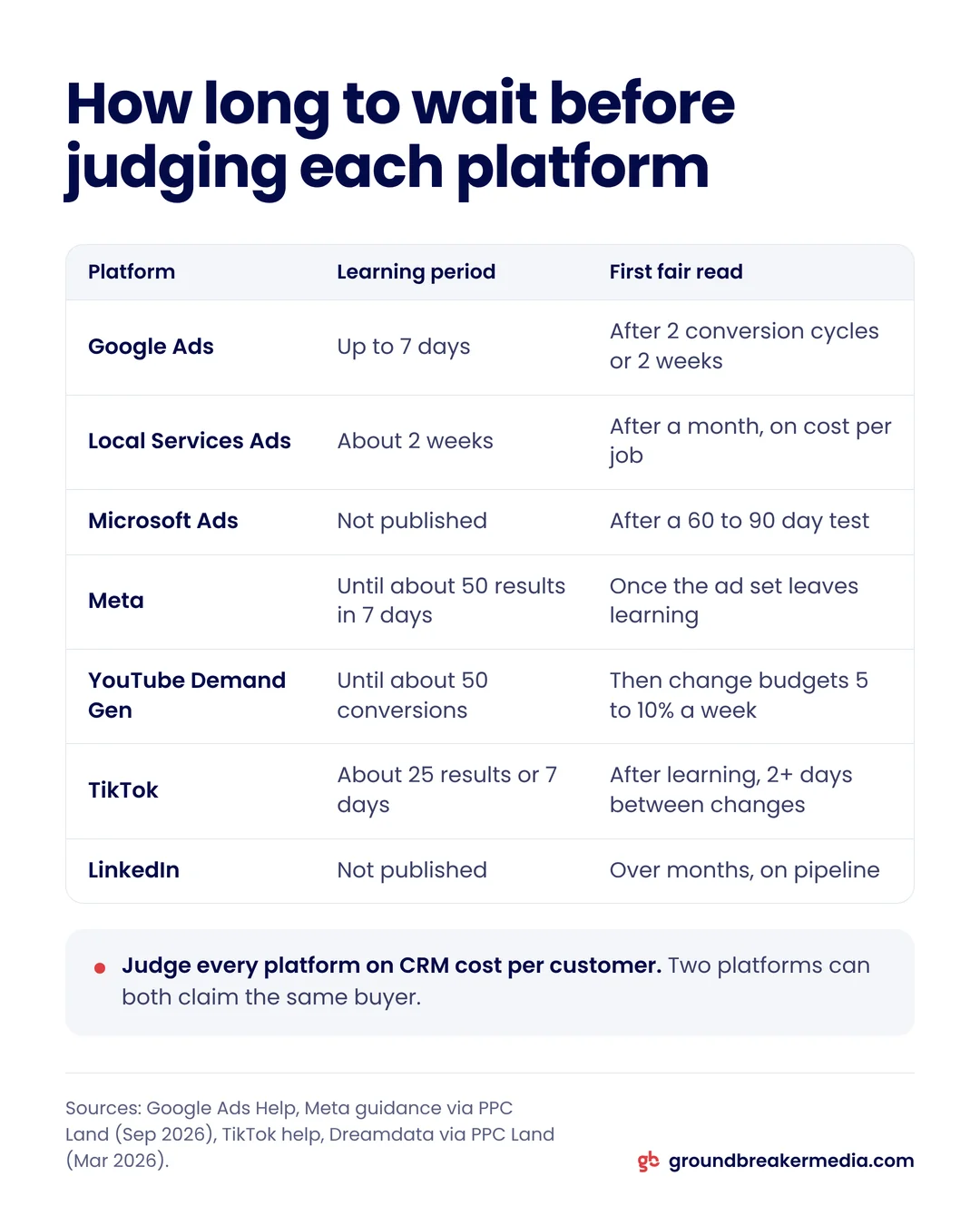
Give each platform time before you judge it:
| Platform | Learning period | When to make the first call |
|---|---|---|
| Google Ads | Up to 7 days for a bid strategy | After two conversion cycles or two weeks, whichever is longer |
| Google Local Services Ads | About 2 weeks to settle | After the first month of leads, judged on cost per job |
| Microsoft Advertising | No published period | After a test of 60 to 90 days |
| Meta | Until an ad set reaches about 50 results in 7 days | After the ad set leaves learning |
| YouTube Demand Gen | Until about 50 conversions | After 50 conversions, changing budgets by 5 to 10% a week |
| TikTok | About 25 results or 7 days | After learning, with at least 2 days between changes |
| No published period | Over months, on pipeline, since B2B journeys averaged 272 days |
When should you add a second advertising platform?
Add a second platform when the first brings customers at a cost you accept, you have bought most of the searches or reach it offers at that cost, and your budget can fund the second platform’s learning threshold without starving the first.
Each possible second platform does a different job. Microsoft Ads extend a profitable Google search account. Meta builds demand that Google search then collects, and retargets the people who visited but did not buy. LinkedIn, or Microsoft’s LinkedIn profile targeting, reaches business buyers by role. YouTube shows the product to people who are not yet searching for it.
Four rules keep the second platform honest:
- Give it its own budget and its own test window from the table above, rather than shifting money back and forth week to week.
- Keep a brand search campaign running, so the searches the new platform creates land on your ad, not a competitor’s.
- Hold back about 10% of the total budget for tests.
- Rebalance on cost per customer from the CRM, never on each platform’s own return on ad spend, because both platforms claim the same buyers.
Frequently asked questions
Is PPC advertising the same as online advertising? Not quite. PPC, or pay-per-click, is one way to pay for online ads: you pay when someone clicks. Google and Microsoft search ads work that way, but Meta, TikTok and YouTube often charge per 1,000 impressions, and Google Local Services Ads charge per lead. Online advertising covers all of these models.
Can a small business advertise online with $500 a month? Yes, on some platforms. At $500 a month, you have about $16 a day: enough for one Google, Microsoft, Meta or LinkedIn campaign, but below TikTok’s floor of more than $50 a day per campaign. Pick one platform, one campaign and a goal frequent enough for the bidding to learn.
Should a small business run its own ads or hire an agency? Run them yourself if you can give the account a few hours a week and track leads to sales. Hire help when the budget outgrows your time or results stall. Either way, keep the ad accounts in your business’s name. What a performance marketing agency does explains the options.
How long does online advertising take to show results? Most platforms need one to two weeks to learn before results mean much. Google suggests judging over two conversion cycles or two weeks. Judge Meta and TikTok after their learning phases, and B2B platforms like LinkedIn over your sales cycle, which can run for months.
Written by
GroundBreaker Media
A performance marketing agency that connects what you spend to what it brings back. About us
Related insights
All insights


Want one version of the truth? Start with a free audit.
Answer 10 quick questions and get a written audit within 2 business days: what your marketing is producing, what's holding it back, and what to fix first.